
Two cemeteries in Bielsko-Biała: one active, the other closed down
The Jewish community in Bielsko was established in 1865, and before that the Jews of Bielsko belonged to the Cieszyn community and buried their dead in Cieszyn. Their own cemetery was founded in 1849 in Aleksandrowice, on what is now Cieszyńska Street. The impulse was a cholera epidemic and the ban on transporting bodies that came with it. The first burial took place on 31 July 1849, and the oldest surviving gravestone is the matzevah of the seventeen-year-old Josef Neumann, who died on 3 September 1849. Today it stands in the funeral house, protected from the weather.
The cemetery covers 2.39 hectares and is divided into seven sectors marked with letters from A to G. About 1200 gravestones have survived there, and the total number of burial places is estimated at 3000. In 1988 it was entered in the heritage register. It remains an active cemetery to this day, owned by the Jewish religious community.
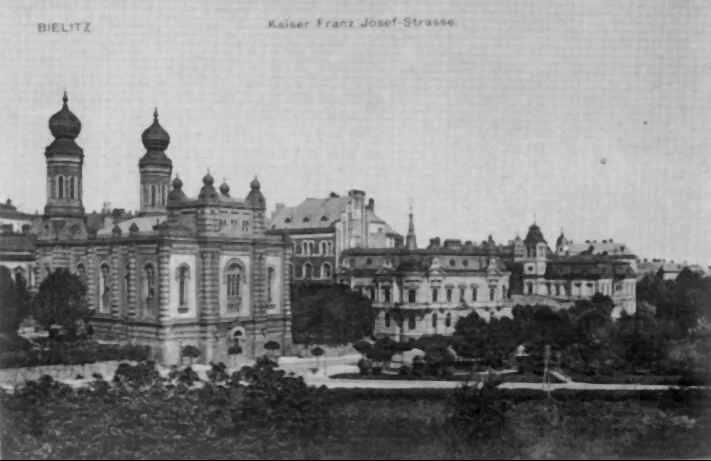
The funeral house was built in 1885 to a design by Karl Korn, on the site of an older one from 1867 that burned down. It combines elements of Neo-Romanesque and Moorish style. The most valuable are the ceiling polychromes covering 144 square metres, entered separately in the heritage register. They are regarded as one of the few surviving paintings of this type in the region in Jewish sacred culture. The same architect designed the synagogue in Bielsko, destroyed in 1939, which is recalled today by a plaque on the wall of the Bielska BWA Gallery building.
The war and the post-war years
In 1941 the mayor of Bielsko put forward an initiative to close the cemetery for housing development. Permission for the closure was finally issued in February 1944, but the town did not carry it out and the cemetery was not removed. It did, however, suffer heavy losses: more than half of the gravestones were stolen or destroyed, and in the oldest sector F about 95 per cent of the monuments are missing. The plot for Orthodox Jews has disappeared completely.
After the war the gravestones continued to be destroyed. In September 1945 the county office ordered the removal of German-language inscriptions from the cemetery. The Jewish committee reported that they had been removed, although most gravestones kept their German inscriptions, and in many cases the gravestones were simply turned over with the inscription facing the ground. Similar actions are known from the Old Evangelical Cemetery, where descendants painted over inscriptions or turned over slabs to save them.
In sector E lies a plot of Jewish soldiers of the First World War, with a common monument from 1929 bearing the names of 61 fallen. In 2009 a monument was also unveiled in memory of the Jewish citizens of Bielsko-Biała and the surrounding area who were murdered or died in exile in 1939-1945.
The cemetery on Wyzwolenia Street
The second cemetery lay in the former Biała Krakowska, at what is now 59 Wyzwolenia Street. It was founded in 1849, the same year as the cemetery in Aleksandrowice. The plot belonged to the estate in Lipnik and was leased, and the Jewish community in Biała bought it only in 1902. In 1919 the site was enlarged. The funeral house was built in the early 1860s and rebuilt in 1926.
The cemetery was used until the end of 1942, when the ghetto was liquidated and most of the Jews were expelled from the town. During that time 49 people were buried in it. The last post-war burial took place in February 1956. The municipal and voivodeship authorities considered the closure necessary for the expansion of the Polsport sports equipment factory. Despite the objection of the religious congregation, the cemetery was closed down in 1966.
Between June 1966 and May 1967 remains from 170 of about 1700 graves were exhumed. They were moved together with the gravestones to the cemetery in Aleksandrowice, to sector G. The remaining graves disappeared along with the cemetery. Today a monument in the shape of a matzevah stands on the site, unveiled on 13 December 1996, with an inscription in Polish and Hebrew. Its author is the sculptor Bronisław Krzysztof. The site adjoins a factory, so before a visit it is worth checking on what terms the monument can be reached.
Cieszyn: two cemeteries on Hażlaska Street
The Old Jewish Cemetery in Cieszyn is the older of the two Jewish cemeteries in that town. The land was bought in 1647 by Jakub Singer, of the oldest Jewish family permanently resident in Cieszyn. Duchess Elisabeth Lucretia then granted him privileges, including permission to set up a cemetery for the dead of his family. In 1785 the cemetery was sold for 900 florins to a community comprising 88 tolerated Jewish families and ceased to be private property. It then served Jews from the whole of Cieszyn Silesia.
The cemetery covers 1.9 hectares. More than 1500 gravestones have survived there, and other data give 1576. The oldest dates from 1686. The funeral house from the second half of the 19th century was funded by Emanuel A. Ziffer, a railway specialist in Austria, originally from Cieszyn. The last burial known by name is that of Dr Walter Schramek, who died in 1928. In 1986 the cemetery was entered in the heritage register.
In April 1945 the Gestapo shot 81 hostages in this cemetery, including 18 Czechoslovak scouts. After the war the bodies were exhumed and moved to a mass grave in the municipal cemetery in Cieszyn.
The New Jewish Cemetery was opened on 25 June 1907. Construction dragged on for years, because protests by local residents halted it in 1902. The cemetery covered 1.14 hectares and had a funeral house designed by the Viennese architect Jakob Gartner. The last burial took place in 1961. Today more than a hundred gravestones have survived on an area of 0.75 hectares, and of the funeral house only the front wall was left as a permanent ruin. The site has also been entered in the heritage register since 1986. After 1989 both cemeteries have been looked after by the Jewish religious community of Bielsko-Biała.
Other traces nearby
Cieszyn Silesia and the area around Bielsko have also kept smaller traces of Jewish communities. In Czechowice-Dziedzice there is a 19th-century cemetery where about twenty-five gravestones stand. In Ustroń a cemetery from 1905 became part of the municipal cemetery, and the synagogue was burned in 1939. In Skoczów the synagogue of 1853 was demolished in September 1939. All of these places are described by cards in the portal.
Rules for visiting
At the cemetery in Aleksandrowice, by tradition men should cover their heads, and eating is not permitted on the grounds. Information about people buried there is provided by the Jewish religious community. The accessibility of the cemeteries in Cieszyn and the rules of entry, including the possibility of obtaining a key from the administrator, should be checked with the community before a visit.
Be the first! Add a comment.
You need to log in to add a comment.
Log in