
The first weeks of the German occupation in September 1939 brought a series of arsons and demolitions of synagogues in the towns of today's Silesian Voivodeship. They affected the Jewish communities in Katowice, Będzin, Bielsko, Cieszyn, Tarnowskie Góry, Ustroń, Skoczów, Czeladź and Mysłowice. In some places nothing survived at the ruins, in others there is today an obelisk, a plaque or a boulder with an inscription in Polish and Hebrew.
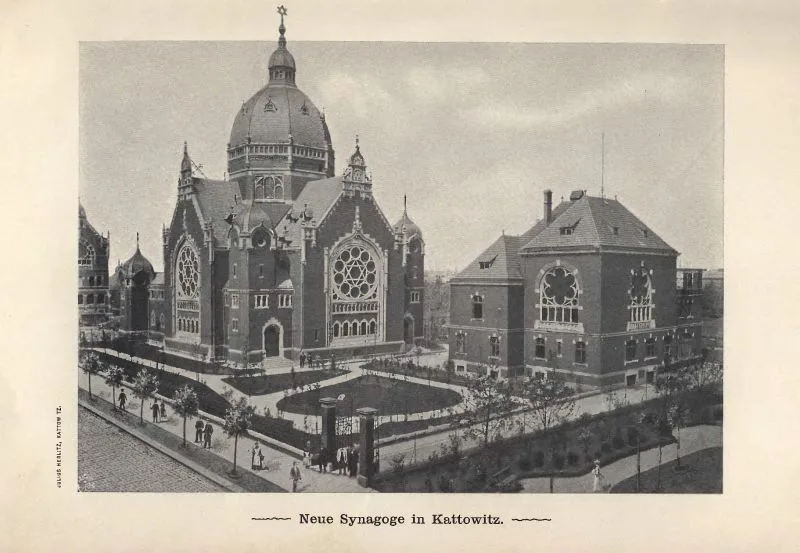
Katowice: the domed synagogue on Synagogue Square
The Great Synagogue in Katowice, designed by the architects Max and Hugo Grünfeld, was opened in 1900 on today's Mickiewicza street. The main hall could hold about 1,120 people, and above it rose a large ribbed dome crowned with a Star of David. The plot also contained a mikveh, a ritual poultry slaughterhouse and a matzah bakery.
The sources do not give the date of the burning uniformly: some indicate 8 September 1939, others 4 September. The ruins were demolished still during the occupation, in accordance with an order of the German building police of 20 September 1939, and some of the bricks were taken after the war to rebuild Warsaw. The former community administration building was converted into a clinic.
Since 1990 the site has borne the name of Synagogue Square. A monument by Kiciński stands there, with text in Polish and Hebrew. The sources give two versions of its unveiling: July 1988 and 27 June 1989, so the year remains unresolved here.
Będzin: the fire of the night of 8 to 9 September
The synagogue in Będzin was built in 1881 on the site of an older, wooden one. According to one account, the German army burned it on the night of 8 to 9 September 1939, together with the Jews praying in it, and the fire lasted 20 hours and attempts to extinguish it were prevented.
On the site of the burned synagogue a granite obelisk was unveiled on 1 September 1993, funded by the Society of Friends of Będzin. A Torah scroll with scorch marks, regarded as a relic of the fire, later went to the Mizrachi synagogue.
Bielsko and Cieszyn: 13 September 1939
The synagogue in Bielsko, built in 1879-1881 in the Neo-Moorish style to plans by Ludwig Schöne and Karl Korn, was destroyed on 13 September 1939. The foundations and cellars survived. In the 1960s the modernist building of the Bielsko BWA Gallery was erected on its site, and in 1991 a plaque was set into its west wall. A virtual reconstruction of the synagogue, made by the Viennese architect Matthias Seitner, was shown in the gallery in 2017. The site is described in the entry on the synagogue in Bielsko.
On the same day the synagogue in Cieszyn on Bożnicza street burned down. It was built in 1837-1838 to a design by Karl Jilg, and in 1878 it was rebuilt in the Neo-Romanesque-Moorish style. Today there is a car park and a secondary school playing field on the site.
Smaller towns: plaques and monuments
In Tarnowskie Góry the synagogue opened on 1 September 1864 was burned in 1939, and the ruins were removed in 1943 to widen the street. In 2006 a monument in the shape of a column with a Star of David was unveiled there, and during work on the square in 2021 brick foundations were discovered. Details are in the entry on the synagogue in Tarnowskie Góry.
In Ustroń the synagogue of 1901-1902 was burned in 1939. According to the Austrian census of 1900, 110 people of the Jewish faith lived here. A monument in the shape of a Jewish gravestone was unveiled in 1997, and its donor was Otto Windholz, a Jew from Ustroń living in Australia (the site of the synagogue in Ustroń).
In Skoczów the synagogue of 1853 was demolished in September 1939. The monument was unveiled on 21 June 1994 with funds from the descendants of the long-time head of the community, Heimann Urbach (the synagogue in Skoczów). In Czeladź the Jews were forced to demolish the interwar synagogue; an obelisk on Katowicka street commemorates the demolished synagogue. In Mysłowice the synagogue on Wolności square, modelled on the Great Synagogue in Budapest, was burned after the outbreak of the war, and the Jews of Mysłowice were forced to clear the rubble.
In Pszczyna the synagogue was set on fire at the beginning of the war, but the fire was quickly put out because of the risk to neighbouring buildings. The building was then converted into a cinema, as discussed in a separate text on former synagogues after 1945 (the synagogue in Pszczyna).
Other dates: 1938 and 1940-1943
Not all Upper Silesian synagogues burned in September 1939. Bytom, Gliwice and Zabrze still belonged to Germany then, and the synagogues there were destroyed on Kristallnacht, the night of 9 to 10 November 1938. In Bytom a plaque on the site of the synagogue was unveiled on 9 November 2007 (the synagogue in Bytom); the sites of the New Synagogue in Gliwice and the Great Synagogue in Zabrze were commemorated in a similar way.
In Żywiec the Reform synagogue Tempel in Zabłocie was demolished in 1940-1943, and school buildings were put up there after the war. A boulder from 2003 is described in the entry on the Tempel synagogue. Similarly in Milówka the German occupier demolished the synagogue of 1882, and a plaque was unveiled in 2019 (the synagogue in Milówka).
The rules of access to the commemorative sites are given by their administrators; some stand on publicly accessible squares, some next to public buildings.
Be the first! Add a comment.
You need to log in to add a comment.
Log in