
The ironworks that named itself Peace
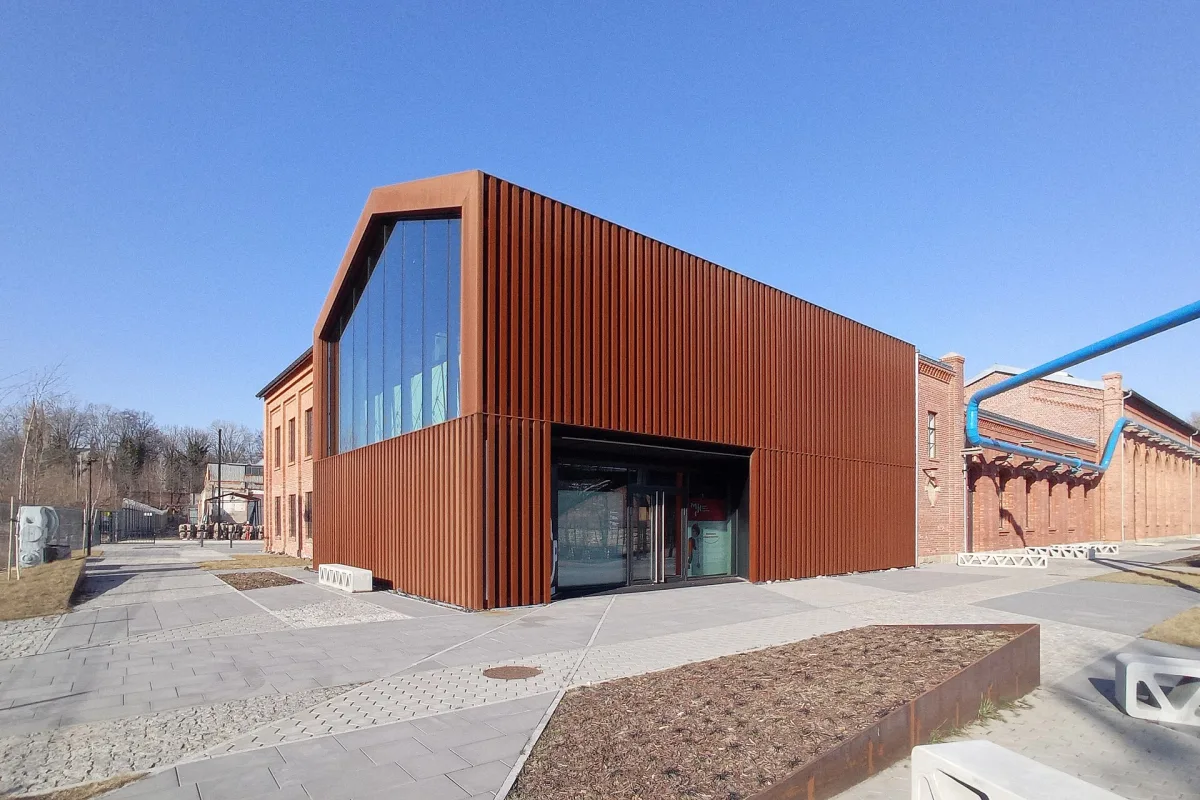
In Nowy Bytom, a district of Ruda Śląska, stands an ironworks whose German name, Friedenshütte, means literally “peace ironworks”. It was founded in 1840 by David Löwenfeld, Moritz Friedländer and Simon Löwi. At the start the works consisted of a coke-fired blast furnace, a foundry hall, a boiler house and a carpenter's workshop, and employed 12 people.
The following decades brought changes of owner and expansion. In 1851 the works were bought by Count Andrzej Renard, who added a second blast furnace and a coking plant. In 1855 they passed to the Wrocław company “Minerwa”, and by the end of the 1860s they had four blast furnaces and puddling furnaces. The company's bankruptcy in 1871 closed that chapter, and the assets were taken over by a new entity linked to Count Karl Wolfgang Ballestrem. In 1884 a Thomas (basic Bessemer) steelworks was brought into operation, and three years later an open-hearth steelworks and the plant's own power station.
The growth had a dark side. On the night of 24 to 25 July 1887 gas exploded in the plant's boiler house: 10 people died and 55 were injured. The losses were then estimated at 375 thousand marks.
Figures from the age of heavy industry
Employment gives a good idea of the scale of the works. In 1865 the ironworks employed 228 people, in 1887 1352, in 1910 3898, and in 1922 8284. On the eve of the First World War it produced 250 thousand tonnes of pig iron, or 23.8 per cent of the output of all Upper Silesian ironworks.
The partition of Upper Silesia in 1922 introduced a border, and the works ended up on the Polish side. In 1928 the company merged with the “Baildon” ironworks in Katowice, and from 8 February 1930 the group and its largest plant bore the name Huta “Pokój”. The world crisis hit hard, however: in December 1931 production was halted and the company was placed under court supervision. The compulsory administration was lifted at the end of 1932, and in 1934 the Polish state became the majority shareholder.
The Sendzimir rolling mill
At the same time the engineer Tadeusz Sendzimir (1894-1989) worked at the ironworks, an inventor born in Lviv and nicknamed the “Edison of metallurgy”. He was developing a rolling mill that made it possible to reduce the thickness of sheet many times over in a single pass through the rolls. The whole process was based on rolling the sheet while stretching it at the same time, which allowed the thickness to be reduced from 6 mm to 0.1 mm. The line started in May 1934, at first producing 400 tonnes of sheet a month, and just before the war, after improvements, about 1000 tonnes.
The sources differ on dates. Some speak of regular production starting in 1934. Others add that a rolling mill built to Sendzimir's idea was started in Nowy Bytom as early as 1932, and that in 1934 a line for continuous cold rolling of thin sheet was created. Still others say that in 1934 he introduced the method of cold rolling thin sheet at the “Pokój” ironworks. It is therefore safe to say that the breakthrough line began to operate at the works in the first half of the 1930s, and that 1934 is taken as the start of regular production.
The invention attracted interest around the world. In 1935 the French company Fabrique de Fer de Maubeuge bought a licence, followed by another French company and the British John Summers, and in 1938 by the American Armco Steel. Sendzimir left Poland and after the outbreak of war stayed in the United States. He held 120 patents, including 73 American ones. According to some sources, in the early 1980s more than 90 per cent of the world's stainless steel passed through his process, according to others it was 90 per cent of galvanised steel production, so this claim should be treated with caution.
The ironworks and its district
The ironworks built a town around itself. As early as 1840 the first two residential buildings stood nearby, at first single-storey red-brick houses. On the estate in Czarny Las a department store, a school and a nursery were built, and the estate was named Kaufhaus after the German word for the department store. In 1913 nearly 57 per cent of the workforce lived in company buildings in the nearby workers' colonies.
The company also ran vocational schools and a clinic, and beside the works there was the sports club “Pogoń” with football, basketball, boxing and swimming sections. The “Harmonia” choir was re-established in 1946. The history of iron and steel making in Upper Silesia is shown by the Museum of Metallurgy in Chorzów.
From the largest ironworks to a group of companies
After the war, in 1946, the works in Łabędy and Gliwice were joined to the “Pokój” ironworks, creating one of the largest iron and steel works in Poland. From the 1960s departments that were a nuisance to the surrounding estates were withdrawn from production: in 1961 the coking plant was shut down, and in 1970 the ore sintering plant. In 1973 the production of thin sheet was abandoned, and in 1975 the “Sendzimir” rolling mill was switched off. Employment fell from 9177 people in 1956 to 4292 in 1987, and in 1988 the steelworks was closed.
At the end of the 20th century the departments were turned into companies of the “Huta Pokój S.A.” capital group, and since 2015 they have belonged to the Węglokoks group.
Be the first! Add a comment.
You need to log in to add a comment.
Log in