
Szczakowa in the 18th century
Szczakowa is today a district of Jaworzno, and in 1933-1956 it was a town in its own right. It is first mentioned in 1427, and in the 16th century it was a royal village in the Będzin starosty. It entered the history of mining thanks to a date repeated by Polish sources: in 1767 the first Polish hard coal mine in the lands of the former Polish-Lithuanian Commonwealth was supposedly established here. This is how it is recorded in the entry on Szczakowa and in the entry on Jaworzno, and the entry on the Kraków Coal Basin gives the same date.
The sources do not agree on the details, however. One of them speaks of the year 1766 at the Sobieski Mining Plant and adds that extraction was at first opencast, later also underground, and with little demand for coal was not continuous. According to it the mine worked for several months in 1766-1767 and 1789-1790. The term “first mine” should therefore be read as a finding of the sources cited, not as a verified record. Lasting mining began in Jaworzno later: in 1792 Count Moszyński founded a mine which over the following decades changed owners and names, from Friedrich August, through Piłsudski, to simply Jaworzno. It ceased operation in 1999, when it was merged with the power station.
A railway junction and three empires
Development was accelerated by the railway. The station in Szczakowa was opened in 1847, and nearby the borders of three powers met: Austria, Russia and Prussia. Anyone who crossed the border in those days had to stay the night here or at least pass through the station. Szczakowa is one of the largest Polish railway junctions, important for coal transport. Around the station a cement works, a glassworks, an ammonia factory, a tannery and dolomite works grew up, and in 1956 Szczakowa was incorporated into Jaworzno.
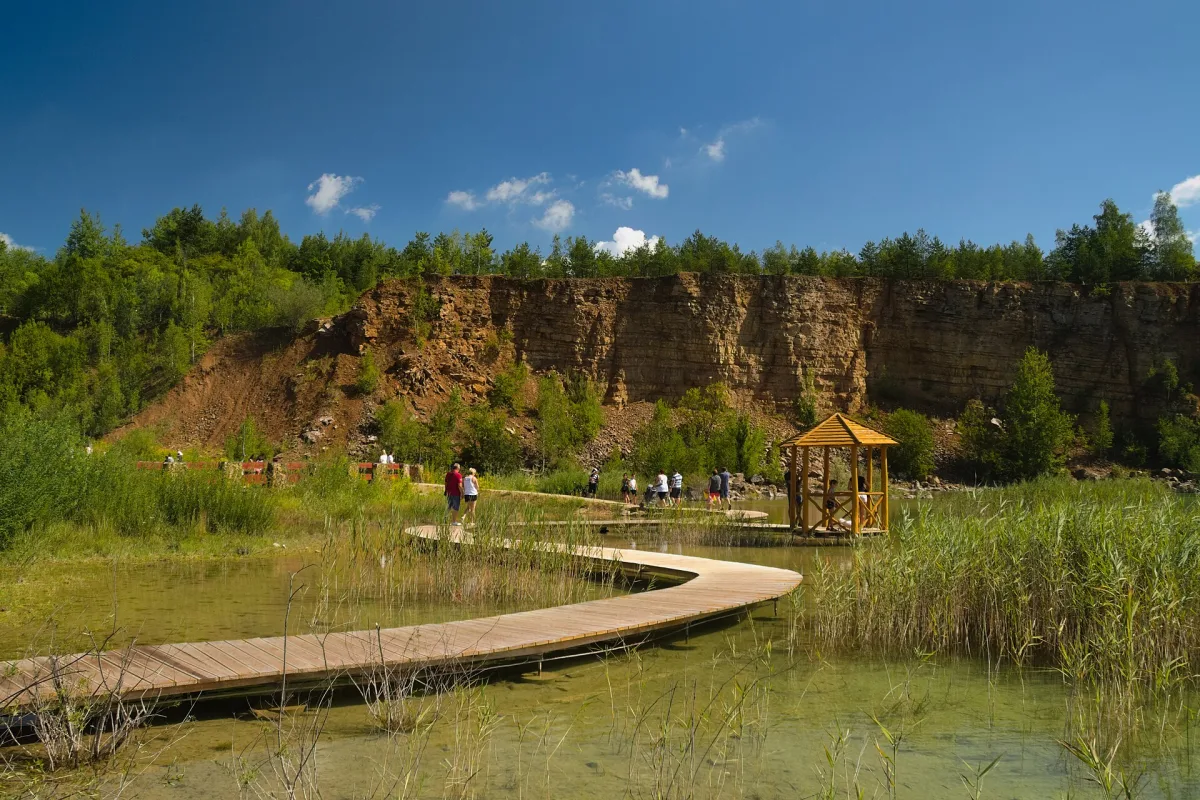
These works left behind a landscape legacy that can be visited. From the former dolomite pits of the Szczakowa Cement Works the Gródek Arboretum Park was created, with turquoise reservoirs, although despite its name it is a municipal park and not an arboretum in the scientific sense. In a limestone quarry whose output went mainly to the needs of the cement works, the GEOsfera centre was set up, with a geological trail and models of dinosaurs. On the site of the pits of the Szczakowa Sand Mine the Sosina reservoir was created. The reclamation of the land after this mine, carried out since 1959, is regarded as one of the most advanced in the Polish mining industry in terms of the ratio of reclaimed area to area occupied.
The town of three power stations
The power industry of Jaworzno begins with a mine. In 1898 two direct-current generating sets with a total output of 320 kW were installed at the Rudolf shaft, to light the mine and houses. In 1903 a boiler house with a 800 kW turbine set was built at the Friedrich August shaft. From this seed grew the Jaworzno I Power Station, connected to the national grid on 1 January 1953. This plant no longer exists. The Jaworzno II Power Station was started up in 1953, and Jaworzno III was built from 1972, with the first unit delivered in 1977 and the whole completed in 1979, reaching 1200 MW. Around the second power station a residential district grew up, which its inhabitants jokingly called the Funfair (Wesołe Miasteczko), after the young miner's houses and the makeshift huts of the construction period.
At the end of the 20th century three power stations operated in Jaworzno, which according to some descriptions gave the town the largest number of power stations in the world, but this claim should be treated with caution. The three plants operated at the same time only until 1998, when Jaworzno I was shut down after the modernisation of the second power station. On the chimney of the third power station the sources differ: some give about 300 or, according to some data, 306 metres, others 306 metres, and regard it as one of the tallest in Poland. Flue gases are now directed through desulphurisation installations and cooling towers, and the chimney has been taken out of use.
Where to see it
How work underground looked is told by the mining exhibition in the Jaworzno City Museum, with tools, maps and lamps from the Jaworzno, Komuna Paryska and Sobieski mines. The older history of the town, going back to 1229 and town rights of 1901, is shown by the Main Market Square and the Collegiate Church of St Adalbert and St Catherine. Along the site of the former Jan Kanty mine runs the Velostrada in Jaworzno.
In the forest south-west of this mine stands the Monument to the Prisoners of the Jaworzno Camp. The labour camp that operated here in 1945-1956 is described in a separate article in the Places of Remembrance section; here we note only that this part of Jaworzno's history requires a different tone from the history of industry.
Be the first! Add a comment.
You need to log in to add a comment.
Log in