
Ruda Śląska came into being on 1 January 1959 through the merger of two towns, Ruda and Nowy Bytom. Each of today's districts developed separately earlier and has its own history, so it is worth separating at once the two threads from the title. The Ficinus Colony stands in Wirek, a district that was called Nowa Wieś until 1948. The story of the first village with electric lighting concerns Ruda, the oldest district of the town. These are two different places, a few kilometres apart.
Wirek: a municipality, a mine and ironworks
Today's Wirek separated from Nowa Wieś in 1828 as a separate municipality and remained in that role until 1870. It got its German name from the Antonienhütte ironworks, founded by Lazarus III Henckel von Donnersmarck and named in honour of his wife Antonina. The first mine, "Gottessegen" ("God's Blessing"), was opened here in 1828, and in the 19th century zinc and iron works also operated. The village grew quickly, and colonies were built along today's Katowicka, 1 Maja, Bytomska, Kubiny and Robotnicza streets. Wirek received town rights on 1 January 1949, in 1951 it was joined to Nowy Bytom, and in 1959 to Ruda Śląska.
What remains of the former "Gottessegen" mine includes the shaft head of the "Andrzej" shaft, built of brick in the form of a defensive tower. The mine stopped working in 1926, but the shaft itself was used for a long time afterwards, among other things for draining the workings.
The Ficinus Colony: sixteen sandstone houses
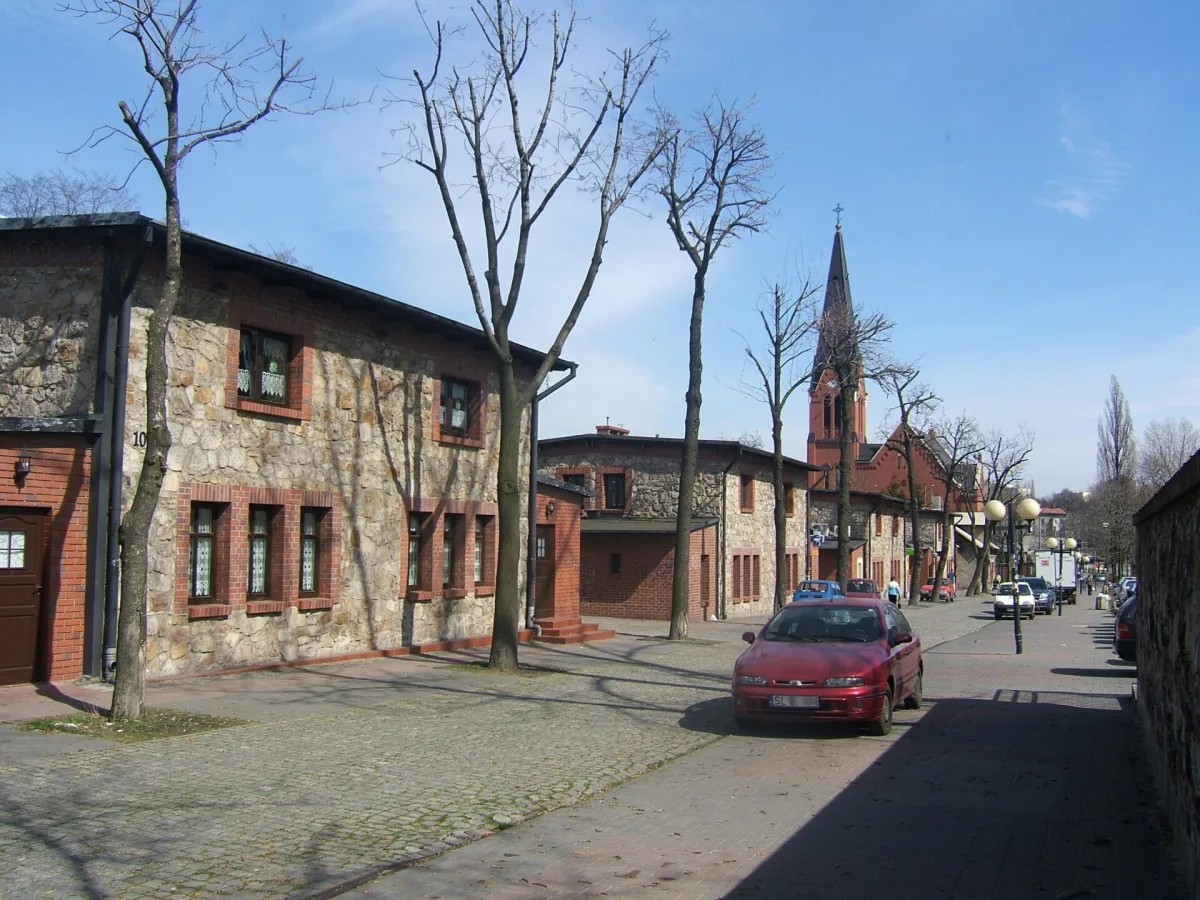
The Ficinus workers' colony lies on Kubiny Street and was built for the miners of the "Gottessegen" mine. Sources give two dates: some speak of the years 1860-1867, others of houses from 1867. They do not settle which version describes the start and which the end of construction.
The complex consists of sixteen identical two-storey houses, set gable-end to the street in its northern frontage. They are built of sandstone, unplastered, with brick window surrounds and low gable roofs. Each had four flats, two on the ground floor and two upstairs, and each was reached by a separate entrance through an annexe. The flats measured about 40 square metres: a vestibule, a kitchen and one room. Behind the houses stood outbuildings for keeping small livestock, and gardens.
The estate took its name from Georg Ficinus, a mining official responsible for the construction. The entry about him presents him as a royal mining councillor and general director of the estates of Count Hugo Henckel von Donnersmarck, who died on 3 August 1880. The same entry claims that after 1871 the main shaft of the Hrabina Laura mine in Siemianowice was named after him. That is why the name Ficinus appears twice in the region. The remains of that other works are the former Ficinus mine complex in Siemianowice Śląskie, which has nothing to do with Ruda Śląska apart from the name.
The colony has been entered in the heritage register since 1978, and since 19 October 2006 it has lain on the Industrial Monuments Route of the Silesian Voivodeship, together with Giszowiec and Nikiszowiec. It is regarded as one of the oldest estates of this type in Upper Silesia.
From ruin to arcade
In the 1970s blocks of flats were built on the site of the gardens behind the houses. At the beginning of the 1990s the colony was in a very poor technical condition: of the sixteen buildings only one was in use. In 1990 a concept was drawn up to create a service arcade here, and implementation began in 1995. Today the estate serves a service function, mainly retail, and the house at number 24 holds a branch of the municipal library. It is inhabited and in use, so you look at it like an ordinary street.
The second surviving workers' estate in the town is Kaufhaus on the border of Nowy Bytom and Chebzie, built in 1880-1913 for the workers of the "Pokój" ironworks. Its hallmark is a department store from 1904, which is regarded as one of the oldest such buildings in Poland. A separate article in this section writes more broadly about the miners' workers' colonies.
Ruda and the electric light of 1889
Ruda is the oldest district of the town. The first mention dates from 1295, and in 1497 the castle of the Rudzki family was mentioned here. Its remains today are a ruin with fragments of stone walls. From the 19th century industry determined the face of Ruda: the "Carlshütte" zinc works, operating in 1816-1908, the "Bertha" ironworks from 1855, and the mines.
In this context it is worth mentioning that electric lighting was brought here in 1889 and that Ruda was said to be the first rural municipality in the German Empire with such an installation. The mentions of this are, however, very brief and without footnotes, so the sentence about priority in the whole of Germany is a claim, not an established fact. What is certain is that at the same time in Upper Silesia electricity was reaching industrial plants, for example the "Cleophas" mine in Katowice, where one of the region's first industrial power stations was started in 1888.
The history of the industrial town, including Ruda at the turn of the 19th and 20th centuries, is shown by the Maksymilian Chroboka Municipal Museum, housed in the building of a former continuation school in Ruda.
Traces of industry in other districts
If time is left after Ficinus, other traces of industry survive in the town. In Chebzie the railway station from 1897-1899 was converted into the Stacja Biblioteka (Library Station). In Orzegów you can see a former coking plant from 1903. In Wirek itself stands the Church of St Andrew Bobola, built after the war and damaged by mining subsidence in the 1950s, which shows well how strongly the mines changed this town.
Be the first! Add a comment.
You need to log in to add a comment.
Log in