
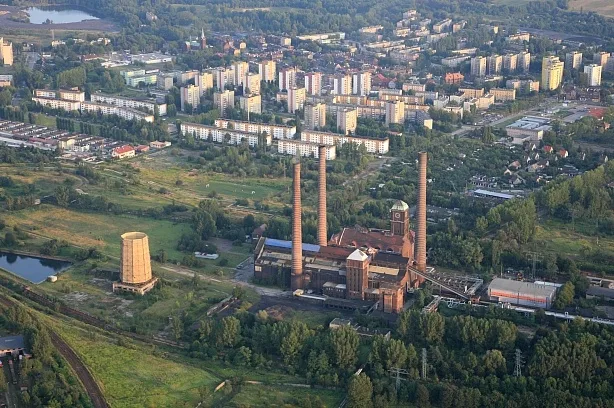
From a distance the first things you see are three chimneys and a tower with a four-sided clock. The Szombierki Power Station in Bytom, also called the former Bobrek power plant, was built just after the First World War and is among the most recognisable industrial buildings of Upper Silesia. Its authors are Emil and Georg Zillmann, Berlin architects who also left behind mine buildings in Silesia.
A plant that was to be a gunpowder factory
The first design drawings date from 1917. The plant was initially planned as a gunpowder factory, as indicated by its solid, massive construction, typical of military buildings. Because the company needed a buyer for the waste coal from its Bobrek and Szombierki mines, the facility was adapted as a power station. The investor was the company Schaffgotsch Bergwerksgesellschaft. The buildings were placed between railway tracks forming a triangle, where in case of defence armoured trains were to stand.
The power station was opened on 29 November 1920. The first equipment was four Babcock boilers and a WUMAG turbine set with an output of 12.8 MW. In the following years further boilers and turbine sets were added. The complex included a boiler house, a pumping station, an engine hall, a switchgear building, a water tower called the Clock Tower, a coal tower, three chimneys, an administration building and a gatehouse, altogether on an area of about 17.88 hectares.
The Siemens clock and Behrens's lamps
In 1925 a four-sided clock by Siemens und Halske was installed on the tower, linked to 54 clocks operating in the plant. The clock on the tower is to this day the trademark of the building.
The information about lamps designed by Peter Behrens in the facility comes from a single source. The Zillmanns' authorship concerns the whole complex, and in Bytom one can also see their buildings of a former mine, which we write about below.
One of the largest power stations in Europe
Around 1930 more than 900 people worked at the plant. It was then one of the largest power stations in Europe. In 1937 the tallest of the three chimneys was built, 120 metres high, and in 1939-1944 the power station reached its maximum output of 100 MW.
1945 and later fortunes
The power station was among the first plants that resumed operation after the Red Army entered Bytom in 1945. This was thanks to the workers, who, despite the evacuation of most of the management, brought about the start-up. In the same year Soviet units dismantled part of the equipment and took it deep into Russia: three boilers, one turbine set and two coupling transformers. The plant was handed over to the Polish authorities on 15 May 1945. Four turbine sets and 20 boilers remained, which allowed an output of 70 MW. In 1955 an output of 108 MW was reached, and Szombierki was again counted among the largest power stations in the country.
In the 1970s the condensing power station was turned into a combined heat and power plant by extending the heating systems and the pipelines of the city mains. Electricity generation ended in 1995-1998, and afterwards the facility served as a reserve and peak heat source for the city. Production was wound down in October 2011.
The Industrial Monuments Route and new plans
In 2010 the power station was included in the Industrial Monuments Route of the Silesian Voivodeship (a later audit removed it from the route), and in January 2013 it was entered in the heritage register under number A/398/13. Before the plant closed, concerts, festivals and conferences were held in its largest hall. Successive owners announced adaptation for cultural purposes. The site could be entered as part of Industriada, but the complex is privately owned and there is no regular sightseeing, and the facility, damaged over the years, is not safe, so the fenced area is not entered. From the street the tower with the clock and the chimneys are clearly visible.
What else to see nearby
Following the Zillmanns' trail it is also worth checking the buildings of the former mine on Siemianowicka street. Next to the power station stands the Neo-Romanesque church in Szombierki, and in Miechowice stands the Tiele-Winckler Palace. The full entry on the monument can be found under the name Elektrociepłownia Szombierki.
Be the first! Add a comment.
You need to log in to add a comment.
Log in