
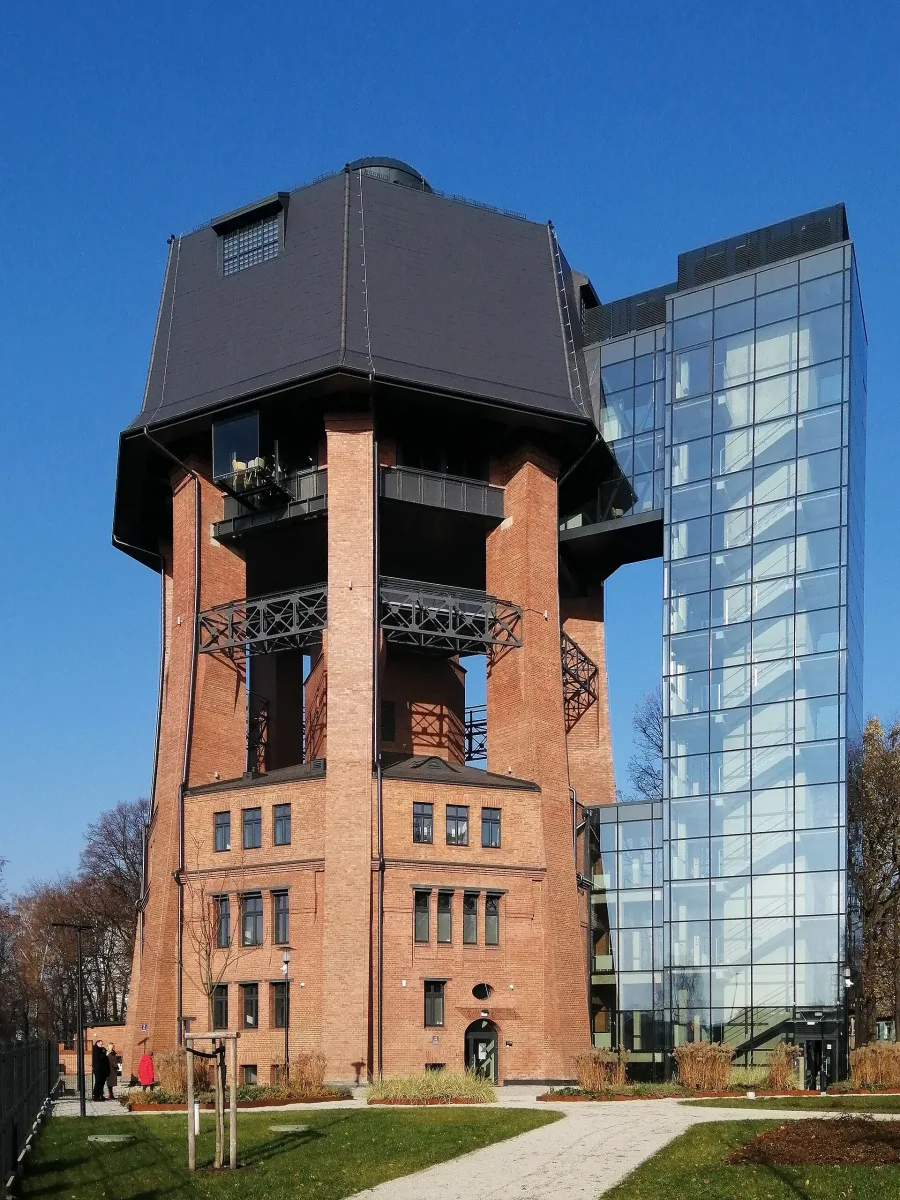
A water tower is a tank placed high up on water, so that the pressure in the pipes comes from the difference in levels alone. In Upper Silesia such a tank was needed by mines, steelworks, new housing estates and railway stations, so whole series of towers were built, often designed with more care for appearance than the function itself required. Several have survived to this day, some as museums and viewpoints, others as disused structures that are seen from the outside.
Towers of company housing estates and zinc works
The best known is the water tower in Giszowiec, built of brick and about 33 metres high. It stands at the highest point of the estate, which was built for the families of miners of the Giesche mine and designed by Emil and Georg Zillmann. The tower has stone consoles, small balconies on corbels and a portal frame borrowed from medieval fortifications. Water reached it from a pump in Zawodzie, and pipelines ran from here along the streets. Water supply was not initially brought to the workers' houses: residents drew water from hydrants and pump-cranes that stood every hundred metres. Sources give the year of construction differently, 1908 according to the heritage register and 1909 according to other sources. The estate is described in the entry on Giszowiec, and the same architects link it with Nikiszowiec.
In the Szopienice-Burowiec district stand two towers from the same world of zinc works. The tower on Korczaka Street, from 1911-1912, is 68 metres high and was built for the Georg von Giesches Erben works to a design by Georg and Emil Zillmann from 1907. It was built in a style of Art Nouveau and modernism. In 1919 it had two telescopes covering a horizon with a diameter of 40 km, and in the 1960s, when it belonged to the Szopienice Non-Ferrous Metals Works, lead shot began to be produced in it.
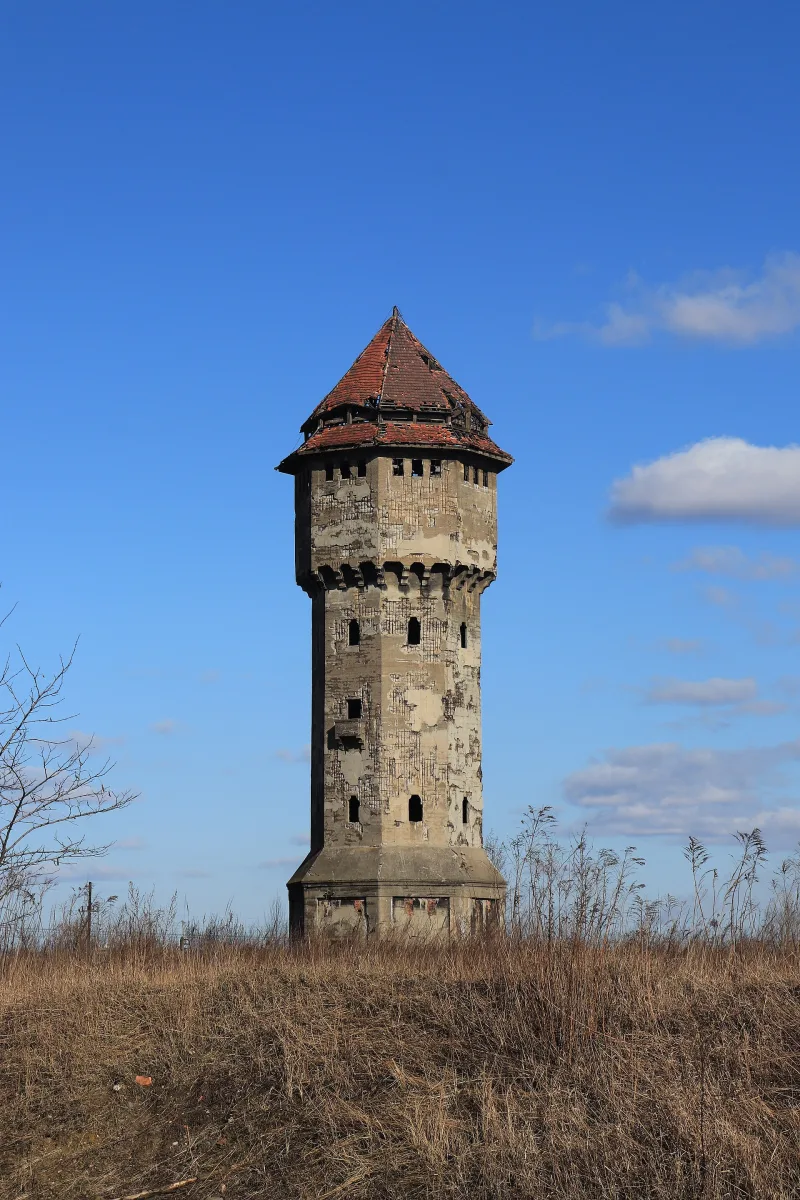
The other is the water tower of the former Saeger steelworks from 1912, on ks. mjr. Karola Woźniaka Street. It is a 35-metre reinforced-concrete structure on an octagonal plan, resembling a Gothic fortification. Together with a second tower it supplied process water to a complex with a zinc blende roasting plant and a sulphuric acid factory, for which an intake on the Brynica was built. The tower was probably designed by the Zillmanns. It was entered in the heritage register on 30 July 1978, together with the lamp room, the gatehouse and the rolling mill. Today it is unused, unfenced and in poor condition, so it is viewed from the outside, without entering the site. The history of zinc is told by the nearby Rolling Mill, Museum of Zinc Metallurgy.
Towers of mines and towns
The tower in Będzin-Grodziec from 1902 is regarded as the only fully riveted steel water tower in Poland. It was built by the Warsaw company Drzewiecki i Jeziorański for the Grodziec Coal Mines Society. Water was supplied by two pumps from a depth of about 300 metres. It first supplied the mine, then the workers' estate, the Solvay works, a brewery and the railway station. The tower stands on a rise, because height provided the right water pressure. It is 27 metres tall and originally had a rusty colour; after the renovation in 2020 it is grey. Visitors do not enter inside.
The tower in Świętochłowice from 1909, on Katowicka Street, is 40 metres tall and Neo-Baroque. The design was prepared by Richard Lummert, director of the Wałbrzych waterworks, and a steel Klönne-system tank for 500 cubic metres has survived at the top, described as unique. The tower ceased to serve its function in the 1960s and belongs to a private owner.
In Racibórz, on Starowiejska Street, stands a water tower from 1933-1936, 37 metres high, on a rise at 216 m above sea level. It proved a design flaw: it produced too high a pressure and caused failures of the network, so it supplied only the higher-lying district of Ocice, while the rest of the town was still served by an older tower. In the time of the Third Reich the building was used for propaganda purposes, with a place of worship on the ground floor and a training centre on the upper floors; the emblem and inscriptions were removed after the war. Today it houses a production plant and offices of a confectionery company.
The tower at the station in Katowice, the railway water tower, is 30 metres tall and has a brick body completed in 1951. An older tower previously stood on the site. Until the mid-1970s it supplied water to the railway junction, and the building also housed rooms for conductors and signalmen. Plans from 2015 to set up catering and galleries here were not carried out. Before a visit it is worth checking whether the building is accessible yet.
Towers you can climb
The tower in Zabrze has been used most fully. The water tower on Zamoyskiego Street is 46 metres tall and was built in 1907-1909 to a design by August Kind and Friedrich Loose. It is in the Expressionist style and is regarded as having no counterpart in Poland. In 2017 it was bought by the Coal Mining Museum, and after revitalisation it houses the CARBONEUM exhibition on coal, a viewing platform and a restaurant. From the platform the Beskids and the Tatras can be seen in good visibility. The museum also runs the nearby Guido Historic Coal Mine.
The second tower with access for tourists is the one at the Ignacy Historic Mine in Rybnik. It was converted into a viewpoint, opened on 1 January 2008, with a terrace at a height of about 46 metres.
Be the first! Add a comment.
You need to log in to add a comment.
Log in