
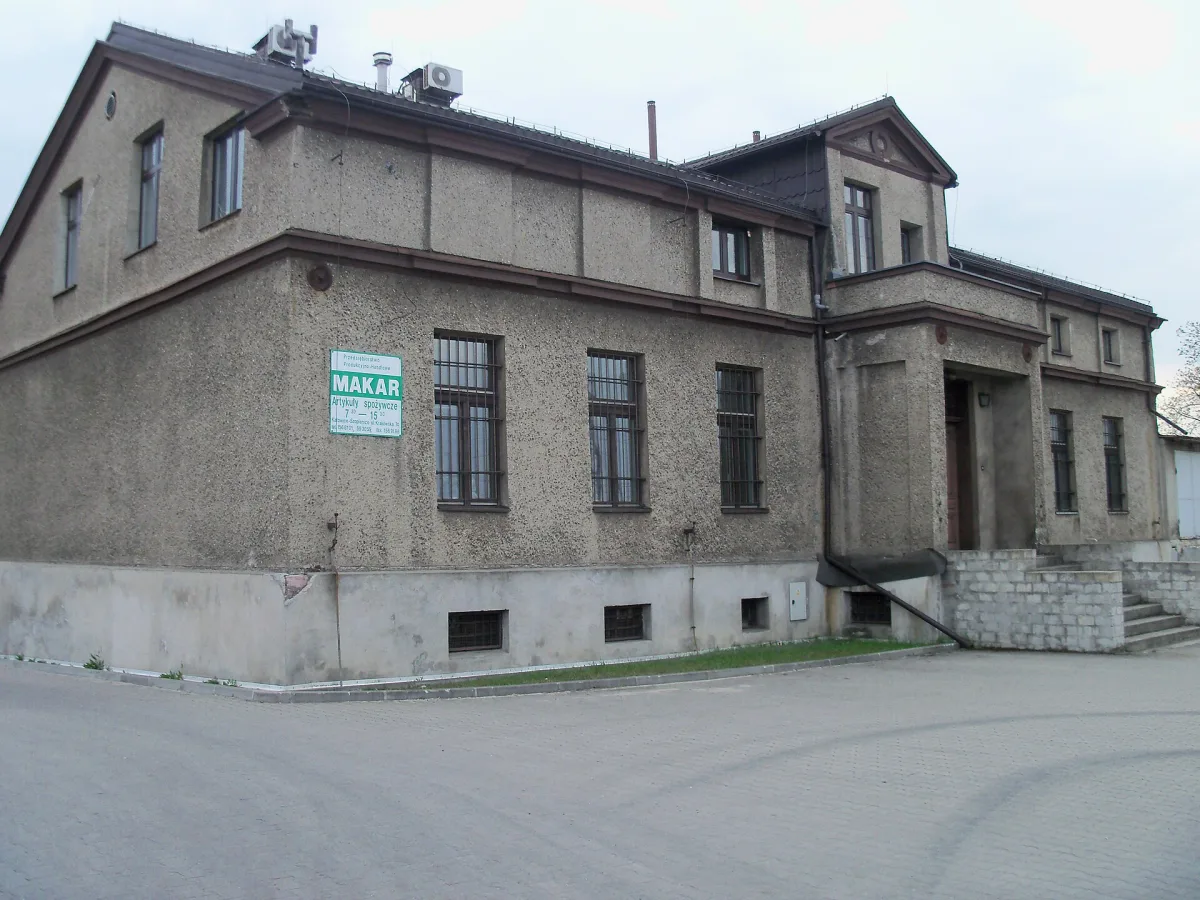
Before estates such as Giszowiec and Nikiszowiec arose in Upper Silesia, the owners of mines and steelworks built much more modest colonies for their workforces. They were usually rows of familoks (workers' family houses) next to the plant, with a laundry, bakery and school. Many of them survive, although each has a different history: some have been turned into an arcade, others renovated as flats, and still others stand empty. All the estates described here are inhabited or listed, so they are viewed from the street.
The oldest: Ficinus and Wilhelmina
The Ficinus workers' colony in Ruda Śląska, in the Wirek district, was built in 1860-1867 for the employees of the "Błogosławieństwo Boże" (Gottessegen) mine. It is named after Georg Ficinus, a mining official who was responsible for the construction. Sixteen identical two-storey houses of unplastered sandstone, with brick window surrounds, were set gable-end to the street along the northern side of Kubiny Street. Each held four flats of about 40 square metres: a vestibule, a kitchen and one room. In the early 1990s one of the sixteen buildings was in use. Since 1995 the concept of a services arcade has been pursued, and in one of the houses a library branch operates today. The colony has been in the heritage register since 1978 and lies on the Industrial Monuments Route of the Silesian Voivodeship.
Wilhelmina in Szopienice-Burowiec grew up around a zinc smelter, not a mine. The smelter was founded in 1834 by the Georg von Giesches Erben concern, and the first familoks, without water or sewerage, began to be built in 1846. In 1857 the smelter employed 272 workers, most of whom lived right here. In June 1910 the workers began a 49-day strike, after which the company dismissed the leaders and evicted almost a hundred workers from company houses. In the northern part of the estate Helgoland was built in the 1890s.
Colonies at mines: Alfred, Kleofas and Emma
The Alfred colony in the Katowice district of Wełnowiec-Józefowiec dates from the mid-19th century. The "Alfred" mine was founded in 1834, and its name came from the first name of one of the sons of John Baildon, who set it up with the Princes of Hohenlohe-Öhringen. In 1859 it was merged with the "Hohenlohe" mine. The "Alfred" shaft was stopped in 1923, and the whole "Hohenlohe" mine ten years later. The buildings of the former shaft, among them the shaft head building, engine house, bathhouse and lamp room, were then adapted as flats. In buildings 10 and 11 the projecting bay is a remnant of the altar of St Barbara. The buildings were entered in the register in August 1978, and the last residents moved out around 2012. Today it is an estate emptied of its residents, not a museum.
The workers' colony of the "Kleofas" mine in Załęże was built in 1890-1914 for the company Georg von Giesches Erben, partly to designs by Emil and Georg Zillmann. The familoks are of brick on a stone plinth, and the buildings are set gable-end along streets perpendicular to Gliwicka Street, with internal courtyards and green areas. The colony included a laundry, a bakery and a school opened in 1903. Some of the familoks resemble Nikiszowiec, because they were designed by the same architects. The larger and better-known estate of the same company is covered in the article on Nikiszowiec, and the garden estate in the text on Giszowiec. The western part on F. Bocheńskiego Street was demolished to widen the carriageway linking the A4 motorway with the Drogowa Trasa Średnicowa.
The Emma colony in the Marcel district of Radlin has two stages. The first buildings, for officials of the "Emma" mine, were put up in 1897, and their designer was probably A. Becher. The main part from 1910-1913 refers to the garden city idea and resembles English cottage-type houses. The author of this part was William Müller. Hans Poelzig designed an extension, but his designs were not carried out. In 1913 the estate had 14 houses for officials, 49 houses for working families, and a department store, an inn, a library, a bathhouse, a laundry and three lodging houses.
Brick colonies at steelworks: Zgorzelec and Kaufhaus
The Zgorzelec colony in the Łagiewniki district of Bytom was built in 1897-1901 on the initiative of Hubert von Tiele-Winckler, for the employees of the nearby Hubertus Steelworks. It consists of 34 detached two- and four-family familoks of red brick, without ornament, fully with cellars. It was entered in the heritage register in 1994. A partial revitalisation covered nine buildings in the 1990s, and the city carried out another from 2020 to March 2024: 24 of the 34 houses were renovated.
The Kaufhaus estate in Ruda Śląska, on the border of Nowy Bytom and Chebzie, was built in 1880-1913 for the steelworkers of the "Pokój" steelworks. Its centre was marked by the steelworks department store of 1904, from which the estate took its name. It had three storeys, lifts and a slaughterhouse. It is one of the oldest buildings of this type in Poland and in Europe. In the 1980s it was decided to demolish the estate and half of its oldest part ceased to exist.
Three colonies at one mine
At the "Oheim" mine, today "Wujek", three separate colonies were built in Katowice, and they are easy to confuse with one another. Here we describe them solely as housing development.
- The officials' colony is eight modernist semi-detached villas at Mikołowska 118-148, built from 1910 for officials and supervisory staff. The loose layout was forced by mining damage.
- The municipal colony in Śródmieście is eleven buildings designed by Bruno Taut in 1915-1916, completed around 1920. Six of them had storeys added in the 1960s and 1970s.
- The workers' colony on the Załęska Hałda is 36 single-storey terraced houses in two rows, with 72 flats, also designed by Taut in 1915 and built in 1918-1920. It was entered in the heritage register on 30 October 2023.
The workers' colony is often wrongly called the Twelve Apostles colony, that is, a separate 19th-century estate on today's Mikołowska Street. The layout of the flats in the municipal colony was almost identical to that in Nikiszowiec.
Taken together, these estates show that Upper Silesian workers' colonies differed in age, material and fate. Some were built of sandstone, others of red brick, some as low houses, others as compact tenements. A walk around any of them is a good complement to a visit to a nearby mine or steelworks.
Be the first! Add a comment.
You need to log in to add a comment.
Log in