
Zawiercie is a town that was first a station and factories, and only then a town. Before it received a town charter it already had a railway, ironworks, textile mills and a workers' housing estate. The town charter came late, and traces of that period remain in the parks, the walls of the works and the monuments that can be seen on a single walk.
The train of 1847
The first train passed through Zawiercie on 1 December 1847, when the single-track section of the Warsaw-Vienna Railway from Częstochowa to Ząbkowice was opened. Double-track traffic from Koluszki to Ząbkowice was started in 1881. The station and a second-class station building began operating in 1890, and the present station building was put into use in April 1914. Factories set themselves close to the tracks, and those that stood further away got their own railway sidings.
In this part of its history Zawiercie developed as a collection of smaller settlements. The town is the result of urbanisation: villages and estates merging into one organism. Formerly there were separate Greater Zawiercie with a sawmill and Lesser Zawiercie with a bloomery, and at the turn of the 19th and 20th centuries the so-called Big Zawiercie, also called Nowy Świat, was created.
Factories and the workers' estate
In the 1870s the Reich family built a Glassworks in the town. The Ginsberg brothers bought a cotton spinning mill operating since 1833, and in 1875 Carl Brauss started an artificial wool factory. On 1 August 1878 the board of the Zawiercie Joint-Stock Company decided to build the TAZ workers' estate. In 1893 foundry and machine-building works were created, in 1897 the ironworks of the Joint-Stock Company of the Sosnowiec Pipe and Iron Works, called the Hulczyński or Huldczyński ironworks (the surname appears in both spellings), and in 1901 the Zawiercie Ironworks. Lignite and iron ore mines also operated here.
In 1894 one of the first strikes in the Congress Kingdom was organised in the weaving factory. It was broken after several hundred workers were dismissed.
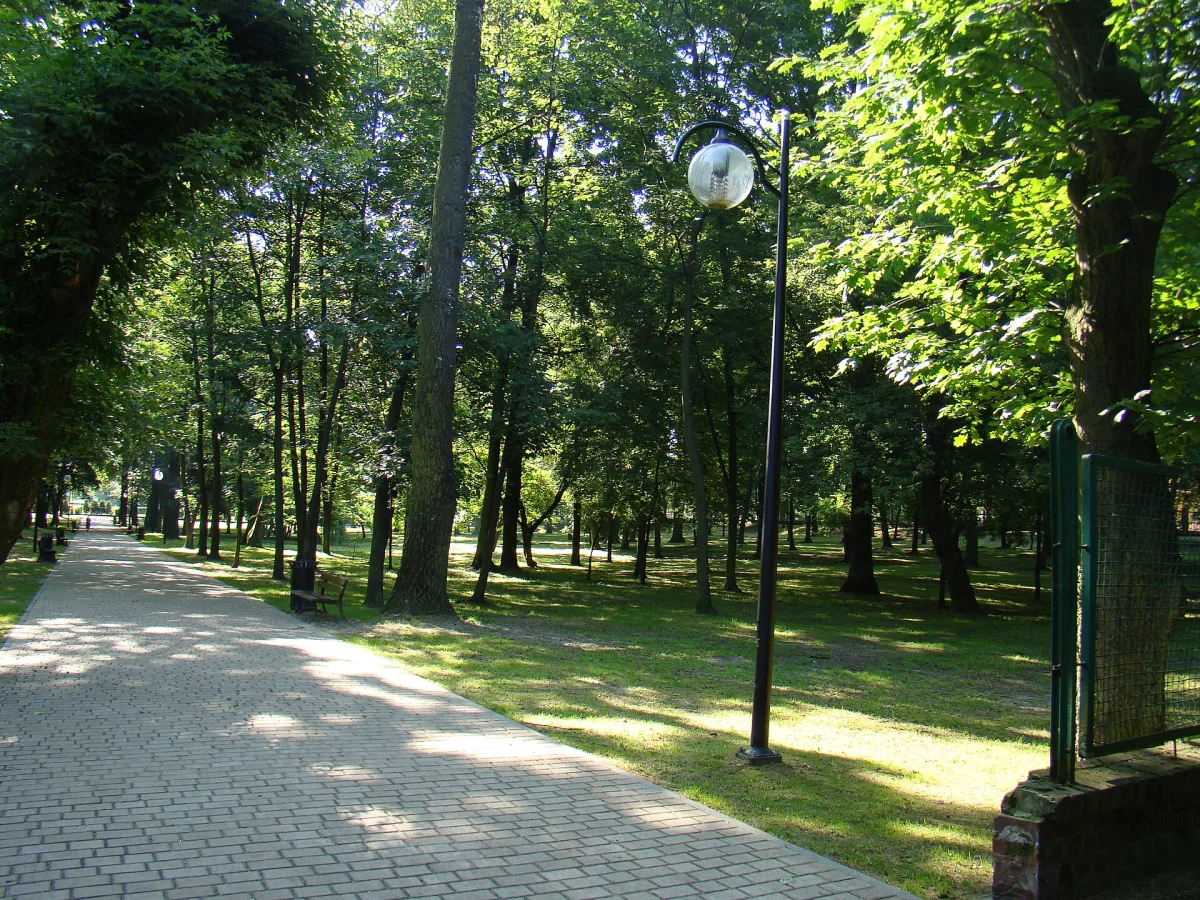
Green spaces remain from those times. The park on Szymańskiego Street, called the OSiR Park, covers about 5 ha and was laid out beside the Szymański villa in the English style, to a design by Hugo Kuder, before 1901. On 10 July 1991 it was entered in the heritage register as part of the layout of the TAZ workers' estate. The largest of the town's three parks, Adam Mickiewicz Park, is younger: it was laid out on 1 September 1929, and Jakub Löwenstein donated the land for it. The third, Tadeusz Kościuszko Park from the 1930s, has a copy of the chapel of Our Lady the Spinner, whose original stood from 1894 on Piłsudskiego Street.
A factory settlement without a town charter
During the First World War Zawiercie had over 30,000 inhabitants, an impressive station and numerous factories, and yet it had no town rights or urban structure. It acquired a town charter on 1 July 1915, although some sources also give the year 1926.
In the interwar period, with very high unemployment, Zawiercie was written about as a town of the unemployed. Zawiercie County was created in 1927.
Kromołów: the oldest district
Kromołów, mentioned in 1193, is part of Zawiercie today. It had a town charter before 1388 (we do not know the exact date, because the founding document has not survived), and lost it in 1870. It was incorporated into Zawiercie on 1 February 1977. By the source of the Warta stands the octagonal brick chapel of St John of Nepomuk from 1803; in 1988, because the street level had risen, it was dismantled and recreated a metre higher, with minor changes.
The Jewish community
Before the Second World War the Jewish community of Zawiercie numbered about 5,500 people. A Jewish district was created in 1941, and the liquidation of the ghetto began in the night of 25 to 26 August 1943. Several thousand people were deported to the Auschwitz-Birkenau concentration camp; the last transport left on 18 October 1943. After the Holocaust two traces of the community remained: the synagogue of 1880 on Marszałkowska Street, heavily altered after the war, and the Jewish cemetery on Daszyńskiego Street, with a funeral house and about two hundred gravestones. It was founded in 1911. The cemetery is a place of remembrance, so quiet is expected here.
Be the first! Add a comment.
You need to log in to add a comment.
Log in