
A technique without a pattern
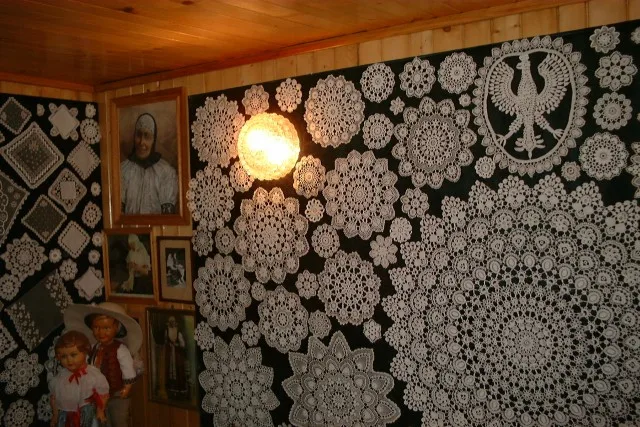
Koniaków lace is lace made with a crochet hook from fine cotton thread, called heklowanie in the dialect, while the lace itself is called "różia" or "różićka". Its characteristic is that it is made without a template or pattern. Each element, that is the chain stitch, half-treble stitches and treble stitches, is made separately, then arranged in a circle and joined with the hook from the smallest to ever larger. The whole rests on counting stitches and on the symmetry of the motifs.
The lacemaker does not draw a design. She must plan which motifs she will use, how many there will be and how large, and then count the stitches. The motifs have their own names, often in dialect: cones, grapes with leaves, clovers, snails, moons. As the founder of the lace foundation, quoted in the press, says, there are no ready templates, everything is passed down from generation to generation and kept in the heads of the lacemakers, and to scholars who ask why the patterns are not written down she replies that this is not the point. The official tourist guide of the Silesian Voivodeship writes in a similar spirit about oral transmission and individual creativity.
From bonnets to doilies
The first records of lace as a decoration of bonnets are dated to 1883 and 1884. The bonnet was a valuable part of a married woman's costume, and its most ornate element, the forehead piece (naczółek), was made, among other ways, with a crochet hook. The historian Barbara Poloczkowa links the beginnings of this tradition to the introduction in Austria in 1869 of compulsory schooling and of instruction in handicrafts for girls as well.
The beginnings of the doilies are described by two hypotheses, both connected with Zuzanna Wałach, who was in service in the Goleszów area. According to one, the first doilies were made in Koniaków around 1906 and 1907, according to the other around 1900, and she was said to have learned crocheting from her mother from Istebna. The round shape of the doily is attributed to Maria Kulej. The age of the tradition is given variously: the tourist guide writes of about 150 years, the press of more than 140, another study of 140, and other compilations generally of more than a hundred. The sources therefore do not agree on the date of the beginning, which depends on whether bonnets or doilies are counted.
After the war Maria Gwarek founded a lace cooperative in Koniaków, which in its best period brought together about 250 lacemakers from the region. There was also a Koniaków branch of Cepelia, which for 50 years was a centre drawing together the makers. In the 1980s interest in the lace weakened, and later returned when new products began to be made: from jewellery and Christmas decorations to lampshades and underwear.
An entry on the national list, not on the UNESCO list
One sometimes reads that Koniaków lace has been placed on the UNESCO list. This does not follow from the sources. The National List of Intangible Cultural Heritage, kept by the Minister of Culture, contains the entry "Traditions of making Koniaków lace" dated 1 June 2017. This is a national list, separate from the UNESCO lists. The justification of the entry states that this kind of lace is made in no other region of Poland or the world, and that the tradition is still alive.
In 2022 the Polish Patent Office also registered the geographical indication "koronka koniakowska". It covers products made by hand by residents of Koniaków, Jaworzynka and Istebna, that is, the Trójwieś (Three Villages). The applicant was a foundation from Koniaków. As to the number of lacemakers, the sources give about 700 people in Koniaków and the surrounding area.
Gifts for popes and a queen
Maria Kulej made lace for clergy: a tablecloth for Cardinal Stefan Wyszyński in 1958, for the popes John XXIII in 1963 and Paul VI in 1966, and also for John Paul II. Maria Kulej's tablecloth of 1962 went to the then Queen of the Belgians. Maria Gwarek was making a doily for Queen Elizabeth II and did not manage to finish it, because she died. That unfinished doily is today in the museum.
Where to see the lace
Collections of lace, including bonnet forehead pieces, doilies, tablecloths and curtains, are gathered in the Lace Museum in Koniaków, that is, the Maria Gwarek Memorial Room in the hamlet of Szańce. The tourist guide also mentions a lace 5 metres in diameter, displayed since 2013 at the culture centre in Istebna, but this is information from a single source.
Be the first! Add a comment.
You need to log in to add a comment.
Log in