
The Silesian highlanders are an ethnographic group of the Polish population which originally inhabited the Silesian Beskids and the Moravian-Silesian Beskids, within the borders of the former Duchy of Cieszyn. They should not be confused with the Podhale highlanders or the Żywiec highlanders. They have their own dialect, their own costume and their own way of farming mountain meadows, and their centre today on the Polish side of the border is the Beskidzka Trójwieś (the Beskid Three Villages): Istebna, Jaworzynka and Koniaków.
Who the highlanders of the upper Olza are
Wincenty Pol, who described the population of the northern slopes of the Carpathians in the mid-19th century, distinguished four groups among the Silesian highlanders: the Breniaks of Brenna, the Wiślans from the sources of the Vistula, the Jabłonkovians from the upper Olza and the Moravians from the basin of the Morawka river. The Jabłonkovians live in Koniaków, Jaworzynka and Istebna, among other places, and they took their name from the Jabłonek range and the small town of Jablunkov on the Czech side of the border.
The dialect of these areas, with its jabłonkowanie and the Old Polish "rz", is described separately, in the text on the Cieszyn dialect. Here we stay with farming, costume and custom.
Shepherding in mountain huts: summer on the pasture
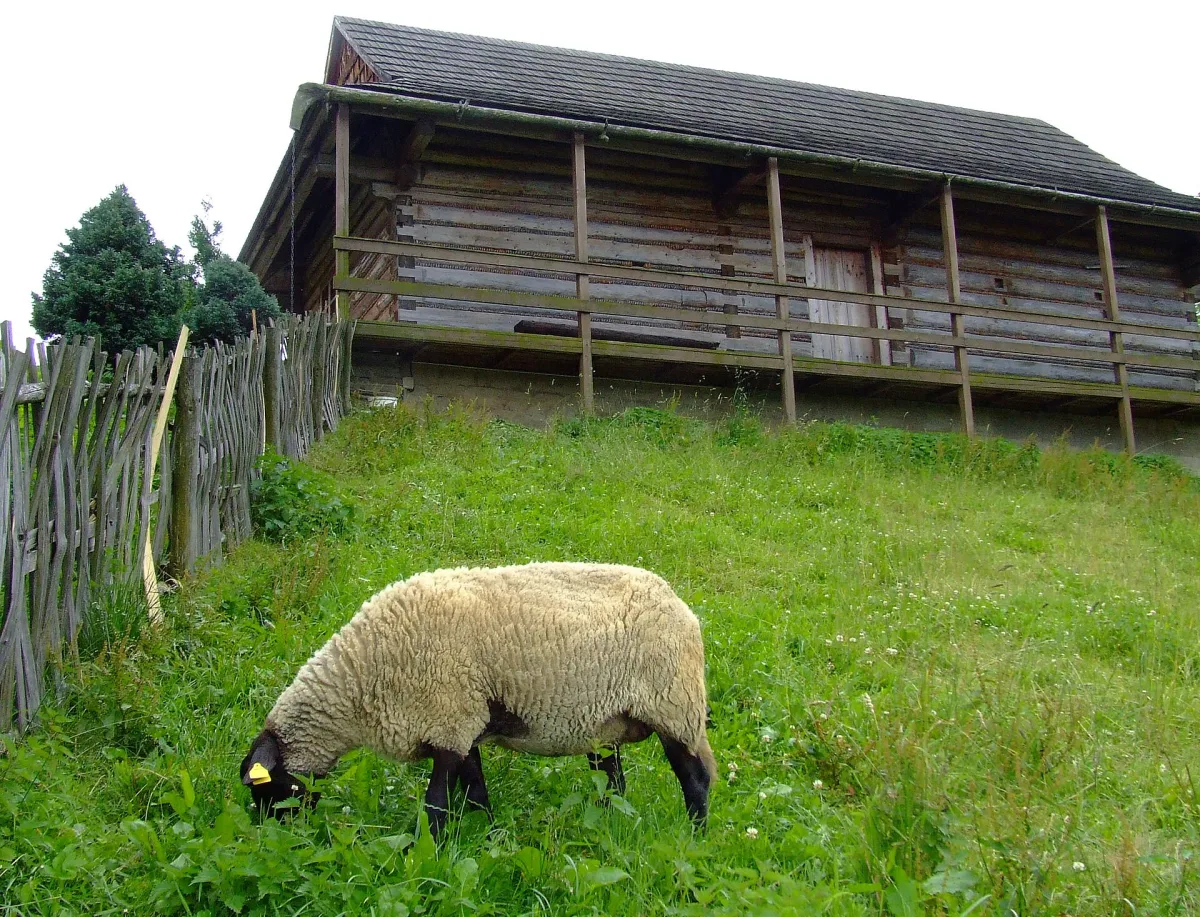
Szałaśnictwo is the name for the mountain form of pastoralism: sheep, goats and cattle spent the summer on mountain meadows under the care of shepherds living in huts. Pastoral culture was brought to the Carpathians by waves of Wallachian settlers, and it reached the Silesian Beskids at the turn of the 15th and 16th centuries. In old records the inhabitants of Istebna called sheep and goats "Wallachian cattle".
Soon after the founding of the village the local highlanders already had three huts in the mountains. Eight farmers grazed 1,166 head of "Wallachian cattle" in them, and near their fields below the mountains nineteen of the first settlers grazed 372 head of horned cattle. The land here was infertile and the growing season short, so herding paid better than farming and remained the inhabitants' main occupation until the mid-19th century.
Herding was also tied to a dispute over the forest. The first seal of the Istebna municipality, from 1702, shows a goat gnawing at a tree, which symbolises the long struggle of the administration of the ducal estates against the grazing of goats in the forests.
The end of the huts
The decline of hut-based herding began at the end of the 18th century, and it was sealed by the abolition of servitudes, that is the highlanders' rights to use the forests and pastures. The sources differ on the date: one gives 1853, while another speaks of a compulsory buy-out of servitudes in 1851, against which the highlanders appealed four times to the court in Vienna, without success. The highlanders then looked for other earnings: work in the forests, carting, hauling bog iron ore to the ironworks in Ustroń and Węgierska Górka, and timber to Cieszyn and Jablunkov.
The researcher Ludomir Sawicki studied pastoralism in Cieszyn Silesia in 1913 and already counted the hut "na Dupnym" among those entirely lost. Elsewhere hut-based herding survived longer: the clearings on the ridge above Brenna were an active centre of it until the end of the interwar period, and the remains of stone sheepfolds could still be seen in the 1980s.
Costume and kierpce
In 1846 Henryk Jastrzembski captured a highlander couple from Istebna in a watercolour, and Mieczysław Orłowicz, who described these areas in his guidebook just before the First World War, noted that the local population "is distinguished by beautiful costumes". The entry on the Cieszyn costume adds that the women's Cieszyn costume gradually spread in the areas of Wisła, Koniaków and Istebna, where the costumes of the Silesian highlanders had previously predominated. Istebna costumes can be seen today in the "Na Grapie" Regional Museum in Jaworzynka.
Kierpce, footwear cut from a single piece of leather, were part of the costume. Among the highlanders of the Silesian Beskids festive kierpce were made from calfskin tanned light brown or yellow, felt cloth insoles were put into them, and they were tied with a green ribbon. In 1913 Sawicki recorded that shepherds in Cieszyn Silesia wore krypcie and white woollen leg wraps, which in the western parts of the Silesian Beskids were fastened on the calves with cords called nawłoki.
A separate branch of local handicraft is the lace of Koniaków, to which we have devoted a separate article in this section. A trace of it can be seen in the Lace Museum in Koniaków.
The cottage, instruments and timber
The old life of the highlanders is best seen in Kawulok's Smoke Cottage (Kurna Chata Kawuloka) in Istebna. The wooden cottage from 1863 belonged to the Kawulok family, and its master Jan Kawulok (1899-1976) was a regionalist, storyteller and maker of folk instruments. After returning from France he took up herding and worked in a hut on the slopes of Barania Góra. He made bagpipes (gajdy), Wallachian trumpets, shepherds' horns and fujarka flutes, and the gatherings with music and storytelling that he held at home gave rise to the regional room, which has operated since 1964.
In the so-called black room stands a "kurlawy" or smoky stove: without a chimney, with the smoke escaping into the room. A similar smoky stove, set on inverted spruce roots and used for drying herbs, is shown by the cottage from 1920 in Jaworzynka. The "Na Grapie" museum was established there in 1993 and organises workshops on making butter, bread and curd cheese by traditional methods, as well as on blacksmithing, embroidery and basket weaving.
The Istebna spruce, a variety of the Norway spruce, is the subject of the Istebna Spruce Museum at the Regional Gene Bank. The exhibition shows, among other things, the characteristics of the wood from which folk musical instruments are made.
Gorol and Gorolski Święto
The word "gorol" has two faces. In Cieszyn Silesia, especially in the Czech Republic, it has kept its original meaning, that is "highlander", and in Zaolzie (the Trans-Olza region) describing oneself as a gorol does not contradict a Silesian identification, and even strengthens it. In Upper Silesia the same word means a person from outside the region and can be offensive, which in the Polish part of Cieszyn Silesia changed the highlander identity, which stopped going hand in hand with the Silesian one.
The Highlanders' Festival is organised on the first weekend of August by the Polish minority in the Czech Republic in the Municipal Grove in Jablunkov. The festival descends from the pre-war Mountain Festival (Święto Gór), which was last held in 1937 in Wisła, and the first post-war festival was organised on 12 September 1948. The name "Gorolski Święto", in the dialect form, has been used since 1967, and the original name "Święto Góralskie" was proposed by the writer and folklorist Karol Piegza.
Be the first! Add a comment.
You need to log in to add a comment.
Log in