
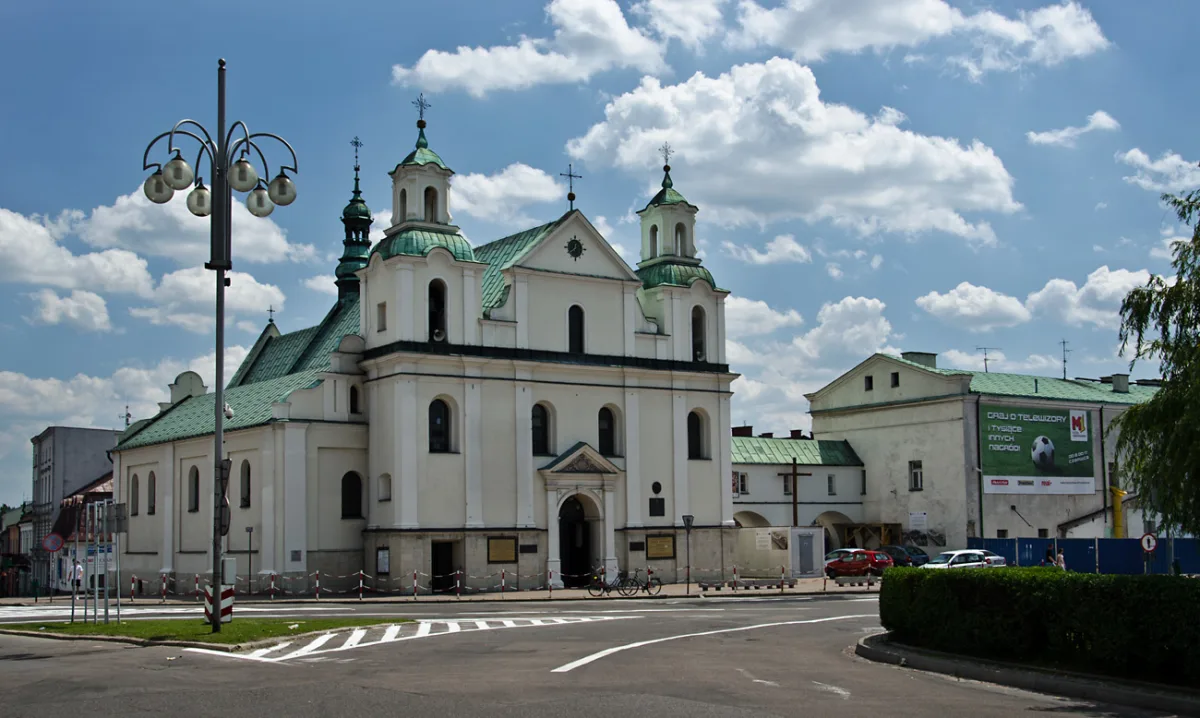
In Częstochowa it is simply called “Aleje” (the Avenues), although the street register lists a single street, Aleja Najświętszej Maryi Panny (Avenue of the Blessed Virgin Mary), with one continuous system of house numbers. It is about 1.5 km long and 44 m wide, and its layout, two dual carriageways with a boulevard in the middle, marks the route from the city centre to Jasna Góra. The history of its name is as layered as the history of the trees that line it.
The road that joined two towns
Until the early 19th century there were two separate settlements on the Warta: Stara Częstochowa (Old Częstochowa) and Nowa Częstochowa (New Częstochowa), a former monastery village. The avenue was meant to connect them. It was created in the early 19th century as a road linking the two towns, and their formal merger took place on 19 August 1826. On that day the Administrative Council also confirmed the existence of the street itself.
Laying out began in 1818, and the plan for the expansion and regulation of the new town was drawn up, on the orders of the authorities of the Kalisz Voivodeship of the Kingdom of Poland, by the engineer Jan Bernhard, who surveyed both towns three times, in 1822, 1823 and 1825. From 1824 the still empty plots along the avenue were let in perpetual lease, with the obligation to build on them within two years. This was when the name of the street first appeared in documents: ulica Panny Maryi (Virgin Mary Street). The avenue was planted with four rows of horse chestnuts as early as 1823.
The division that residents still use today has also survived. The first avenue runs from Daszyński Square to the viaduct over the railway line, the second from the viaduct to Biegański Square, and the third from Biegański Square to the parks below Jasna Góra. The division into three parts already existed in the 19th century.
How the name changed
At first it was Aleja Panny Maryi. Later the name we know today was used, although its spelling kept changing: Aleja Panny Marii, Aleja Najświętszej Marii Panny, and finally the present form. During the German occupation the street was first renamed Marien-Allee, and on 28 January 1942 Adolf Hitler-Allee. After the Germans were driven out of Częstochowa the Polish name was restored. In practice, then, one street had three names: the colloquial Aleje, the official Aleja Najświętszej Maryi Panny, and the occupation-era name, imposed for a few years.
A walk from square to square
The avenue begins at Ignacy Daszyński Square, which until 1934 was called Nowy Rynek (New Market). Not far away lies the former market square of Stara Częstochowa, the Old Market Square, the former centre of Old Częstochowa, to which the avenue was meant to connect the new town.
The buildings are mostly Neoclassical and late Neoclassical tenement houses, less often Eclectic, with a mixture of modern buildings. The first avenue includes the House of Adolf Franke, a Protestant from Greater Poland and the owner of a spinning mill and textile factory, built in 1901-1903. The second avenue has the Kohn House of 1865, known as the Bata House after the shoe shop that was located here in the 1930s, and the former State Bank building of 1903-1904. At number 17 there stood a hospital, headed in 1883-1907 by Władysław Biegański. The hospital was demolished in 1969. In the second avenue, by tenement house number 20, stands the Władysław Biegański bench, unveiled on 23 June 2008.
The third avenue begins at Władysław Biegański Square. Here, at several addresses, you can look into cultural institutions. The former priest's house of 1875, the building at number 47, originally the seat of the Orthodox clergy and in the interwar period the Roman Catholic bishop's palace, now houses the Good Art Gallery (Galeria Dobrej Sztuki), a branch of the Częstochowa Museum. At number 56 stand the Neo-Gothic rectorial church of the Most Holy Name of Mary of 1859-1861 and the building of the Sienkiewicz 4th General Secondary School, in a former Mariavite convent. In front of the school, in a small square, sits the monument to Henryk Sienkiewicz of 1973.
This part of the avenue also has bronze benches. The Halina Poświatowska bench was unveiled on 11 October 2007, and opposite it the Marek Perepeczko bench was placed in 2014. In the central promenade of the third avenue there are two fountains: Amonit (Ammonite), made of Długopole sandstone, and Dziewczynka z gołębiami (Girl with Pigeons).
Trees that kept changing
The original horse chestnuts did not survive in full. In the interwar period they were cut down: the first avenue was planted with lime, maple and sycamore trees, the second with limes, and the third with poplars. According to other sources, however, the second and third avenues kept their horse chestnuts until 1935, and the third was then replaced with Berlin poplars, which grew until 1998. The account of the changes in the sources is therefore not fully consistent, so the dates for tree species should be treated as approximate.
Limes have been planted again since the end of the 20th century: in the first avenue silver limes of the Varsaviensis cultivar were planted in 2006, in the second silver limes of the Brabant cultivar in 2013, and in the third, in 1998-2013, Dutch limes of the Pallida cultivar. In time the avenue also gained a surface: a beaten one in 1848-1850, with granite setts first laid in 1923. In the 1950s car races were held here several times.
The end of the road: parks and monastery
The continuation of the avenue towards the monastery is Henryk Sienkiewicz Avenue, bordered by the Stanisław Staszic Park and the 3 Maja Park, known as the parks below Jasna Góra. At its end rises the hill of Jasna Góra. During the pilgrimage season the boulevard between the carriageways is used by pilgrims heading for the monastery, so the city thoroughfare has a second function as well.


Be the first! Add a comment.
You need to log in to add a comment.
Log in