
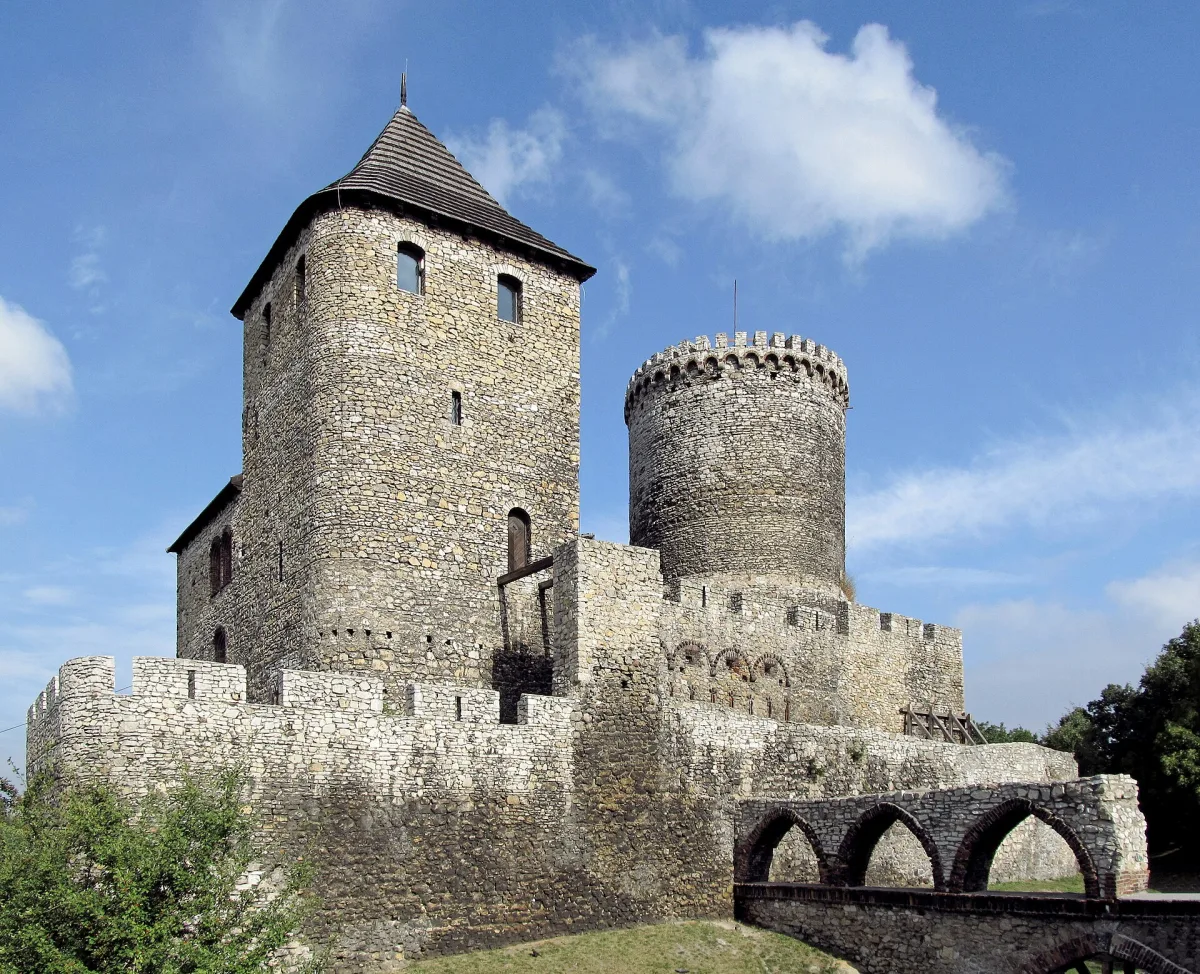
Będzin Castle stands on a hill above the Czarna Przemsza and can be seen from far away. Its history begins with a wooden stronghold, passes through King Casimir the Great, several fires and a demolition that almost went ahead, and ends with the romantic rebuilding of 1834 and a post-war reconstruction. This text walks through those layers one by one, following what the portal's entries say about the castle.
Stronghold, keep and a castle on the border
The history of fortifications on this spot goes back to the 9th century, when a stronghold was built on Castle Hill. In the second half of the 13th century, probably under Bolesław the Chaste, a stone keep was built within it, a tower that still stands today. In 1349 Casimir the Great added a castle to it. It consisted of an upper castle, surrounded by two rings of walls, and a lower one with a gate on the north side. Only remnants of the foundations of the lower castle survive today.
The first burgrave of Będzin is mentioned in 1349, which proves that the castle was already standing then. Its construction is linked to the loss of Silesia to Bohemia in 1348: the border between the Crown and Bohemia then ran along the Czarna Przemsza, at the very foot of the hill. The founding charter of 1358 says that the town was founded “beneath our castle”. Traces of that foundation can be seen today on Casimir the Great Square, the former market square of the Old Town, and on a stretch of the town walls, which were built in the 1360s and joined the walls of the castle.
One popular opinion has to be rejected. Contrary to what is often repeated, the Tatars did not take the stronghold: according to more recent archaeological research, the traces of burning in the rampart date from earlier years.
Fires, negotiations and the Deluge
In August 1588 the castle became a venue for negotiations. Plenipotentiaries of Poland and of Emperor Rudolf II discussed the release of Maximilian Habsburg, a pretender to the Polish crown, imprisoned after the battle of Byczyna. The agreement, known as the Treaty of Będzin, was however signed not in the castle but in the town hall in Czeladź, on 9 March 1589. The name therefore comes from the talks held in Będzin, not from the place of signing.
In 1616 the castle burned down together with part of the town. The fortress was rebuilt at his own expense by the Będzin starost Andrzej Dębiński. During the Swedish Deluge, in 1655-1656, the castle was burned again and partly demolished. Royal inspectors ordered it rebuilt in 1660, which happened in 1665.
The castle is also linked to a tradition about John III Sobieski. According to tradition, on 19 or 20 August 1683 the castle hosted the king and his wife as he was on his way to relieve Vienna. This is a tradition, not a confirmed fact. The tourist Trail of the Polish Hussars, which passes beneath the castle, refers to this event.
Ruin and Lanci's rebuilding
In the partition period the castle fell into ruin. When in 1825 one of the residents was killed beneath a collapsing wall, the commissioner of the Olkusz district ordered the castle to be demolished to its foundations. The demolition was halted only by an order from Warsaw of 5 March 1827, which required the monuments of the district to be registered and protected.
In 1833 Count Edward Raczyński came to Będzin and decided to rebuild the romantic ruins. Already in 1834 the castle returned to its former shape, to a design by Franciszek Maria Lanci, an architect from Kraków. Lanci introduced pseudo-Gothic elements into the Gothic structure: blind loopholes were cut, blind machicolations were added, large windows in brick surrounds were introduced, and the round tower was considerably lowered. The castle was to become the seat of a mining school, but this idea quickly collapsed. In 1840 a Protestant chapel was set up in it, in which a service regarded as the first Protestant one in the Dąbrowa Basin was held, and after minor alterations a hospital as well. In 1849 the castle fell into ruin again.
20th-century reconstruction and the museum
In 1919 the Society for the Care of Castle Hill was founded, and in 1929 it began reconstruction to a design by Professor Adolf Szyszko-Bohusz. The castle's present appearance is owed to Lanci's rebuilding of 1834 and the reconstruction of 1952-1956 to a design by Zygmunt Gawlik. The hill is covered by a park, which began with the planting of trees on Castle Hill in the 19th century.
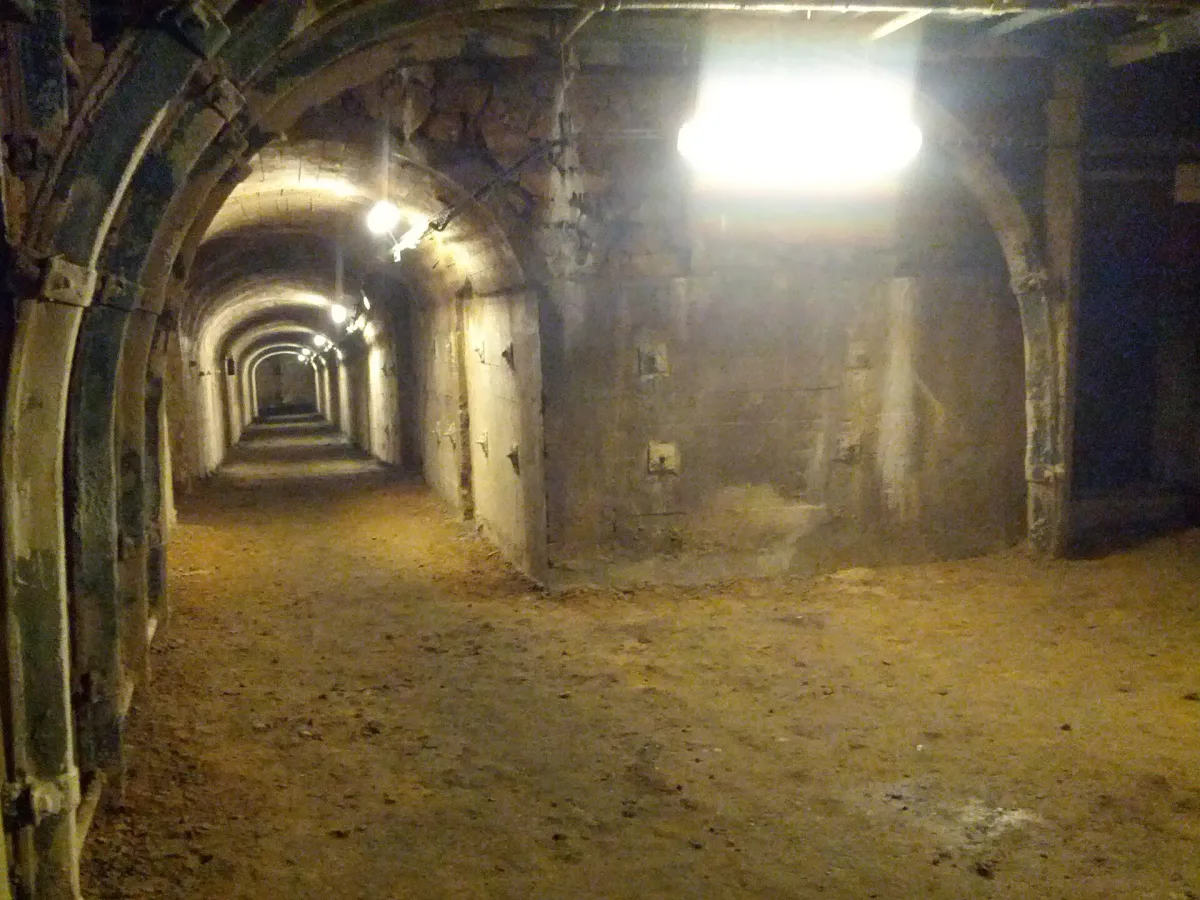
In July 1956 the Basin Museum (Muzeum Zagłębia) was opened in the castle, the first museum institution in the region, with a collection of historic weapons and armour. In 1969 the round tower, with a view over the surroundings, was opened to visitors. Right beneath the hill runs the route of the Będzin Underground, set up in an unfinished German shelter.
The legend of the name and neighbouring castles
The legend of the town's name says that Casimir the Great, surveying the area, said: “tutaj będziem my” (“here we shall be”). This is a tale, not a source. You will find a comparison of Będzin with other fortresses of the region in the article on the castles of Upper Silesia and the Basin, and in nearby Siewierz stands the bishops' castle, described in a separate entry.
The history of Będzin's Jews and the ghetto is a separate subject. It is described in the entry on the Będzin Ghetto, and the fate of the former house of prayer in the entry on the Synagogue in Będzin. Current opening hours of the castle and museum are listed by the operator.

Be the first! Add a comment.
You need to log in to add a comment.
Log in