
The legend of the robbers and the first walls
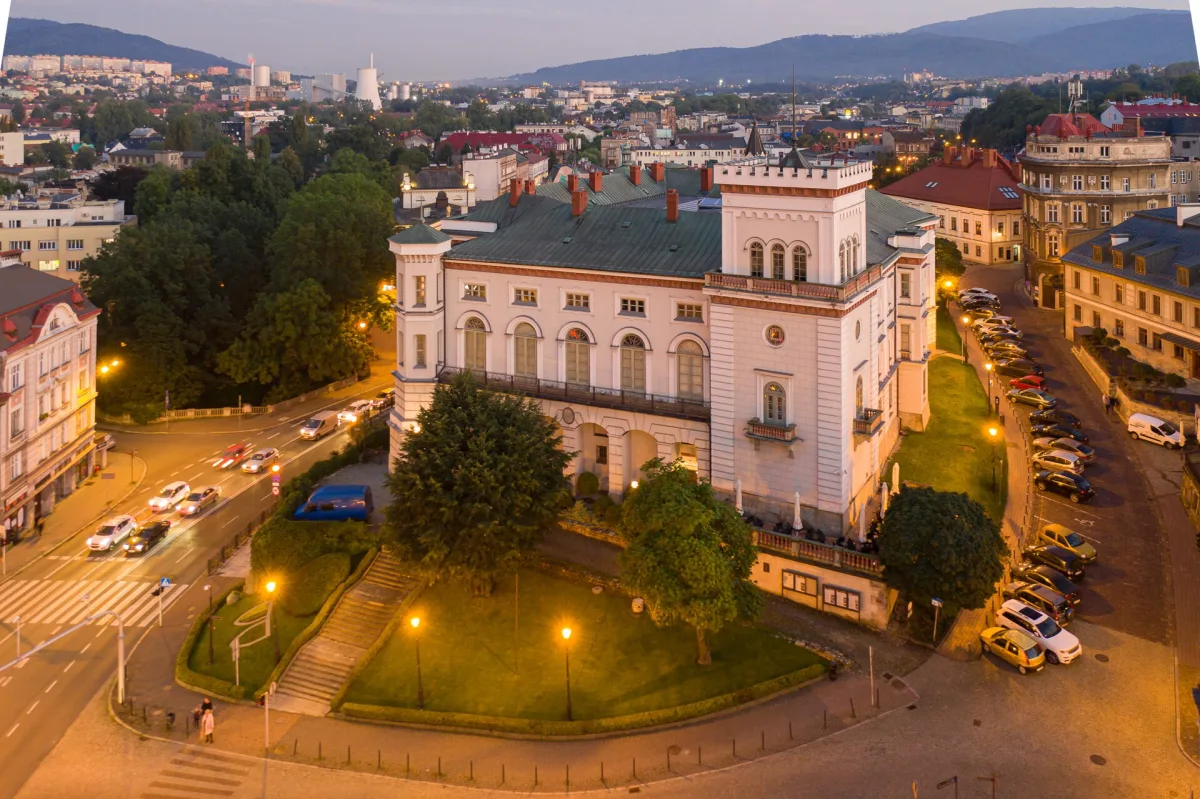
According to legend, a stronghold of robbers who attacked merchants once stood on the site of today's Sułkowski Dukes' Castle. Duke Casimir of Opole was said to have wiped them out, taken the stronghold and built a small hunting lodge in its place, later extended into an imposing castle beside which the town grew up. It is a legend and should be read as one. The data on the walls are more reliable: the oldest parts of the castle date from the 14th century, and its construction is attributed to the efforts of Duke Przemysław I Noszak of Cieszyn.
From the beginning the castle was a town castle, incorporated into Bielsko's system of fortifications and the strongest element of its defences. It also served as a Silesian border fortress. The Biała river separated first the duchies of Cieszyn and Oświęcim, from the middle of the 15th century the Bohemian-Polish border, and more generally Silesia from Lesser Poland. An even older trace of settlement is the stronghold site in Stare Bielsko, about 1.6 km from the Market Square: the stronghold was in use from the late 12th to the late 14th century, and finds from there can be seen today in the castle's archaeological exhibition.
From fortress to residence
From the end of the 16th century the castle's defensive role declined, and it increasingly resembled a noble residence. From 1572 it was the administrative and economic centre of the independent Bielsko state country, ruled in turn by the Promnitz, Schaffgotsch, Sunnegh, Solms and Haugwitz families. The oldest description of the castle comes from a land register of 1571. It lists fifteen rooms and chambers, twenty-two vaulted spaces, a brewery with a malthouse, stables, a granary, a laundry and bathing rooms, as well as an orchard, a hop garden and two ponds in which fish were kept in winter.
In 1752 the Bielsko state country was raised to the rank of duchy and passed into the possession of Alexander Joseph Sułkowski. The duchy existed until 1849, when a modern administrative division was introduced in Austria and its lands became part of a district authority. The castle itself and numerous properties in the town remained in the hands of the Sułkowskis until 1945. The family also looked after the nearby church: from 1752 it acted as its patron, and in the 19th century it funded its furnishings, as we describe in the entry on St Nicholas Cathedral, a few hundred metres away.
Fires and the 19th-century rebuilding
The castle was damaged by town fires in 1753, 1808 and 1836. Its present eclectic form was given to it by the last great rebuilding in 1855-1864, commissioned by Duke Ludwik. It was then that, among other things, the façade facing Bolesława Chrobrego Square was created, almost entirely erasing the building's earlier stylistic features. A few years earlier, in 1853-1855, St Anne's Chapel was added on the south side, in place of an older chapel destroyed by the fire of 1836. Duke Ludwik built it in memory of his wife Anna, who died in 1853, and in time it became the burial place of the family.
In 1899-1973 a row of so-called Castle Bazaars stood on the east side, forming an architectural base for the castle's mass. They were demolished when Zamkowa Street was widened, which is why a brick retaining wall can be seen on the east side today. To the south it closes off Bolesława Chrobrego Square, which began to take shape in the middle of the 19th century, when the town's economic centre was shifting from the Market Square to the Lower Suburb. The older layout of the town, chartered at the beginning of the 14th century, has been preserved by the Market Square on the Town Hill.
The museum in the castle
Bielsko's museum tradition goes back to the beginning of the 20th century, when the authorities of Silesian Bielsko and Galician Biała set up two separate town museums. After the war it was decided to revive the institution in the castle. The castle is sometimes described as the seat of a museum from 1945, but the Town Museum in Bielsko was opened to the public on 14 February 1947, so it is this date that marks the start of visiting. In 1950 the museum was nationalised and placed under the Upper Silesian Museum in Bytom; it regained full independence in 1963, and after the creation of Bielsko Voivodeship in 1975 it was transformed into a District Museum. Since 2013 it has been called the Historical Museum in Bielsko-Biała.
The permanent exhibition includes the 19th-century ceremonial staircase, an exhibition on the history of the castle and the town with an archaeological section, Polish and European art from the 14th to the 17th century, galleries of painting and of the region's contemporary art, and an ethnographic exhibition. Among the most impressive interiors is the Music Salon, with a polychrome ceiling and neo-Baroque mirrors. In the Knight's Hall, known as the lapidary, relics of the castle's architecture are displayed, and separate rooms hold mementoes of the Sułkowski family.
Museum branches and the surroundings
The museum also runs branches outside the castle. The Old Factory (Stara Fabryka) tells the story of the town's textile industry in the former factory of the Büttner brothers, and the Weaver's House shows a reconstructed 18th-century house and clothmaker's workshop. After visiting the castle, the Banialuka Puppet Theatre is a few hundred metres away.

Be the first! Add a comment.
You need to log in to add a comment.
Log in