
The founding of the town and the monastery of the Friars Minor
Wodzisław Śląski has one starting date in the town chronology: the year 1257, when the Minorite order was brought to the town and the town was chartered. The name of the town is patronymic. It derives from the Old Polish name Wodzisław, and scholars today hold that this refers to the Duke of Opole and Racibórz, Władysław. The same duke is linked with the foundation of the first castle and monastery.
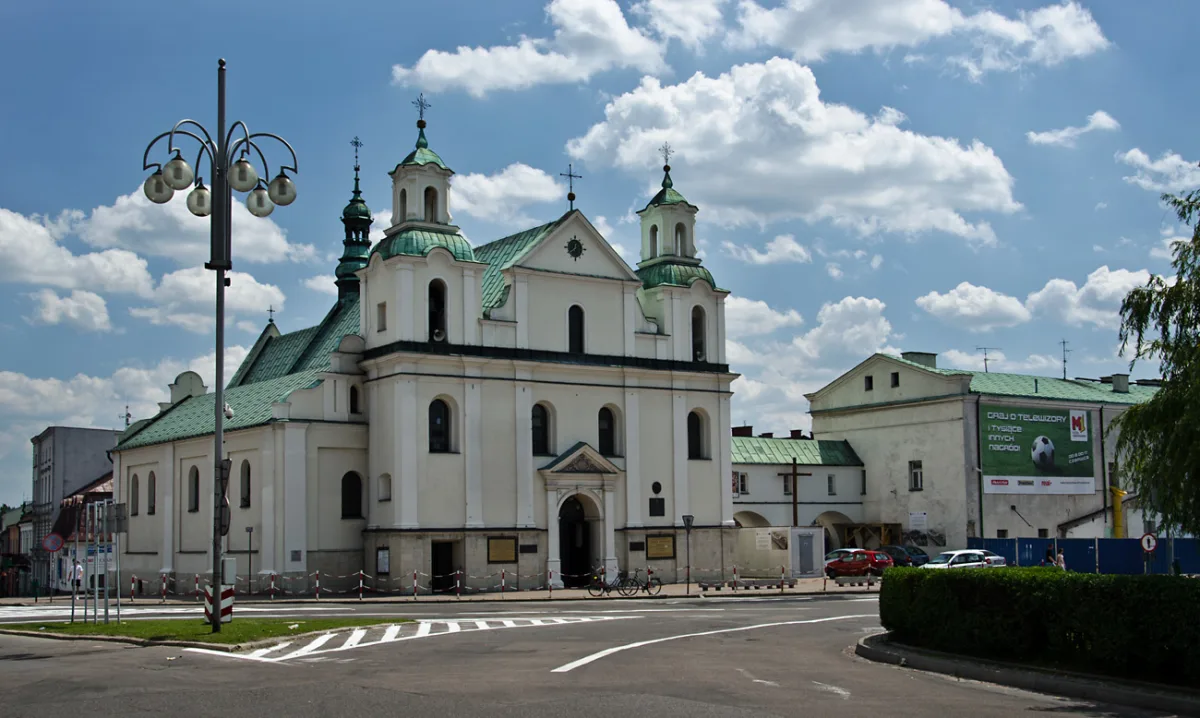
The monastery complex on Minorytów Street stands near the north-western corner of the market square. It is called a Franciscan monastery, because the Friars Minor are Franciscans, and locally they are also called Minorites. 1257 is given as the year the convent appeared, citing information published by Rudolf Hirsch. In the 14th century a brick Gothic Church of the Holy Trinity was built, one of the oldest in Upper Silesia, and in the 17th century next to it a new monastery building with a courtyard. In 2015 a hypothesis was put forward that the founder of the church might have been Constance of Wodzisław.
In 1810 the monastery was dissolved, like all monasteries in the Prussian state, and the buildings were taken over by the town. In 1830 the church was sold to the Evangelical parish. During the Second World War the church was almost completely destroyed, and its reconstruction lasted from 1953 to 1963. Today the church belongs to the Evangelical Church of the Augsburg Confession parish, and the former monastery building houses a district court.
A market square that remembers ruins
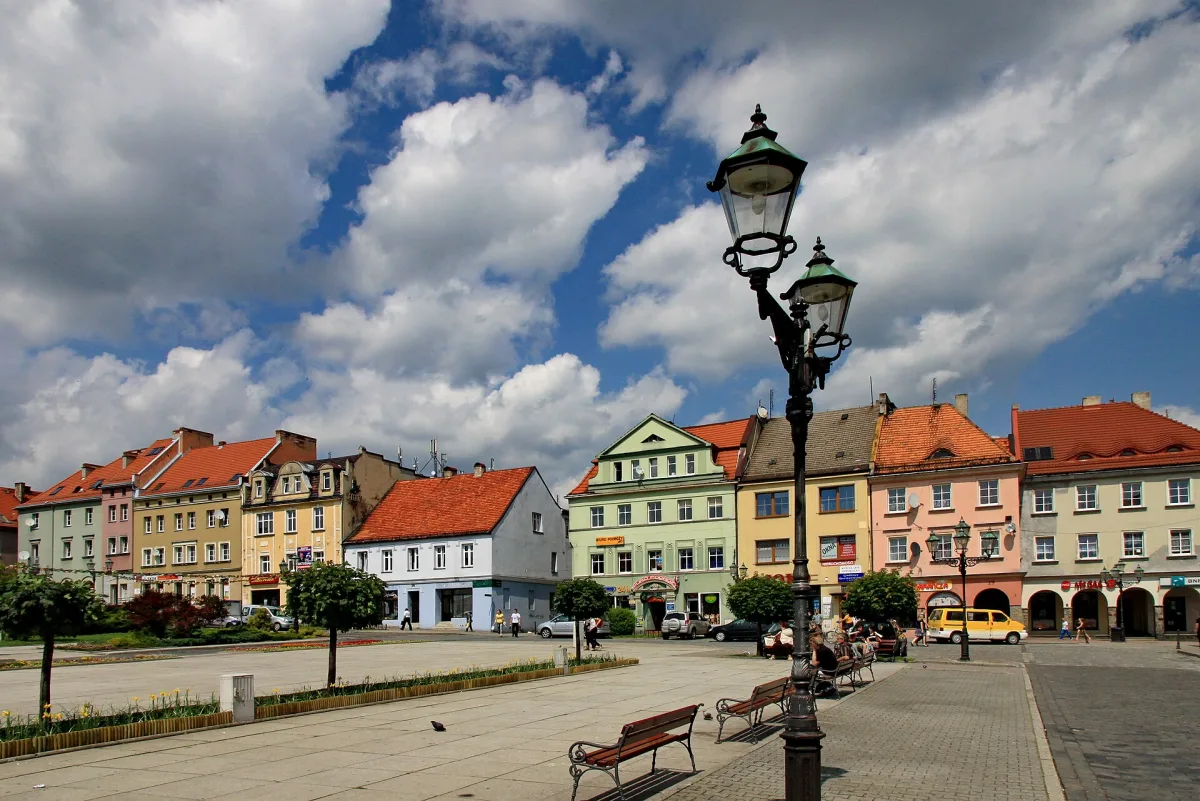
The Market Square (Rynek) is counted among the largest in Silesia. In its southern part the surface is paved with slabs, and in the northern part there is a small park with a fountain. In the Middle Ages a town hall, a pillory and a deep well stood here. Above the northern frontage, on a hill, rises the Church of the Assumption of the Blessed Virgin Mary, whose present building of 1909-1911 stands on the foundations of a Gothic church from 1599.
The frontages are of different ages, because the whole northern part of the square lay in ruins after the Second World War. Tenement houses numbered 16 to 22 were therefore built after the war. Well-preserved 19th-century tenements are on the southern side, and some of them are entered in the heritage register. On the corner of tenement number 9 there is a bas-relief of the Unknown Insurgent, and in a niche of tenement number 13 a sculpture of Duchess Constance of Wodzisław. At number 9 before the war stood the Pod Lwem (At the Lion) tenement, belonging to the Jewish Loewe family.
A few dozen steps further is Wojciech Korfanty Square, where in 1975 the Monument to the Silesian Insurgents was unveiled. It takes the form of marching figures, and on it are inscribed the dates 1919, 1920 and 1921 and the names of places in the Wodzisław land where fighting took place. Town ceremonies on 3 May and 11 November are held by the monument. In the former Racibórz Suburb lies, in turn, Holy Cross Square. From 1525 to 1826 a wooden church stood here, and a cross and an obelisk erected in 2000 recall that it is no longer there.
A castle that gave way to a palace
The first castle was probably built around 1257, and its oldest fragment is considered to be a mound in the Town Park, about 40 metres south of today's palace. In the 16th century the castle consisted of a gate, an armoury and a main building, and the whole was surrounded by a moat with a bridge. According to some sources it was demolished by the Swedes in 1648, while the town chronology speaks of the burning of the town and castle in 1618. These are two different events, and both fit into the turbulent 17th century.
In 1685 the Wodzisław estates were received in pledge by Count Ferdinand Joseph von Dietrichstein, and he officially took them over in 1696. His grandson Guidobald Joseph von Dietrichstein commissioned the construction of a new residence. The Dietrichstein Palace was built in 1742-1747, and the narrower dates 1744-1747 are also given. The design was probably by the Moravian architect Franz Anton Grimm. The two-storey building measures about 52.8 by 17.3 metres, has a symmetrical façade of fifteen bays, and above the entrance a cartouche with the coats of arms of Guidobald and his wife Maria Gabriela Henckel von Donnersmarck. It is regarded as one of the first Neoclassical buildings in Polish lands. The old castle was demolished, and gardens were laid out in its place.
The Dietrichsteins held the palace until 1772, after which it often changed owners. The great fire of the town on 12 June 1822 destroyed the roof and the first floor. From 1881 the whole building was occupied by the municipal authorities. Since 1971 it has housed the Museum in Wodzisław Śląski, which grew out of the regional room of the Society of Friends of the Wodzisław Land. After a thorough renovation in 2018-2022 the mansard roof with dormers and bull's-eye windows was recreated.
The synagogue, the tower and churches of the districts
In the centre of the old town, on Targowa Street, stands the former synagogue from 1826, built after a fire destroyed an older, wooden one. In 1938 the building was bought by the Union of Silesian Insurgents and converted into the Insurgents' House, and later it housed a cinema and shops. Today it can be seen only from the outside.
Outside the centre it is worth seeking out the Romantic Tower in the forest at Grodzisko, a Neo-Gothic viewing tower from 1867-1868 founded by Edward Brauns. The tower burned down in 2004, and after reconstruction it was opened to visitors in 2021. The town also has several churches in its districts: the Church of St Mary Magdalene in Radlin II, Neo-Baroque, from 1929-1930, the Church of the Immaculate Heart of Mary in Kokoszyce, built in 1948-1950 as voluntary community work by parishioners, and the Church of St Lawrence on the 1 Maja estate. St Lawrence has been the patron of the town since 10 August 1536, when the residents placed themselves under his protection in the face of a threatening disaster.
In January 1945 a death march from the camps in Oświęcim and their subcamps reached Wodzisław. This subject has a separate text on the portal; here it is only a reminder that the history of the town does not end with the palace.

Be the first! Add a comment.
You need to log in to add a comment.
Log in