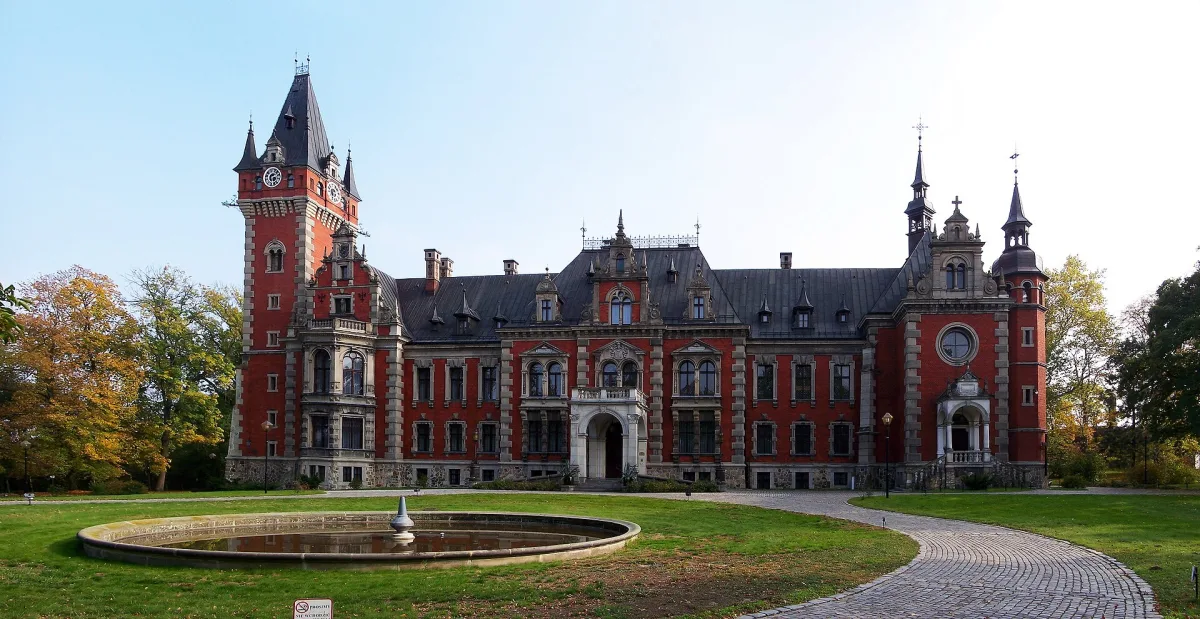
The Ballestrem Palace in the Dutch Neo-Mannerist style from 1882-1885 with a park, today a diocesan retreat house.
The palace and park complex in Pławniowice is a clinker brick palace in the Dutch Neo-Mannerist style and the park with exotic trees around it. It was built in 1882-1885 by the Ballestrem family, and today it serves as a diocesan retreat house.
The village appears in documents in 1317 and 1364, and in 1393 there was a stronghold here manned by knights under the command of Piotr Szafraniec. In 1525-1532 the estate belonged to the Seydlitz family. In 1737 Baron Franz Wolfgang von Stechow established an entailed estate, and in 1798 the estate passed by marriage to the Ballestrems, who held it until 1945.
The present palace was built in 1882-1885 by Count Franz II Ballestrem, to a design by the master builder Konstanty Heidenreich of Kopice. The cost of construction was 386,000 marks. The last owner, Count Nikolaus Ballestrem, was killed on 13 February 1945 during the bombing of Dresden.
The palace represents Dutch Neo-Mannerism with Neo-Gothic elements. It has three wings on a U-shaped plan, two storeys, and a clinker brick façade with stone details. The roofs are decorated with numerous towers, spires, pinnacles and dormers, and in the north-western corner stands a square clock tower. The Chapel of the Immaculate Conception of the Blessed Virgin Mary was consecrated on 15 October 1885, and until 1945 served as a parish church.
The park, covering about 2.4 hectares, was laid out in 1885 and surrounded by a massive brick fence. It contains 40 species of trees and 23 species of shrubs, among them maples, ash, limes and a pedunculate oak with a trunk circumference of 5 metres. Among the exotic trees are ginkgo, bald cypress, Canadian hemlock and magnolia.
After 1945 the palace was taken over by the state, and then by the Church. Since 1989 the host has been the Educational and Formation Centre of the Diocese of Gliwice, and the palace operates as the Diocesan Retreat House. From 1993 a thorough renovation of the roofs, façades and installations was carried out, and in 2007 the site received from the General Conservator of Monuments the Well-Kept Monument (Zabytek Zadbany) award.
In Pławniowice there is also the parish Church of the Immaculate Conception of the Blessed Virgin Mary, and in the area lies the Dzierżno Duże reservoir.

Be the first! Add a comment.
You need to log in to add a comment.
Log in