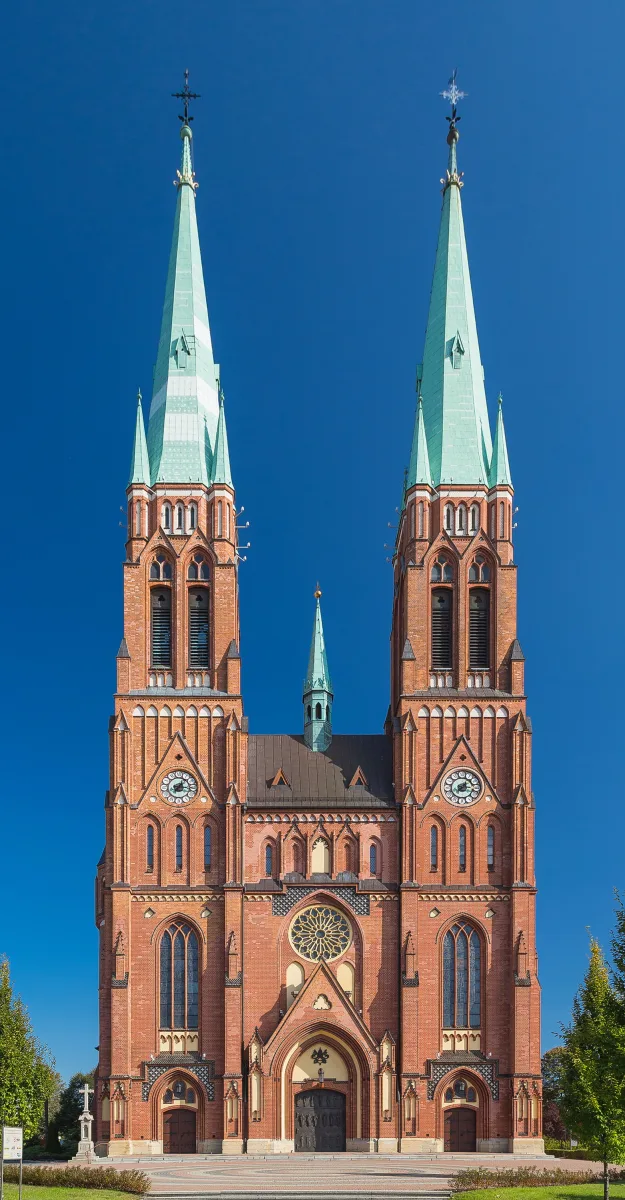
A neo-Gothic brick basilica built in 1903-1906, with towers 95 m high, the tallest church in Upper Silesia.
The Basilica of St Anthony of Padua in Rybnik is a neo-Gothic brick church built in 1903-1906. Its towers reach 95 metres, which makes it one of the tallest churches in Upper Silesia. It is informally called the Cathedral of the Rybnik Land, and in 1993 Pope John Paul II granted it the title of minor basilica.
The decision to build was taken on 20 April 1903, and work began on 14 September of the same year. The design was prepared by Ludwig Schneider, a government architect from Opole. The foundation stone was laid on 13 June 1904, on the feast of St Anthony, and construction work was completed in November 1905. High-quality brick was supplied by a brickworks in Wielopole. The police permit for use was issued on 21 January 1907, and the church was blessed in 1907. It was consecrated on 29 September 1915.
The construction changed the layout of the area. A newly laid out street, today Kościuszki Street, linked the church with the railway station, and empty plots along it began to be built up. Before the street was created, the figure of St Anthony, patron of the Rybnik Land, stood in a chapel at the junction of Mikołowska and Żorska streets.
The church suffered damage several times. On 22 June 1921 an explosion of eight tonnes of explosives at the railway station damaged the walls, and one of the towers tilted. In 1945 the war damage was so great that the church was initially slated for demolition. On 14 October 1959 the north tower burned down, and the organ, vaults and liturgical furnishings were damaged. In spring 1960 the steel structure of the tower was painted and clad in copper sheet.
In 1991 the church was entered in the heritage register, on the grounds of its outstanding architectural and urban qualities on the scale of the town and the region. In June 1993 John Paul II made it a minor basilica, one of several in Upper Silesia alongside Piekary Śląskie, Panewniki and Pszów. In front of the entrance stands a monument to John Paul II unveiled in 2005.
The high altar was made by C. Buhl of Wrocław in 1907. In its centre stands a folk-Baroque figure of St Anthony from the 16th or 17th century, probably from the former parish church on Gliwicka Street. The richly carved pulpit dates from 1911, while the bishop’s throne and the Stations of the Cross, from 1908, were brought from Oberammergau in Bavaria. The furnishings are completed by four neo-Gothic confessionals. The chancel windows are filled with stained glass from the turn of 1999 and 2000, with a total area of about 300 m², showing scenes from the life of the patron saint.
The organ was built in 1960-1965 by the Biernacki firm of Kraków. In 2009 it was damaged by lightning, and it was brought back into use in 2012. Organ concerts are held in the basilica.
The largest is the “Divine Mercy” bell weighing 3.5 tonnes, cast at the Grassmayr bell foundry near Innsbruck and installed in the south tower in November 2007. It rings every Friday and on Christmas Eve. In the north tower hang five smaller bells from 2000, and the whole set also includes 15 carillon bells playing the melody of the hymn “Antoni, patronie ty nasz”.
In Rybnik you will find the Museum in Rybnik.
A reminder of the mining past of the region is the Ignacy Historic Mine.

Be the first! Add a comment.
You need to log in to add a comment.
Log in