
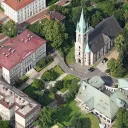
A historic complex around Marcin Luther Square, where the Protestant community of Bielsko gathered from 1782: a church, schools, a cemetery and a monument to Luther.
Bielski Syjon (the Bielsko Zion) is a historic area of Bielsko-Biała on the border of the former Lower and Upper Suburb, where from the end of the 18th century the buildings of the Protestant community clustered. Its centre is Marcin Luther Square. The complex is entered in the heritage register.
The beginnings of the district are linked with the Patent of Toleration of Emperor Joseph II of October 1781, which gave Lutherans freedom of religious practice and the right to build churches. A Protestant congregation was formed in Bielsko as early as January 1782. During the first service, on 19 March 1782, the superintendent Jan Traugott Bartelmus used the expression “Bielsko Zion”, which stuck to this part of the town. First, in 1782-1783, a school was built, and in 1787 construction began on a masonry church, which three years later replaced the wooden structure.
The Church of the Saviour, built in 1787-1790, was rebuilt in 1849-1852, in 1881 (to a design by the Viennese architect Heinrich von Ferstel) and in 1895-1896, when the Neo-Gothic tower was raised. Next to it stand the building of the former Protestant Teachers' Seminary from 1863-1866, the Alumneum boarding house from 1870 and the former girls' school from 1897. Today they house schools, a secondary school and a university. The former deaconesses' house is occupied by the prosecutor's office, and the former orphanage is a care home.
In 1900 the monument to Martin Luther by Franz Vogl was unveiled. It was one of two monuments to the reformer in the Austro-Hungarian monarchy, the other stood in Aš in Bohemia. By the church there is also the Monument of Gratitude and Love, a fragment of the tomb of Pastor Georg Nowak from 1818, moved here in 1916, and the Pastors' Well from 1934, commemorating the distinguished pastors of Bielsko. In 1833 a site was marked out here for a Protestant cemetery, which was used until 1911.

Be the first! Add a comment.
You need to log in to add a comment.
Log in