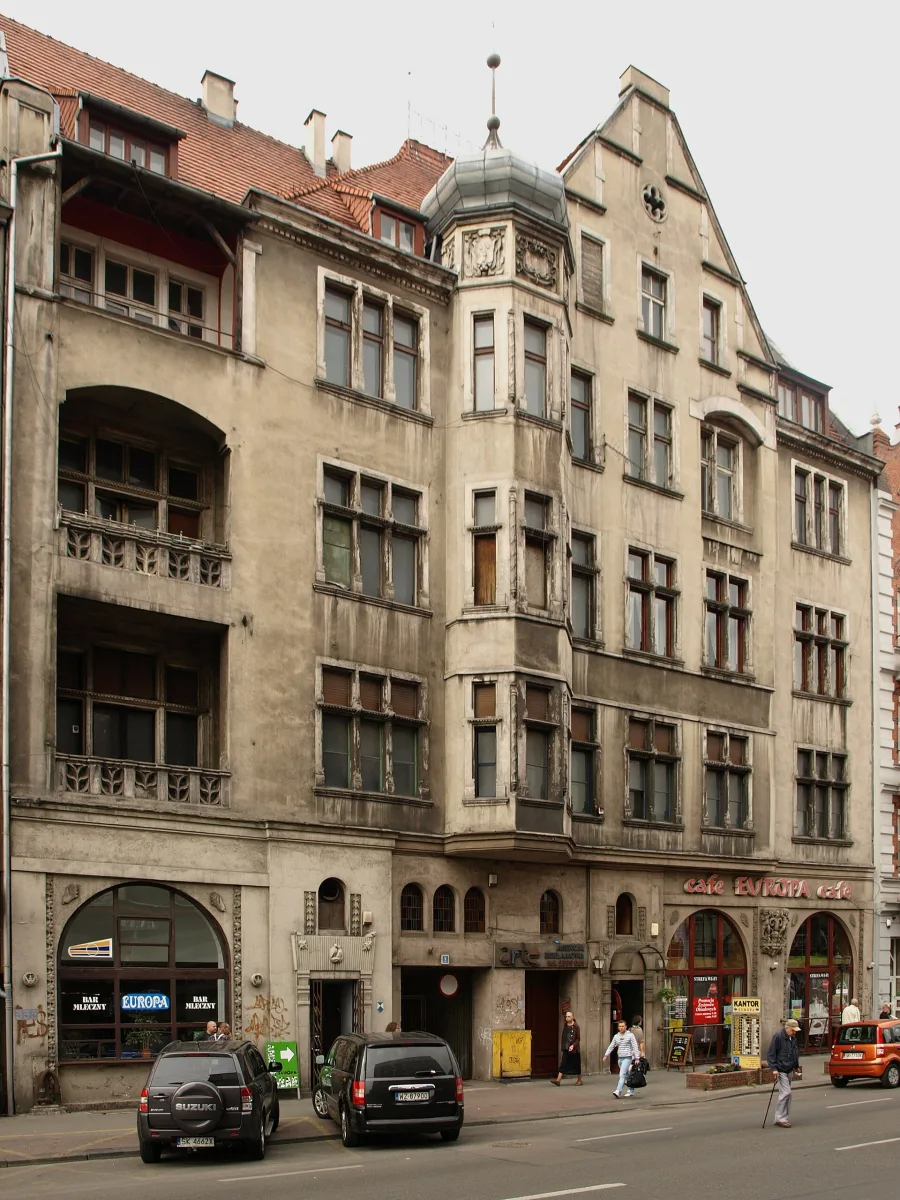
Tenement from 1900 in the centre of Katowice, in which restaurants and the “Wojko” café operated for decades.
The tenement at ul. Mickiewicza 8 in the centre of Katowice was built in 1900 and still recalls the eating places that succeeded one another in it over the decades. From 1935 a restaurant operated here, and later the “Wojko” café, and one of the outbuildings may once have served as a house of prayer.
The tenement was erected in the historicist style with Art Nouveau elements. The first owner and the originator of the design was the building contractor Isidor Riesenfeld, who in 1899 bought the plot of a former garden. According to one publication the design was by the building company Perl and Trapp. Construction took a year.
It is a large, wealthy rental house: the five-storey front building is connected with outbuildings around a courtyard, to which a gate leads from the street. The façade is 27 metres wide, and the ground floor was originally marked out by six bays with wide shop windows. The tenement has been entered in the heritage register since 1983.
The western part of the ground floor served catering from the start. First there was the “Tucherhaus” restaurant with Nuremberg beers, and around 1920 the “Atlantik” café and confectioner's, for which the façade and interior were rebuilt. From 1940 the “Femina” café operated, and from 1945 the “Cafe Club”.
The restaurant with a billiard room on the first floor received the name “Wojko” in 1935. The restaurant and café were closed in the 1970s. In the eastern part of the ground floor there were successively a billiard room, a wine shop and other premises. Today a milk bar and a café operate in the tenement.
On the first floor of the western outbuilding there was most probably a house of prayer, attested in the address book of 1905. The larger Great Synagogue stood on the same street and was too big for everyday use, so a smaller one nearby was needed. Researchers explain the layout of the building, which departs from typical pattern books, precisely by the designer's Jewish faith and by the inclusion of a prayer hall.
About two hundred metres further on stands the Stanisław Wyspiański Silesian Theatre. Not far away is also the Rialto Cinema-Theatre, and at a distance of about eight hundred metres the Museum of Katowice History.

Be the first! Add a comment.
You need to log in to add a comment.
Log in