
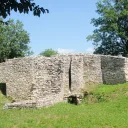
The ruins of a medieval castle of the bishops of Kraków from the end of the 13th century, with a tower and surviving fragments of walls.
The ruins of the castle of the bishops of Kraków in Sławków, entered in the heritage register. The fortress from the second half of the 13th century was built by the curia of the bishops of Kraków, and today mainly fragments of the walls and the tower survive.
Construction began before 1283 on the initiative of Bishop Paweł of Przemankowo. In 1283 work was interrupted, because Duke Leszek the Black imprisoned the bishop and seized his property; after a settlement in 1284 it was resumed on a limited scale. The first surviving mention of the castle dates from 1289, when a Silesian duke imprisoned the bishop and occupied the fortress. At the beginning of the 14th century, under Bishop Jan Muskata, an earth rampart, a gatehouse, a moat, reinforcements of the tower and a secret passage were added. In 1327 the castle was occupied by Bohemian and then Hungarian troops. In 1455 the castle and the town were destroyed by Polish-Moravian troops; the rebuilding is probably attributed to Bishop Zbigniew Oleśnicki, and the tower then received a late Gothic roof.
The castle measured 124 by 90 metres, with walls 2-3 metres thick and 6-7 metres high, reinforced with rectangular half-towers. A residential and defensive tower was formed from the south-east half-tower. The walls were made of dolomite and limestone, and the use of white and red sandstone from Parcze Hill in Olkusz gave a multicoloured effect. The portals had late Romanesque features. The complex also preserves a bishop's manor from the 16th-17th centuries, described as a lamus (a small manor storehouse), which is in private hands. Archaeological research revealed 15th-century military items, objects connected with horse riding and 16th-century stove tiles, and in 2016 a tunnel under the castle of unknown length and purpose was discovered.
In the centre of Sławków, a few hundred metres from the ruins, stand the Church of the Exaltation of the Cross and St Nicholas, the Regional Museum and the town hall.

Be the first! Add a comment.
You need to log in to add a comment.
Log in