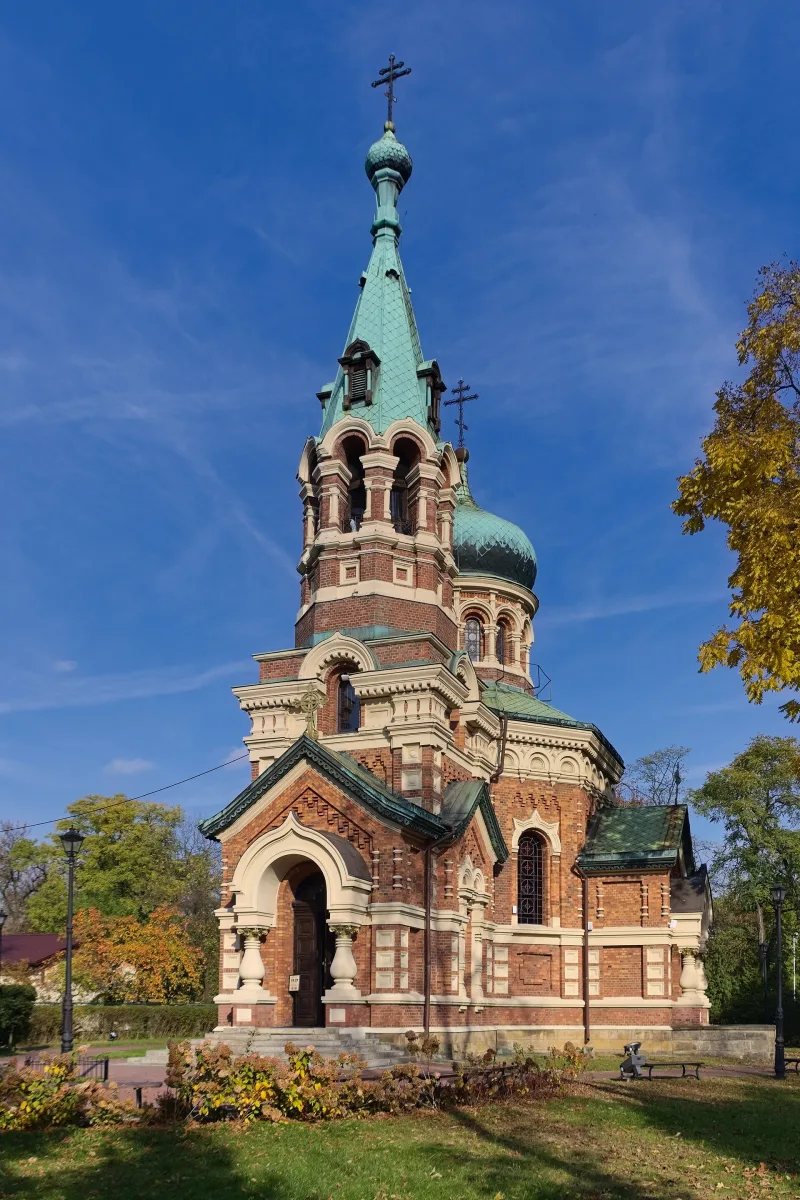
Brick Orthodox church from 1889, the only one surviving of the three Orthodox churches of former Sosnowiec.
The Orthodox Church of Sts Faith, Hope, Love and their Mother Sophia on ulica Kilińskiego in Sosnowiec is the only one of the three former Orthodox churches of Sosnowiec to survive to this day. It was built of brick and stone in 1889.
The idea of building it appeared in 1887, and a collection was made among Sosnowiec and Łódź industrialists. Donors included the brothers Ernst and Franz Schön, Heinrich Dietel and Konrad Gamper, mostly Lutherans or followers of Judaism, who cared about good relations with the Russian authorities. The founders also included the Jewish industrialists Landau, Lowenstein and Meyerhold.
The plot was donated free of charge by the Warsaw-Vienna Railway, and the design was prepared by Prokofiev of Piotrków. The foundation stone was laid on 15 August 1888, and the church was consecrated on 28 November 1889 by Bishop Flavian of Lublin. Its patron saints are Faith, Hope and Love, the daughters of St Sophia. According to the parish, the church stands out of the way, between the railway tracks, and this may have spared it the fate of the town's other two churches. The Church of St Nicholas was pulled down in 1938.
The church has five parts, and at its centre stands an octagon supporting the tower on one side and the chancel on the other. The whole is crowned with an onion-shaped spire, and the dome above the centre is visible only from inside.
The entrance is formed by an ogee-shaped pediment resting on two pear-shaped columns. The interior is light and neoclassical, which distinguishes it from the exterior form. The oak iconostasis, measuring 4.7 by 7 metres, was made by the Moscow artist Klavdiy Lebedev and funded by the Schön brothers. The Częstochowa Icon of the Mother of God in a case to the left of the altar is a gift from railway workers of Częstochowa. Since 2017 the church has also housed an icon of the patron saints, painted on Mount Athos, with relics of the saints brought from Rome in the 1980s.
The monument was entered in the register in 1980, and the register describes its style as eclectic. Today it is a parish church of the Polish Autocephalous Orthodox Church. The parish covers the southern part of the voivodeship, including the Katowice agglomeration, Bielsko-Biała and Rybnik, and services are held in Polish, Ukrainian, Russian and English.
From the church it is about 4 km to the Rolling Mill - Museum of Zinc Metallurgy and about 5 km to Będzin Castle.

Be the first! Add a comment.
You need to log in to add a comment.
Log in