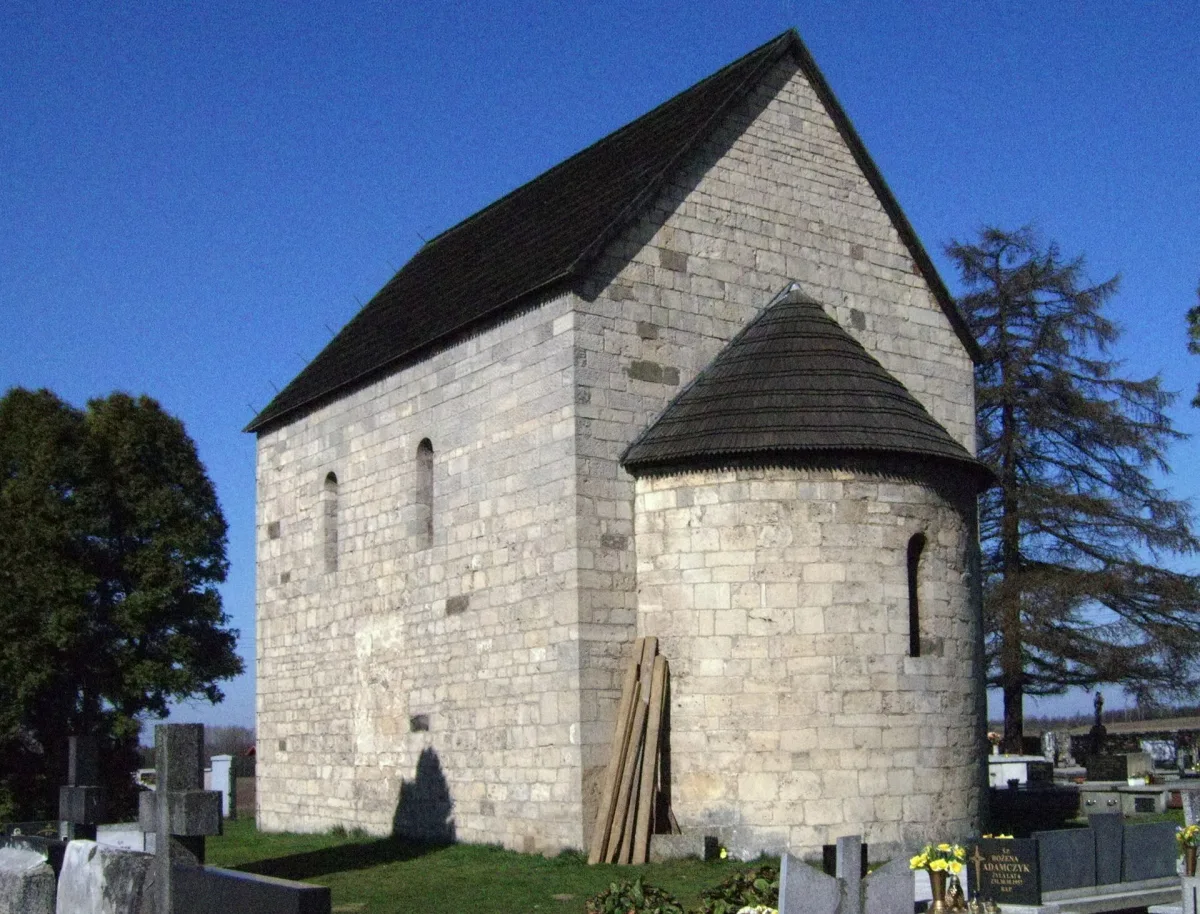
A Romanesque stone church from the 12th century, now a cemetery chapel, with fragments of medieval polychromy in the apse.
The Church of St John the Baptist is a Romanesque stone building beside which a cemetery now lies. It is among the oldest surviving churches in Poland, and its narrow, loophole-like windows are a reminder that it also had a defensive function.
Most sources date the church to about 1144, though 1164 is also given, and the founder was Piotr Włostowic. Around the church there originally stood the wooden Siewierz stronghold, which after the Mongol raids was moved to the area of today's bishops' castle. In 1233 a synod of Polish bishops was held here. Until the 15th century the church was a parish church, later a branch church, and today it serves as a cemetery chapel.
The church was built of ashlar stone, mainly sandstone, and its dimensions are 6 by 9 metres, with a height of 13.2 metres from the floor to the ridge of the roof. The entrance leads through a stepped portal closed with a semicircle. The windows are about 15 centimetres wide and 145 centimetres high, and a single small door suggests that the inhabitants of the stronghold could take refuge here from a raid. In the semicircular apse fragments of Romanesque polychromy from the 12th century have survived, including a depiction of Maiestas Domini and figures of saints, and traces of paintings can also be seen on the outer north wall. On the west wall remains of a gallery have survived.
At an unknown time a fire broke out, the vault collapsed and the walls suffered. The building stood in this state until 1639, when an unknown donor drew the roof together with iron hoops, strengthened the walls with buttresses, replaced the vault with a flat ceiling and added a porch. In the 1950s a rebuilding was carried out that restored the church's original appearance: the buttresses were removed, the roof was covered with shingles and the former character of the vault was recreated. In 1993 the covering was replaced with double shingles.
The cemetery around the church was moved here from the parish church in the 19th century for reasons of hygiene, and it has historic gravestones. It is less than two kilometres from here to the centre of Siewierz. It is worth combining the visit with the Bishops' Castle in Siewierz and the Church of St Matthias the Apostle, which is the parish church today.

Be the first! Add a comment.
You need to log in to add a comment.
Log in