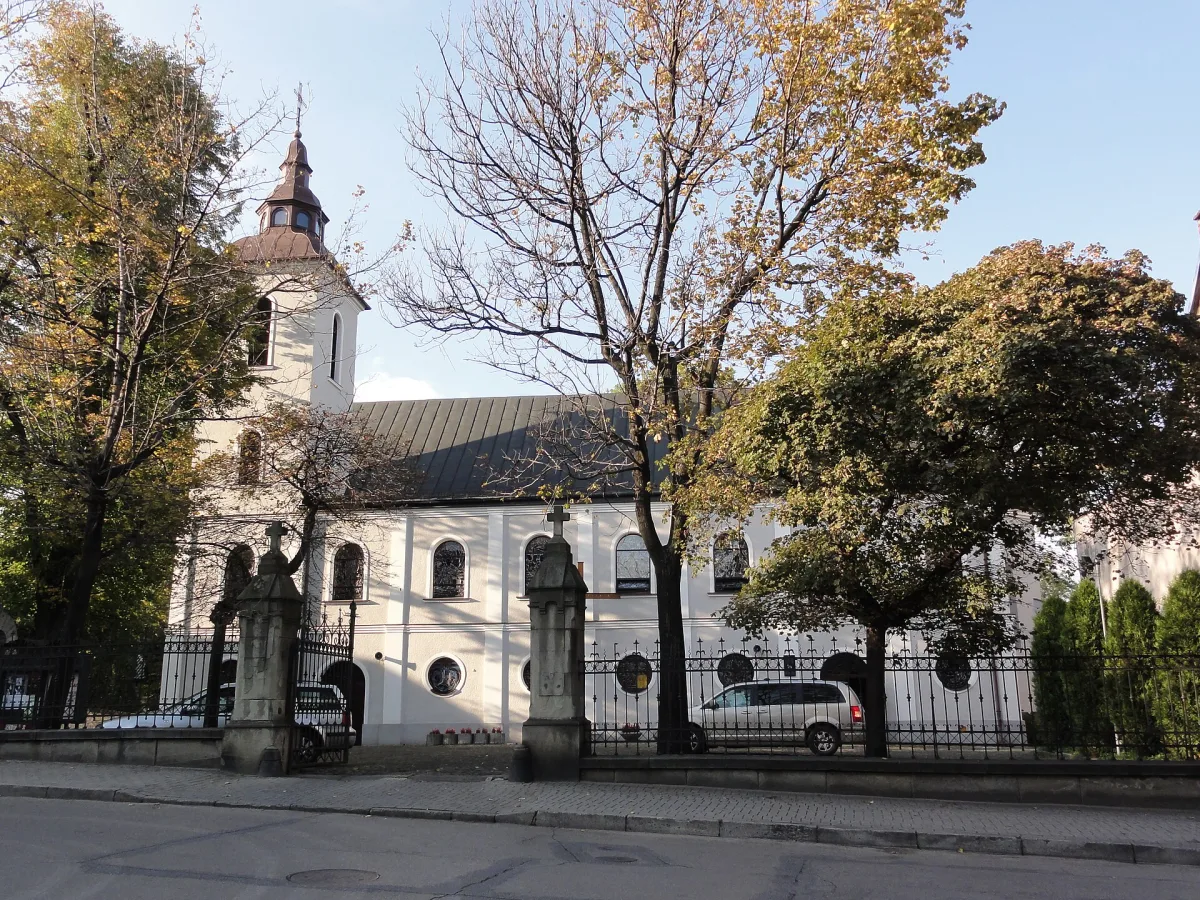
A late Gothic church from 1604-1608 in the Górne Przedmieście district, built to commemorate the victims of the plague, a garrison church until 2014.
The Church of the Holy Trinity stands in the Górne Przedmieście district of Bielsko-Biała, on Sobieskiego Street. Built in 1604-1608 in the late Gothic style, it was the first entirely new Protestant church in the town. It is entered in the heritage register.
The church was built by the master mason Szymon Georg to commemorate the victims of the plague epidemic of 1599, which decimated the inhabitants. It stood in the Protestant cemetery founded in 1550 and was consecrated in 1608 as a cemetery church. In the period of the Counter-Reformation it was the last Protestant church in Bielsko. In 1654 it was taken over by Catholics, from then on as a branch of the parish of St Nicholas.
The church burned down in 1659 and was rebuilt only in 1775. Another fire in 1808 meant that after rebuilding it served as a salt store. In 1826-1831 a side aisle and a tower were added, and in 1883 the church became a school church. The cemetery was closed in 1896 and turned into a churchyard and garden. In 1928 the Bielsko firm of R. Juttner and F. Bolek began a six-year rebuilding: the main nave was extended to the west and a portal and a side gallery were added, and in 1934 the tower was moved from the middle to the end of the church. From 1928 the church served as a garrison church, until 2014, and the parish of the Most Holy Trinity was established in 1958.
Because of numerous alterations the church has distorted stylistic features: late Gothic in the buttresses and chancel and Baroque in the naves. The interior is post-conciliar, and of the former furnishings a 19th-century high altar with a bas-relief of the Holy Trinity has survived. The more valuable movable monuments include a painting of St Anthony and a crucifix from the 18th century, an organ from 1883 and a neo-Gothic sculpture of the Madonna and Child from 1929. In the chancel a Gothic portal to the sacristy and a first-floor gallery with a balustrade have been preserved.
Plaques have been set into the nave walls, including one with an image of John III Sobieski from 1933 and one dedicated to the soldiers of the 21st Mountain Infantry Division who fell in 1939 and their commander, General Józef Kustroń.
Right next door, about 200 metres away, rises the Cathedral of St Nicholas in Bielsko-Biała.
Not far away are also the Władysław Reymont Museum of Literature and the Polish Theatre in Bielsko-Biała.

Be the first! Add a comment.
You need to log in to add a comment.
Log in