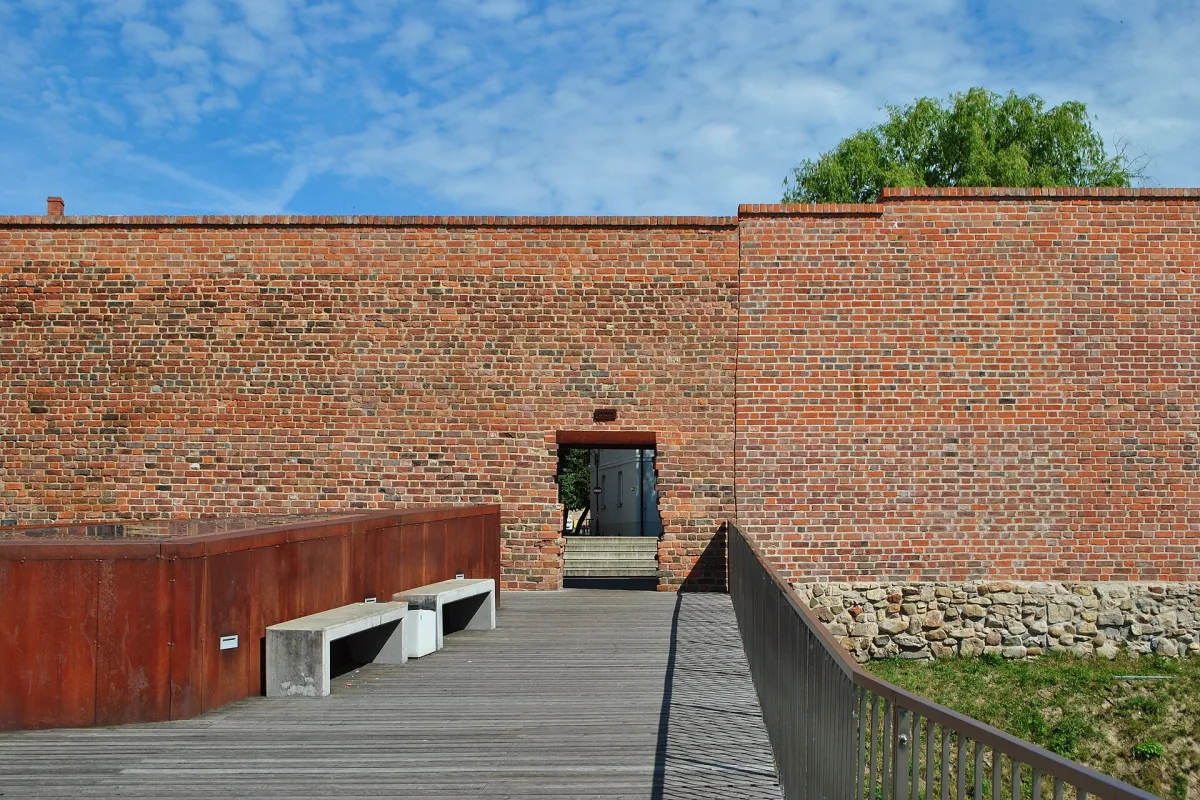
Brick town walls from the 13th and 14th centuries, among the oldest in Silesia, preserved in fragments along ul. Ogrodowa and ul. Męczenników Oświęcimskich.
The town walls in Żory are medieval fortifications, fragments of which have survived along ul. Ogrodowa and ul. Męczenników Oświęcimskich. The Gothic brick walls date from the 13th and 14th centuries and are among the oldest in Silesia. They are entered in the heritage register.
Żory received its town charter in February 1272 from Duke Władysław. Construction of the walls probably began as early as the 13th century. Research in 1968-1972 confirmed that they were built from the last quarter of the 13th century to the mid-14th century and were probably completed before 1345.
The walls fulfilled their purpose: in 1345 they defended the town against the troops of Casimir the Great, and they also survived the siege during the Hussite Wars in 1443 and the fighting for the Bohemian crown in 1473. Fires in 1789 and 1807 contributed to the destruction of the walls, and bricks from the demolition were used to rebuild burned houses. In 1824 the authorities banned demolition, which saved about 40 per cent of the structure.
The medieval town had an oval layout with a market square in the middle, surrounded by a wall and a moat. The moat was about 20 metres wide and about 5 metres deep. There were two gates in the walls: the Kraków Gate and the Cieszyn Gate (also called the Racibórz Gate). The northern section is older and made of “finger” brick (palcówka), while the southern part was built in the mid-14th century as a solid brick wall on a stone foundation. In the southern part the joint between fragments built from two sides can be seen.
The remains of the Cieszyn Gate were discovered in 1972 on ul. Górne Przedmieście. The foundations of the Kraków Gate were found by chance during the demolition of a building on ul. Szeroka. On the Dolne Przedmieście roundabout stands a brick sculpture commemorating this gate, with the town's coat of arms.
The fragments of the walls lie close to the Old Town, near the Church of St Philip and St James, the synagogue and the Municipal Museum.

Be the first! Add a comment.
You need to log in to add a comment.
Log in