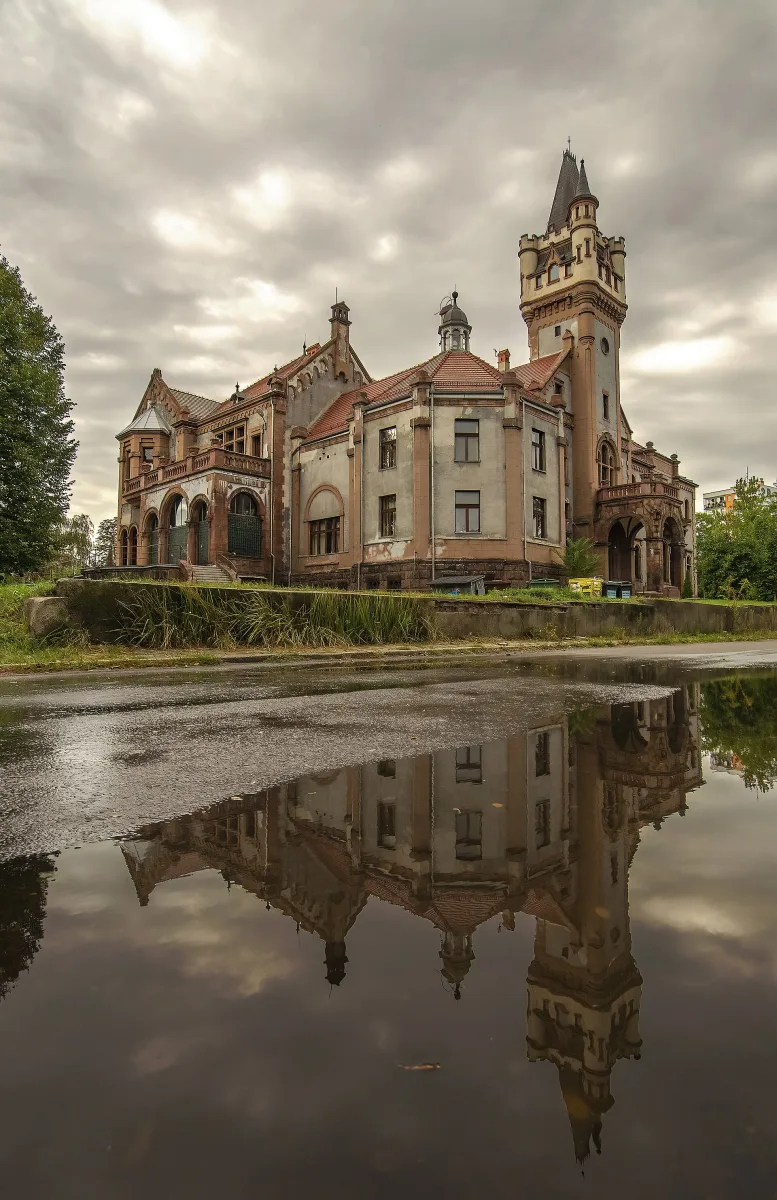
An eclectic palace of the industrialist Franz Schön from the early 20th century, in 1919 the command headquarters of the Silesian uprising, today a district court.
The Franz Schön Palace stands at 1 Maja 19 in Sosnowiec and has served the justice system since the 1920s. It was built as the residence of a wool industrialist, and in 1919 it housed the command headquarters of the Silesian uprising.
The palace was built by Franz Schön, a wool entrepreneur who in 1879 founded a vicuña wool factory on this site. Construction took place in 1900-1903, and the industrialist lived in it with his family. The heritage register gives a different dating for the complex, 1870-1880, while at the same time indicating 1903 as the completion of the palace.
The palace is an example of eclectic architecture. It is dominated by elements of Neo-Gothic in its English variety, alongside which appear Neo-Romanesque, Neo-Renaissance, Neo-Baroque and Art Nouveau features. The heritage register describes the body as irregular, with many projections, oriels and balconies and with various roof forms.
The two-storey building with a cellar is built of brick, with corners reinforced with stone. Inside, carved wooden panelling and ornamental stucco have survived.
In 1919, during the Silesian uprising, the palace housed the command of the uprising. The heritage register adds that in 1921 the headquarters of the plebiscite defence was based here. During the German occupation the building was called Deutsches Haus, and after 1945 it returned to its judicial function. Today it houses the district court.
The building has passed into the ownership of the city, which plans to set up a second seat of the Museum in Sosnowiec in it. The palace was entered in the heritage register in 1988.
It is about 600 metres from here to the Cathedral Basilica, and the Scout Park is just as close.



Be the first! Add a comment.
You need to log in to add a comment.
Log in