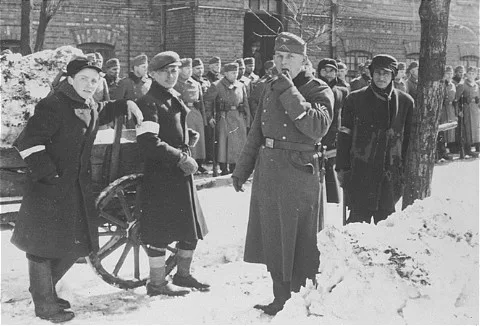
A Jewish ghetto created on 9 April 1941 in Częstochowa, liquidated in September and October 1942, with a small ghetto until June 1943.
The ghetto in Częstochowa was created on 9 April 1941 under a regulation issued two days earlier by the Stadthauptmann Richard Wendler. It covered the eastern part of the city centre, largely coinciding with the prewar Jewish district.
The boundaries were: to the north the streets Kawia, Kiedrzyńska and Jaskrowska, to the south Fabryczna (today Mielczarskiego), Narutowicza (today Krakowska) and Strażacka, to the east the River Warta, and to the west the railway tracks. All Jews living outside this area were to move here by 17 April 1941.
Those who lived here were Jews from Częstochowa and nearby localities, including Krzepice, Olsztyn, Mstów, Janów and Przyrów, as well as people expelled from areas incorporated into the Reich, mainly from Płock and Łódź. The numbers are uncertain: nearly 40,000 people lived here at first and 48,000 at the peak, before the liquidation. The World Society of Częstochowa Jews states that in the summer preceding the liquidation this number exceeded 50,000.
The inhabitants worked in, among other places, the armaments industry, mainly in the building at ul. Krótka 16, the former Metalurgia factory.
The liquidation began on 22 September 1942, the day after the festival of Yom Kippur, and lasted until the night of 7 to 8 October. The place of concentration and selection was plac Daszyńskiego. About 40,000 people were deported to the Treblinka extermination camp, and 2,000 people were shot on the spot and buried in burial pits on ul. Kawia. A study on the website of the World Society of Częstochowa Jews describes the first selection on 22 September, in which more than 7,000 people were condemned to death and about 350 were left because they were useful to the armaments industry.
The survivors, about 5,000-6,000 people, were placed in the small ghetto, bounded by the streets Jaskrowska, Mostowa, Senatorska and Nadrzeczna. Its inhabitants worked in the factories of the Hasag concern and in craft workshops. A strong underground operated in the small ghetto, led by Dr Adam Wolberg and Mordechai Zylberberg.
On 4 January 1943 a roundup was carried out and 25 people were shot in the Warsaw Market Square, today plac Bohaterów Getta (Ghetto Heroes Square). On 20 March 1943, 127 people were gathered there, taken to the Jewish cemetery and executed. On 25 June 1943, when the Germans launched a decisive assault on the shelters on ul. Nadrzeczna, the inhabitants offered self-defence, also called the Częstochowa ghetto uprising. At the end of June 1943 the small ghetto ceased to exist.
The remaining 3,900 people were placed in the Hasag factories in Częstochowa. On 20 July 1943, after a selection, 400 people were murdered at the Jewish cemetery. In the last months of the war the number of prisoners rose to 10,000 as a result of people being brought from the Łódź ghetto and from labour camps in the Kielce and Radom lands. The camps were liberated on 17 January 1945, and 5,200 people survived them, including 1,518 from Częstochowa. In 1966 in West Germany the trial ended of the police captain Paul Degenhardt, who was sentenced to life imprisonment for multiple murders in the ghetto.
In October 2009 a monument to the victims of the ghetto, designed by Samuel Willenberg, was unveiled on ul. Strażacka. The victims are also commemorated at the Jewish cemetery in Częstochowa and on one of the stones of the monument to the Victims of the Treblinka Extermination Camp.

Be the first! Add a comment.
You need to log in to add a comment.
Log in