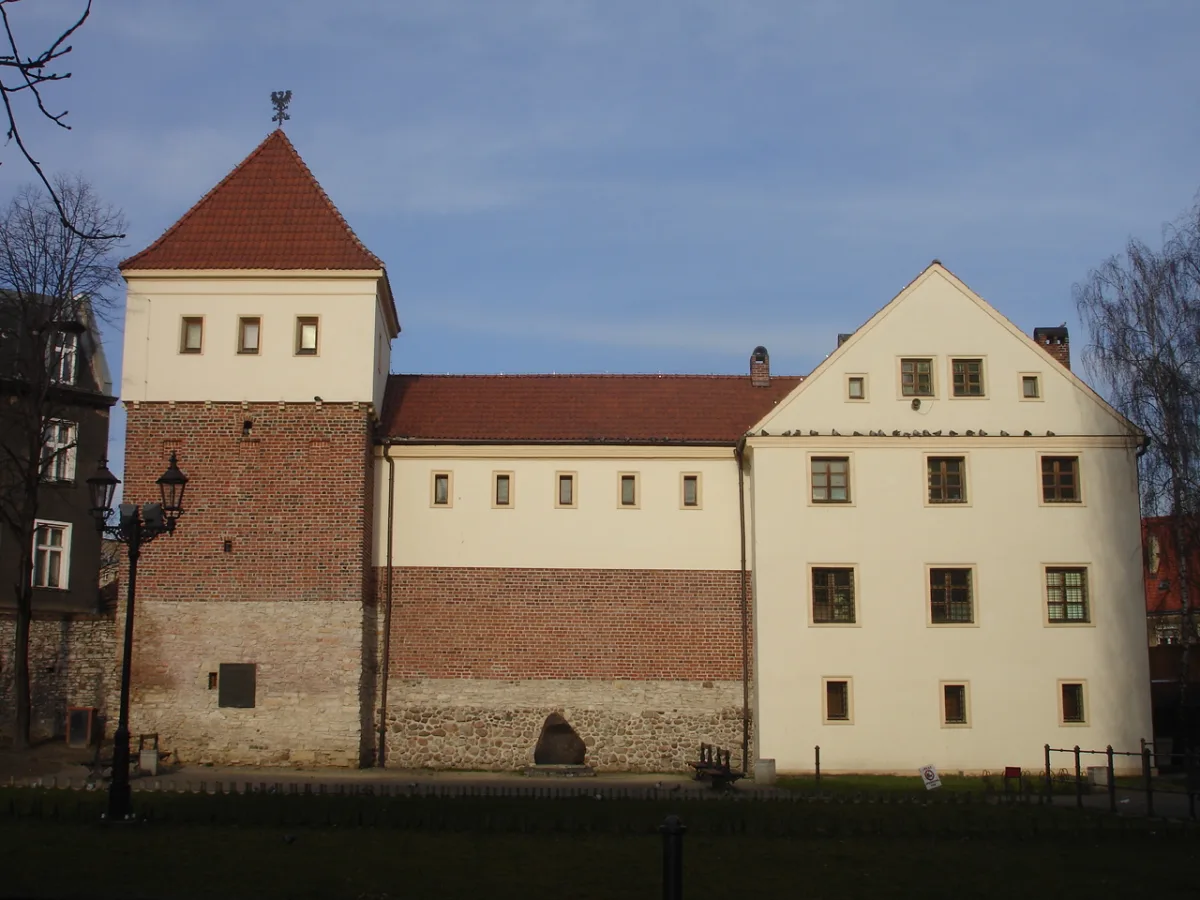
A 14th-century brick building in the centre of Gliwice, since 1960 a branch of the Gliwice Museum with an exhibition on the history of the town and its surroundings.
The Gliwice Piast Castle (Zamek Piastowski) is a brick building from the mid-14th century on Pod Murami Street, within the line of the former town walls. Today it is a branch of the Gliwice Museum with an exhibition on the history of the Gliwice land. Despite its name, it was never a ducal castle, and its original purpose remains uncertain.
The castle was built in the mid-14th century as two square towers joined by a wall and a wooden gallery, built into the town's defensive walls. They probably served as the town arsenal. In 1558-1561 the town's leaseholder Fryderyk von Cetrycz joined the towers with a two-storey brick building. From the 16th century until 1945 the building was called the Cetrycz Court (Zettritz Hof).
In the following centuries the building served as an arsenal, a prison, a farmstead and a warehouse. The prison operated from the early 16th century until the end of the second decade of the 20th century. In the second half of the 18th century the walls were lowered to about 7 m and the western tower was completely rebuilt, after which the building was used for residential purposes, and in the mid-19th century an east wing was added, where the main entrance is today.
After 1945 the name Zameczek (Little Castle) was used, and in 1983 the building was named the Piast Castle. The conversion for museum purposes was carried out in 1952-1959, and the permanent exhibitions were opened in 1960. Further renovations took place in 1984-1988 and 2005-2008, and after the last one the building was reopened to the public on 21 September 2008. The castle is entered in the heritage register, and the first entry dates from 1956.
The permanent exhibition is titled “Gliwice - a City of Many Cultures” and covers the prehistory of the Gliwice land and the history of the town. The castle is the seat of the archaeology and history departments.
The archaeological collections consist mainly of vessels, tools and ornaments from the Lusatian culture cemetery in Świbie, as well as medieval finds from the Old Town in Gliwice, from the castle hill in Toszek and from the hillfort in Pławniowice. The historical collections include guild mementoes from the 17th and 18th centuries, mementoes from the period of the Silesian Uprisings and the plebiscite, a collection of photographs from the 19th and 20th centuries, and militaria, among them armour and samurai swords.
According to the museum, the real ducal castle probably stood elsewhere, in the area of the presbytery of All Saints' Church and the Racibórz Gate. According to the museum, it was most likely built under Duke Siemowit, who ruled in Gliwice from about 1337. In 1430-1431 the castle was the seat of the Hussite leader Zygmunt Korybutowicz, and after the town was taken by Catholic troops it was most likely destroyed.
On the square by the castle a monument to Stephen Báthory (Stefan Batory) was unveiled in 2014, a gift to Gliwice from the Hungarian town of Salgótarján.

Be the first! Add a comment.
You need to log in to add a comment.
Log in