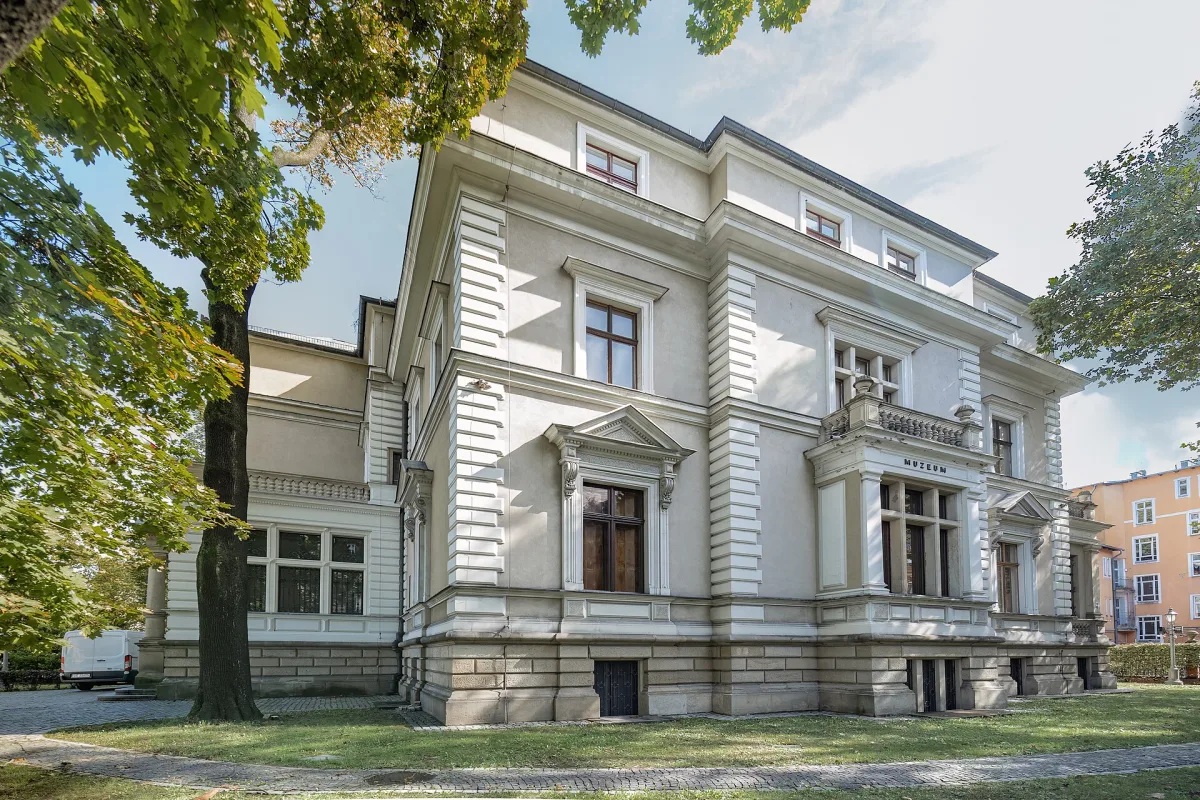
The neo-Renaissance residence of Oscar Caro from 1882-1885 in Gliwice, since 1934 the seat of the Gliwice Museum.
Villa Caro (Willa Caro) is the neo-Renaissance residence of the industrialist Oscar Caro at ul. Dolnych Wałów 8a in the centre of Gliwice, built in 1882-1885. Since 1934 it has housed a museum, and today it is the main building of the Gliwice Museum. The interiors have largely kept their original decoration, and the permanent exhibition shows the 19th-century homes of Upper Silesian industrialists.
Oscar Caro was born in Wrocław in 1852 and inherited the family's Upper Silesian businesses: the Hermina ironworks in Łabędy near Gliwice, the Wire Factory in Gliwice and the Julia ironworks in Bobrek. In 1887 the works were merged with the firms of another Gliwice industrialist into one joint-stock company, in which Caro was general director until 1905. He settled in Gliwice around 1882 and in the same year bought a plot from his brother-in-law Heinrich Kern.
The first design for the residence was probably produced in 1884 by the Berlin architectural firm Ihne & Stegmüller. The final version is simpler, and its author is not known, but the probable designer is considered to be the Gliwice master builder Salomon Lubowski, Oscar's father-in-law. The result was a single-storey building in a form close to a 19th-century vision of Italian villa architecture, with a harmonious, balanced silhouette. The date 1885 was discovered in the stucco above the inner portal in the entrance stairwell. The villa was surrounded by an extensive, eclectic garden with irregular paths and a pond, and on its edges stood farm buildings, a stable and a coach house.
Caro lived in the villa until 1909, when he moved to the Paulinum palace in Jelenia Góra, but he remained the owner until 1916. From 1924 the building housed the seat of an industrial and construction company. A second floor was then added, the building was given a new roof and the interiors were partly rebuilt. In 1929 the owner was Count Nicolaus von Ballestrem of Pławniowice. In 1934 the town took over the villa as the seat of the Oberschlesisches Museum, and in 1945 it was taken over by the Gliwice Museum. A major renovation was carried out in 1991-2000, and the garden today is surrounded by a faithful reconstruction of the former stone and metal fence.
According to the museum's website, the interiors have preserved richly decorated ceilings, wall panelling, parquet floors and door and window joinery. Two departments are based in the villa: art and artistic crafts, and ethnography. The collections include, among other things, art glass from the 17th to 20th centuries, the largest collection of Polish silver jewellery in post-war Poland, and porcelain, faience and stoneware from manufactories such as Meissen, Vienna, Sèvres, Wedgwood and Ćmielów.
A separate collection is Polish art photography, including works by Zofia Rydet and Jerzy Lewczyński, associated with the Gliwice photographic community. The ethnographic collections, that is wood carving, painting on glass, costumes and tools from the 18th and 19th centuries, are currently shown in a permanent exhibition at the Gliwice Piast Castle. The villa also hosts temporary exhibitions, concerts, meetings and workshops.
In front of the building stands a sculpture of a recumbent lion on a plinth, and nearby grows a natural monument, a London plane tree. Its age is estimated at about 100 years.
In the area lies Fryderyk Chopin Park, about 600 m from the villa.

Be the first! Add a comment.
You need to log in to add a comment.
Log in