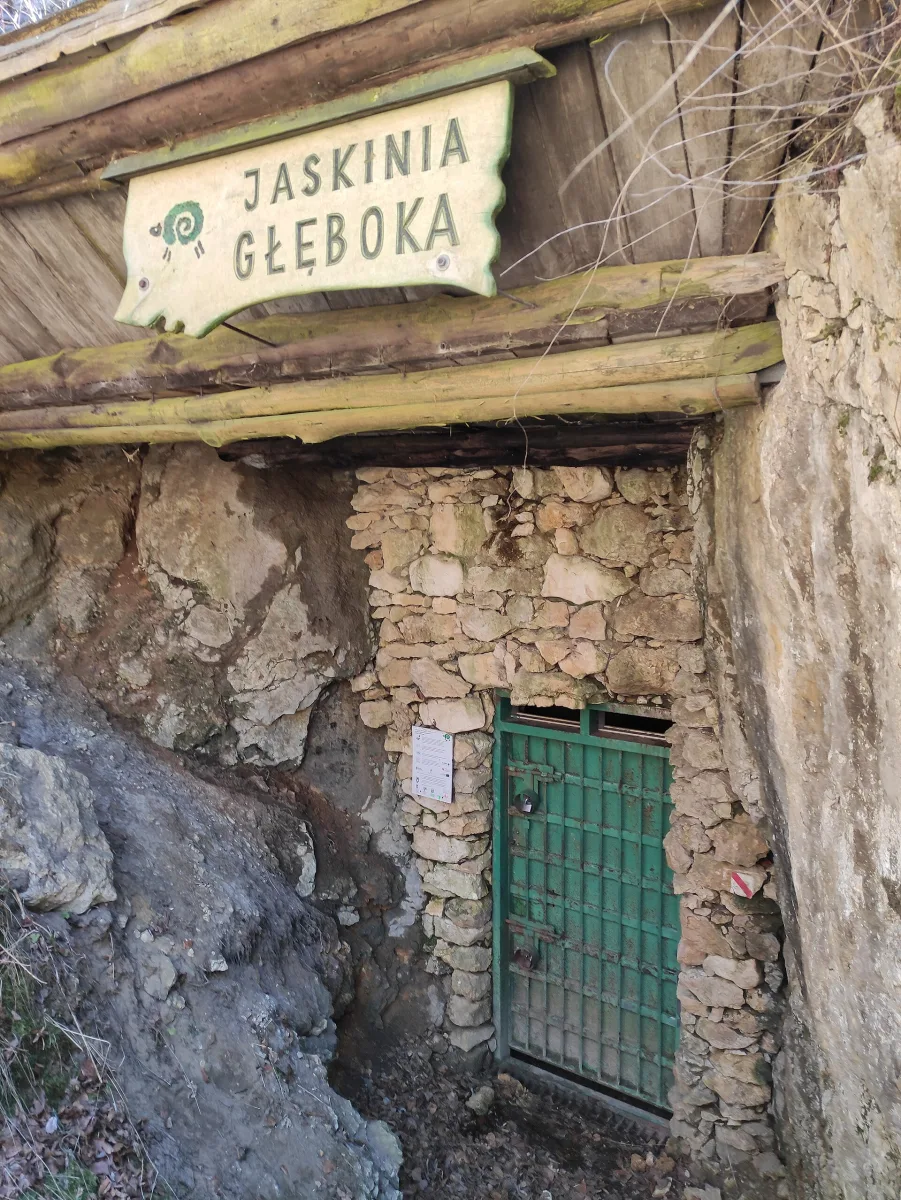
The only cave in the northern Jura open to visitors, 190 m long, in the Góra Zborów nature reserve.
Głęboka Cave is the only cave in the northern part of the Kraków-Częstochowa Upland open to visitors. It lies in the western part of Góra Zborów, in rocks called the Raven Rocks (Krucze Skały), about a kilometre west of Podlesice. It is visited with a guide, along an illuminated underground route.
According to the Jura Natural and Cultural Heritage Centre, the cave is 190 m long, and the difference in level between its extreme points is 22.4 m. Other sources give smaller values: 170 m in length and 12.5 m in depth. It is the largest known underground karst form in the Góra Zborów nature reserve. The entrance leads through the so-called Spar-Miners' Funnel (Lej Szpatowców), a former pit above which rise the limestone Raven Rocks and the Double Bastion (Dwoista Baszta).
The first documentation of the cave was made in 1948 by Kazimierz Kowalski, who also gave it its present name. Even in the warmest seasons the temperature in the South Chamber does not exceed 8 °C, and the humidity is about 95-98 per cent.
The area around the cave is the part of the Góra Zborów nature reserve most transformed by humans. During the Second World War the Germans briefly opened a limestone quarry here. In 1942, during extraction, the middle part of the cave was exposed and destroyed. The cave, which originally had two entrances, was divided into two parts and received additional openings in the floor of the pit. One of them still serves today as the technical entrance of the tourist route, and the other was walled up in 2010.
In the rocks around Podlesice spar, that is crystalline calcite used in the glass industry, was also extracted until the early 1950s. In Głęboka Cave this was done in two periods: before the war in the Spar-Miners' Funnel, after the war in the South Chamber. Drill holes and remnants of thick calcite layers are still visible, and fragments of broken flowstone and calcite lumps lie all over the area.
The cave is a refuge for bats: they use it from spring to autumn as a daytime hideout, and in winter they hibernate. According to the Centre, the number of bats in the cave is growing. In the North Chamber lives a numerous cave spider (Meta menardi), which can be seen during the visit.
The cutting of the cave by a quarry wall more than seventy years ago disturbed its microclimate, as temperature and humidity began to depend on the weather outside. Protective work in 2010, including the closing of the openings in the pit floor, allows it to slowly return to its former state.
The route is led by a guide from the staff of the Jura Natural and Cultural Heritage Centre. The visit lasts about 40 minutes, and a group has at most 30 people. It includes an illuminated basic route, a short discussion of the exhibition on the origin of the cave, its flowstone cover and human activity in the caves around Podlesice, and also a passage through the underground maze of the Esso corridor and the Hall behind Esso (Sala za Esso) with a rich flowstone cover.
The first attempts to open the cave to visitors were made in the 1970s, and the route took its present form after the work of 2010. Tickets are sold at the ticket office in the Jura Natural and Cultural Heritage Centre, by the car park next to the road from Podlesice to Kotowice.
Next to the cave runs the red-marked Trail of the Eagles' Nests. The rock massif in which the cave lies is Góra Zborów.
On the same trail stand the ruins of castles. Closest is Morsko Castle, about 2.8 km from here, and further on the castles in Mirów and Bobolice.

Be the first! Add a comment.
You need to log in to add a comment.
Log in