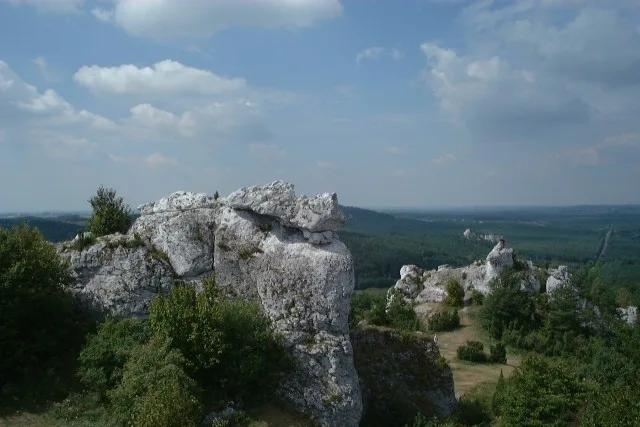
A limestone hill and nature reserve in the Jura, a climbing area with the publicly accessible Głęboka Cave.
Zborów Hill (Góra Zborów) is a limestone rise in the Kraków-Częstochowa Upland, one of the more important climbing sites of this region and at the same time a nature reserve. It is 467 m above sea level and lies in Zawiercie County, by the village of Podlesice, near Kroczyce.
The hill is made of Jurassic limestone, and karst processes have carved numerous outcrops, caves and sinkholes here. The hill belongs to the Mirów-Olsztyn Upland, part of the Częstochowa Upland.
There are more than 50 named rocks and formations, the largest of which are up to 30 metres high. Among the low rock shelters are, among others, Kazamat in Cyrk, the shelter under the White Bastion (Biała Baszta), Skośne and Sadek - about fifteen sites in all. Climbers know the names of the rocks and shelters from climbing guidebooks.
Climbing is permitted, but under certain rules. It is forbidden to climb onto the tops of the rocks, where xerothermic grasslands are being restored. The reserve belongs to the special habitat protection area Ostoja Kroczycka, so the rules in force on site need to be checked in the reserve's regulations before a visit.
By the reserve there is also the Jura Natural and Cultural Heritage Centre, by which is the ticket office serving the reserve. In the area there is also the Góra Zborów Nature Reserve, that is the same protected area described from the natural-history side.
Głęboka Cave is the only cave open to visitors in the northern part of the Kraków-Częstochowa Upland. The conditions and dates of visits are set by the operator, so they need to be checked before you travel. The site has its own entry: Głęboka Cave (Zborów Hill).
The name of the hill is linked to a legend about witches gathering here before flying to Łysa Góra. At the summit stands the Rock with a Pillar (Skała ze Słupem) with a concrete triangulation point from the time of the occupation.
During the Second World War the area of the reserve was at times the scene of skirmishes between the German gendarmerie and units of the People's Army and the Peasant Battalions. Forced labourers worked in the closed quarry.
The red Trail of the Eagles' Nests passes through the area, with a section running from Góra Janowskiego through Karlin, Żerkowice and Morsko to Niegowa. The green Rzędkowice Trail leads from Mrzygłód through Myszków to the car park at the foot of the hill.
Nearby lie the Jurassic castles: Morsko Castle and, a little further away, Bobolice Castle and Mirów Castle.

Be the first! Add a comment.
You need to log in to add a comment.
Log in