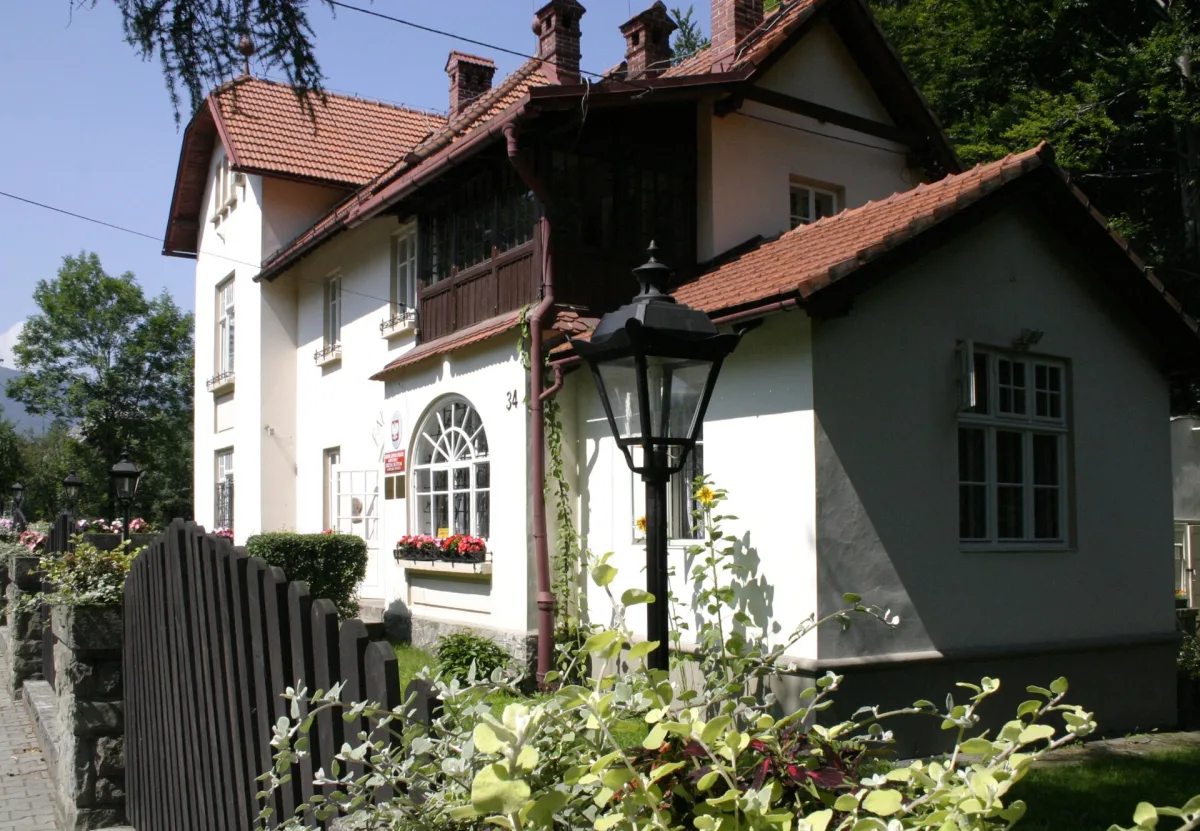
A museum in the villa where Julian Fałat lived for almost twenty years: hunting scenes, watercolours, archives and souvenirs of his travels.
The Fałatówka, that is Julian Fałat's villa in Bystra, is a biographical and art museum, a branch of the Historical Museum in Bielsko-Biała. The painter lived here for almost twenty years, and today his home displays paintings, watercolours, documents and souvenirs from his travels.
According to the museum's website, Fałat bought the house in 1909, and two years later built a larch-wood studio next to it, which burned down in 1935. He moved into the villa in 1910, after leaving the post of director of the Kraków Academy of Fine Arts. After his death the house passed to the artist's children, and in 1947 the property was taken over by the State Treasury. The museum opened in August 1973, and the display has been modernised several times, most recently in 2013 and 2015.
The display occupies eight rooms on the ground floor and the first floor. On the ground floor are early oil paintings from his Munich years, his first watercolours, self-portraits and portraits of family and friends. There are also watercolour views of cities, including Toruń, Leoben and a panorama of Kraków from 1896.
The first floor is taken up by the hunting paintings with which Fałat is most often associated: beaters' drives, stalking game and hunters resting by a campfire. Among them is an oil of 1888, Polowanie na niedźwiedzicę z małymi (Hunting a She-Bear with Cubs). Also worth noting are portrait and landscape studies from the area around Bystra, the group portrait Krakowianki przed lustrem (Kraków Women Before a Mirror) from 1903 and views of the Tatras.
The archive material includes diplomas from exhibitions from 1880 to 1929, materials on the Berezina panorama, which Fałat painted together with Wojciech Kossak, and decorations, including the Commander's Cross of the Order of Polonia Restituta. On the first floor there are also Japanese watercolours, a map of a journey across the Atlantic, Japanese and Chinese prints and porcelain, collected during his journey around the world in 1885.
Bystra lies at the foot of the Silesian Beskids. Closest, about two kilometres from the villa, is the Kozia Góra Mountain Hut, and a little further Szyndzielnia with its cable car.

Be the first! Add a comment.
You need to log in to add a comment.
Log in