A botanical garden of 6.36 ha in Zabrze with French and English sections, a palm house, a rose garden and the National Collection of Heucheras.
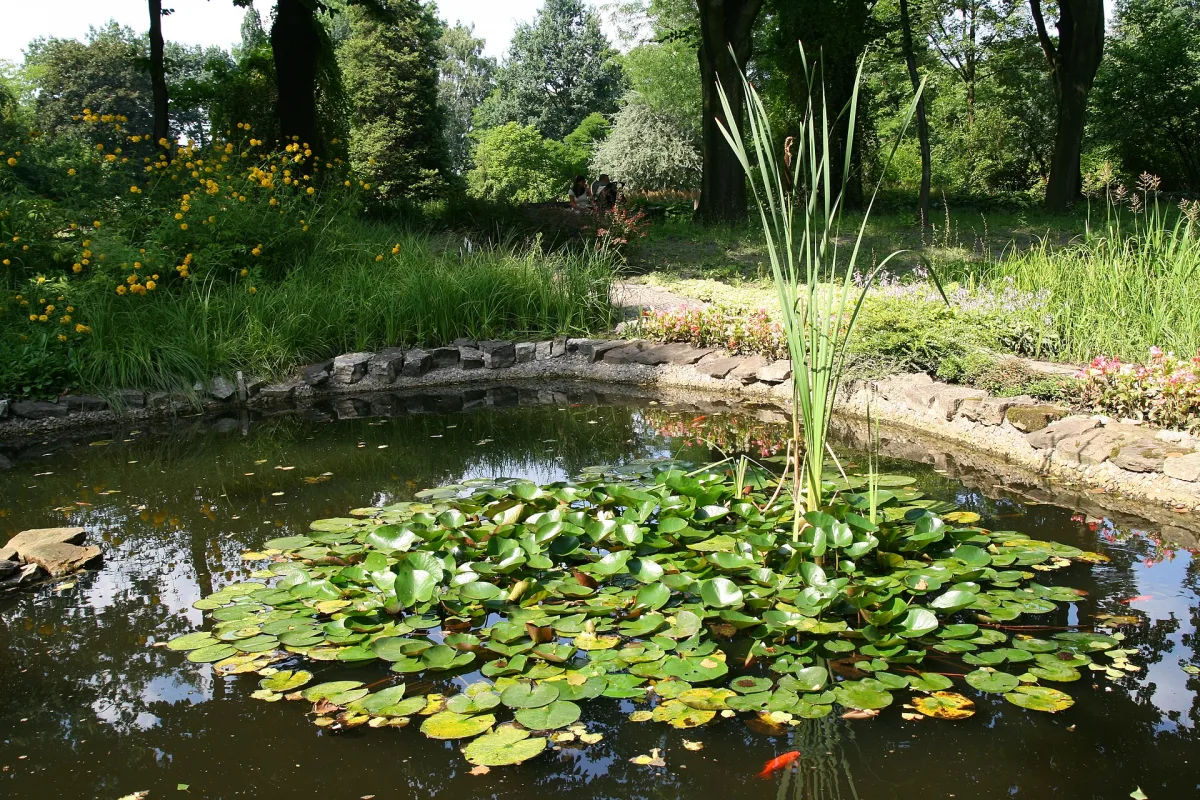
The Municipal Botanical Garden in Zabrze (Miejski Ogród Botaniczny) covers 6.36 ha on Piłsudskiego Street, next to the stadium and sports facilities of Górnik. It has a botanical section laid out in the French style, a park section in the English style, a palm house, a pond and a natural playground. It was opened to visitors in 1938, and after the war it was enlarged several times.
The garden was designed by Fritz Berckling, director of the municipal greenery board, who presented the plan on 14 October 1936. Originally the garden was called the Botanischer Zentralschulgarten, that is the Botanical Central School Garden. It was to show the complete range of plants growing wild in the then Germany and to serve as a teaching resource for the universities of Upper Silesia.
The site had earlier belonged to one of the municipal brickworks. The plot was set aside in September 1937, most of the gardening work was done in 1938, and at the end of June that year the garden was opened to the public. The greenhouses were completed in September 1939. Originally the garden covered about 3 ha and had four parts: woodland-educational, systematic-utilitarian, landscape and utility.
In 1945 the garden was taken over by the Municipal Plantations, and about half of the tree stand had been destroyed. In 1947-1953 2 ha of the closed brickworks were added, and in 1960 another hectare with a brickworks clay pit, which was turned into a pond, the largest of the three. Since then the garden has covered more than 6 ha. In January 2006 the Ministry of the Environment granted it the status of a botanical garden, that is, a scientific research institution.
In the park section grow about 5,000 specimens of trees and shrubs, including a dendrological collection of about 260 taxa. In 2004 a rose garden with 2,500 roses in 64 varieties was established. In the greenhouses about 5,000 plants from various climate zones are displayed, including a palm house and a collection of cacti and other succulents.
Since 2019 the garden has held the National Collection of Heucheras, moved from a private garden: 346 varieties of botanical and garden species, almost 1,000 plants. According to the garden's website, it is the only national collection in the Silesian Voivodeship. In the northern part, since 2014, there has been an eastern garden known as the Garden of Five Candles, with plants from the Far East, especially from Japan.
Among the curiosities is the graft hybrid Crataegomespilus dardari, created by grafting a medlar onto a hawthorn. Species protected in Poland also grow in the garden, for example yew, lily of the valley and European wild ginger.
The botanical section is divided into plots separated by hedges, and the park section has a free, landscape layout and a picturesque pond surrounded by willows. The natural playground in the middle of the garden has play equipment and a sandpit. The garden runs an Ecological Education Centre: workshops, walks with an educator, outdoor games and an educational trail. In the season outdoor events are held, for example the Flower Festival in June and the Great Bee Day in August, and a shop by the ticket office sells exotic plants.
The nearest to the garden, about 1.2 km away, is the House of Music and Dance, and about 2.2 km further lies the Guido Mine and Coal Mining Museum.

Be the first! Add a comment.
You need to log in to add a comment.
Log in