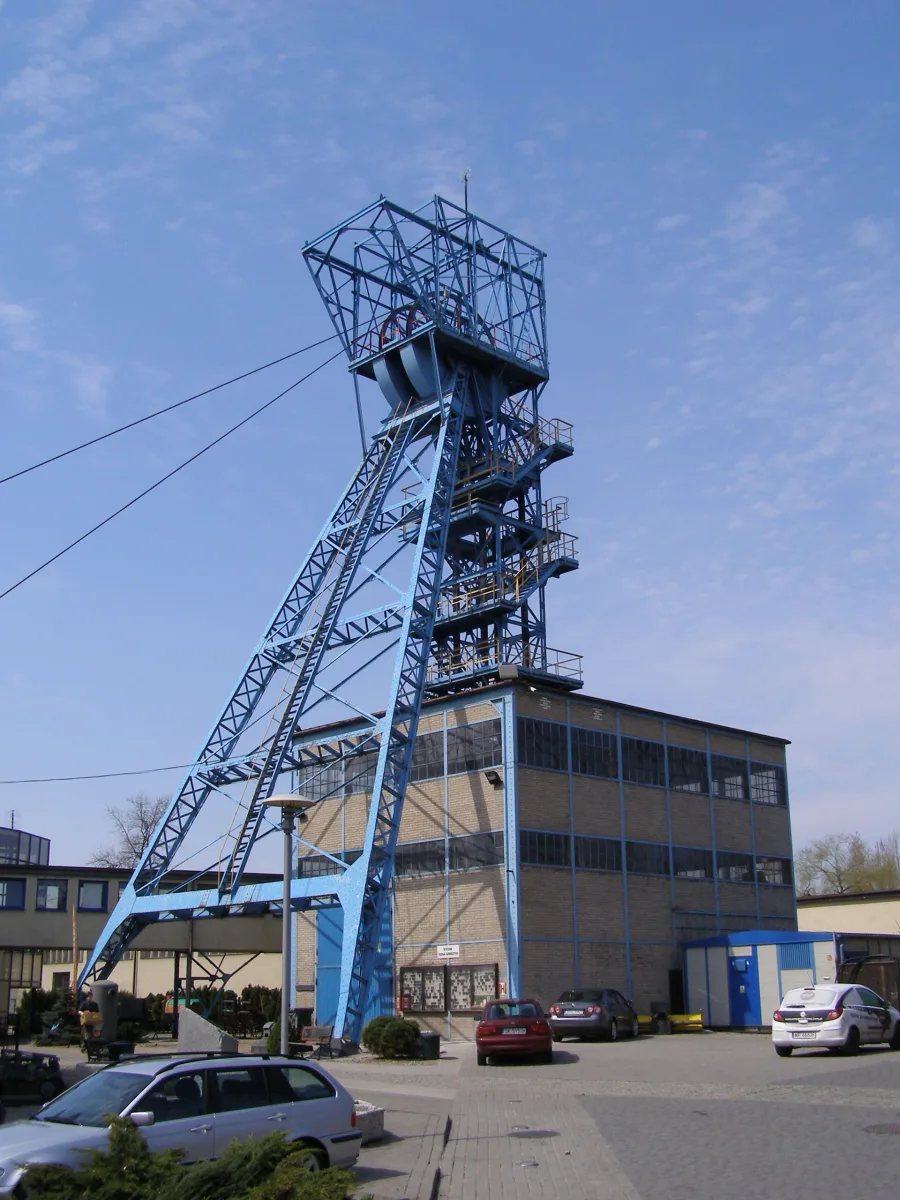
A former coal mine in Zabrze, now part of the Coal Mining Museum, with routes at levels 170 and 320 metres underground and a Monument of History in the background.
The Guido Mine in Zabrze is a former hard coal mine, now part of the Coal Mining Museum in Zabrze. The visitor routes lead underground to levels of 170 and 320 metres. In July 2020 the mine was recognised as part of the Monument of History "Zabrze - complex of historic hard coal mines", alongside the Queen Louise mine and the underground sections of the Main Hereditary Adit.
The mine was founded by Count Guido Henckel von Donnersmarck, who received a mining grant on 2 October 1855 and named the establishment after himself. The first shaft, Barbara, was abandoned in 1856 after being sunk only 30 metres, because quicksand and a geological fault were encountered. Extraction began in the Concordia shaft, later renamed Guido, which reached 97 m in 1859. Conditions were difficult: water-bearing layers and geological disturbances repeatedly halted work.
In 1885 a record 313,000 tonnes of coal were extracted, the highest in the mine's history, but because of low profitability the count sold it in 1887 to the Prussian state. The mine was merged into the Queen Louise mine as its Southern Field. The coal obtained was not suitable for coking, which the founder had hoped for. In 1901 a steel winding tower was erected over the Railway shaft. In 1912 Guido was formally merged into the Delbrück mine, and the Guido shaft kept its role as the main drainage unit for the whole area.
The Guido shaft was put out of operation in 1962. After 1967 the site was taken over by the Coal Industry Design and Mechanical Works, which set up the M-300 Experimental Mine, where new mining machines were tested. In 1982 the Guido Mining Open-Air Museum was created on level 170 and subsequently entered in the heritage register.
In 2000, during cost-cutting in the coal industry, dismantling of the underground tourist mine began. The involvement of the Zabrze local government, the marshal's office and private individuals stopped the liquidation. In 2007 the Guido Historic Mine was established as an independent cultural institution of the city and the voivodeship, and level 170 was again opened to tourists. A year later level 320 was opened, and in February 2015 the 355 sublevel. Since April 2013 the mine has belonged to the Coal Mining Museum in Zabrze.
Underground you will see a working electric winding engine from 1927 and underground workings from the time of extraction. The descent into the mine is by a "szola" (cage), that is, a mining lift. Along the route there are, among other things, underground stables, the Chapel of St Barbara 170 metres below the surface, working mining machines, a ride on a suspended electric railway and a pub on the 320-metre level.
The museum has prepared several routes. The Underground Mining Walk leads to the 320-metre level and takes about 2 hours. Darkness of the Mine reaches raw workings to which only professional miners previously had access. The Underground Shift is a route for adults on which visitors perform simple mining tasks in full equipment. On the 320-metre level there is also Zone K8, four revitalised chambers intended for cultural events and meetings.
The same institution includes the Queen Louise Adit, located about 1.2 km from the Guido mine.
The museum also runs the Water Tower in Zabrze with the interactive coal exhibition CARBONEUM.

Be the first! Add a comment.
You need to log in to add a comment.
Log in