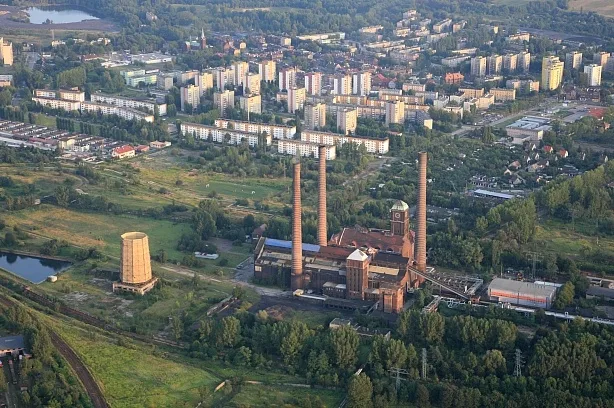
The historic complex of the former Bobrek power station from 1920 in Bytom-Szombierki, entered in the heritage register and the Industrial Monuments Route, not open for regular visits.
The Szombierki Combined Heat and Power Plant in Bytom is the complex of the former Bobrek power station, built in 1920 and in operation until 2011. It covers about 17.9 hectares in the Szombierki district and includes a boiler house, a pump house, an engine hall, a switchgear building, a water tower with a clock, a coal tower, three factory chimneys, an administration building and a gatehouse. The site is entered in the heritage register and belongs to the Industrial Monuments Route of the Silesian Voivodeship, but according to available information it is not open for regular visits.
The first design drawings date from 1917. The plant was originally planned as a gunpowder factory, which is reflected in the solid, massive construction of the buildings, typical of military facilities. The decisive factor was the need to use waste coal from the Bobrek and Szombierki mines, which belonged to the same company, so the site was adapted as a power station. The investor was the company Schaffgotsch Bergwerksgesellschaft, and the whole complex was designed by the architects Emil and Georg Zillmann. The power station was opened on 29 November 1920. Its first equipment consisted of four Babcock boilers and a WUMAG turbine set with a capacity of 12.8 MW.
In 1925 a four-sided clock made by Siemens und Halske was installed on the tower, linked to 54 clocks across the plant. Around 1930 more than 900 people worked here, and the power station was among the largest in Europe. In 1937 the tallest of the three chimneys was built, 120 metres high, and in the years 1939-1944 the plant reached a capacity of 100 MW.
In 1945 the plant was among the first to resume work after the Red Army arrived. Soldiers dismantled part of the equipment and took it deep into Russia, and on 15 May 1945 the site was handed over to the Polish authorities. In the 1970s it was converted from a condensing power station into a combined heat and power plant, and the heating system was expanded. Electricity generation ended in the years 1995-1998, and heat production was shut down in October 2011.
In 2010 the site was added to the Industrial Monuments Route, and in January 2013 it was entered in the heritage register under number A/398/13. In 2020 it was named among the seven most endangered European heritage sites in the Europa Nostra programme. Successive owners planned to use the complex for cultural purposes, and before 2011 concerts, festivals and conferences were held in the largest hall.
In the years 2017-2018 all metal equipment, chutes, platforms, pipelines and staircases were removed from the pump house, the boiler house and the basements, and the copper sheeting was taken off the roof of the water and clock tower. Among other things, part of the WR-25 boiler was saved. In 2018 the Friends of Szombierki CHP Plant Club (Klub Przyjaciół EC Szombierki) restarted the original clock mechanism from 1925. Since 2022 the owner has been the Arche Group, and in 2023 the water and clock tower was being renovated.
In 2017 the site could be entered as part of Industriada.
About 1.3 kilometres away stands the Church of the Sacred Heart of Jesus in Szombierki.
About 2.8 kilometres further on, in Miechowice, is the Tiele-Winckler Palace.
About 5.3 kilometres away lie the Żabie Doły.

Be the first! Add a comment.
You need to log in to add a comment.
Log in