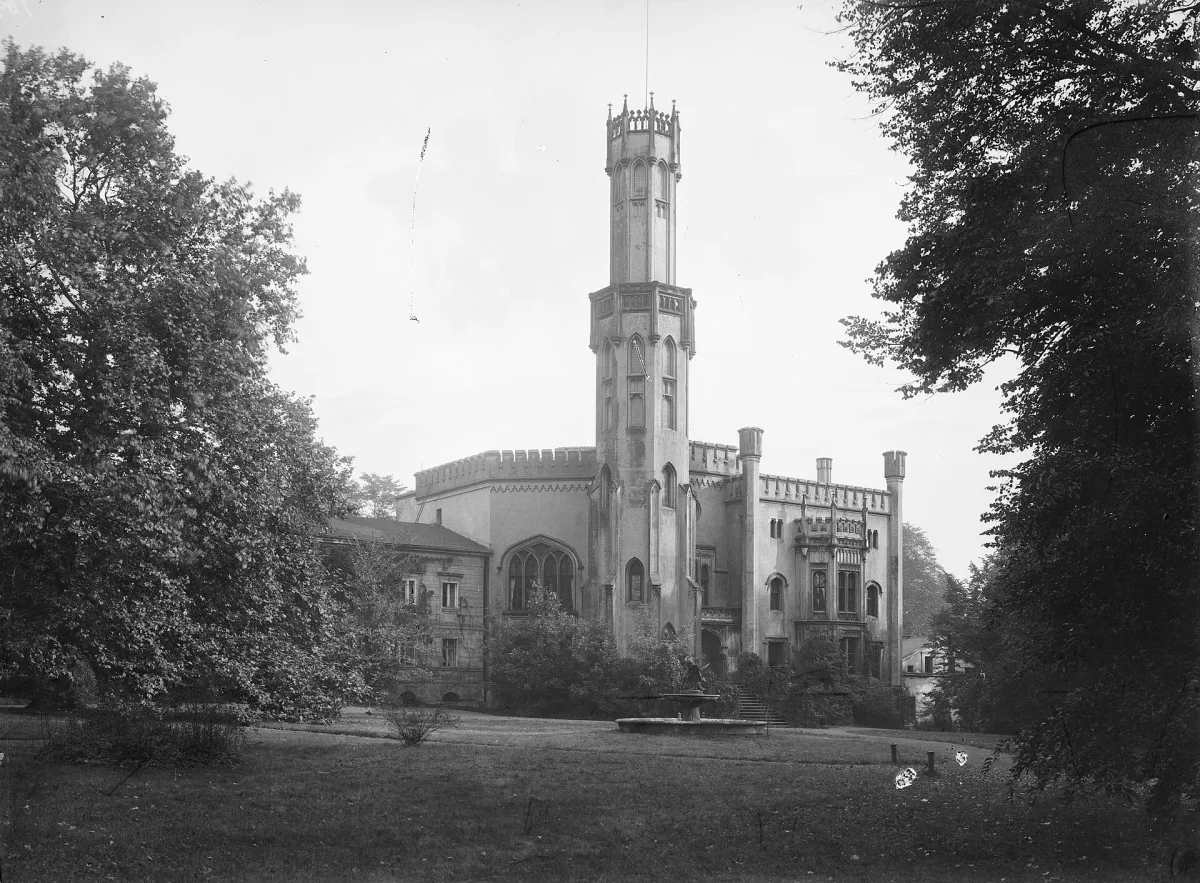
The Tiele-Winckler Palace in Bytom-Miechowice, destroyed in 1945: the outbuilding and a 19th-century landscape park have survived.
The Tiele-Winckler Palace in Miechowice, a district of Bytom, no longer exists in its original form. Of the former residence only the outbuilding has survived, about 10% of the original volume of the building, together with the park around it. It is worth knowing as a trace of the family that built a fortune in the 19th century on Silesian mining and metallurgy.
Construction began in 1812 and continued until 1817. The initiator was the merchant Ignatz Domes, who bought the village of Miechowice, and the palace was a gift for his daughter Maria. It was built in the Classical style. After 1819 the 16-year-old Franz Winckler came to Upper Silesia; he began work as a miner, and years later married the owner of the palace, Maria Aresin.
After 1844, when a tornado tore off the roof, Winckler rebuilt the palace extensively and gave it a neo-Gothic form inspired by 16th-century English Gothic (the Tudor style). Around 1860 wings were added. The palace then belonged to Winckler’s daughter Waleska and her husband Hubert von Tiele. Their daughter Eva von Tiele-Winckler, known as Mother Eva, a deaconess and charity worker, spent her childhood in the house.
The family owned the palace until 1925, when it was sold to the company Preussengrube AG, which managed the local hard coal mine. In January 1945 the palace was looted and burned, and the burned-out walls were blown up in 1954. A small mound by the ruins of the outbuilding conceals the remains of the palace.
Until 2019 the outbuilding remained a ruin. In 2019 it was revitalised and is used for cultural purposes. It is surrounded by a park laid out at the beginning of the 19th century as a landscape garden, the oldest park complex in present-day Bytom. Since 2024 it has been called Tiele-Winckler Park; earlier it was the People’s Park. It covers about 14 ha, and has a beech wood over a hundred years old and a London plane tree named “Jan III Sobieski”, a natural monument since 1973. In 2021 a revitalisation was completed, in which a small pond and an educational trail were created. Since 1995 the park, the ruin of the outbuilding and the remains of the palace have been entered in the heritage register.
After your walk you can visit the Szombierki Power Station, about 2.8 km away, or the Segiet nature reserve, about 5 km away.

Be the first! Add a comment.
You need to log in to add a comment.
Log in