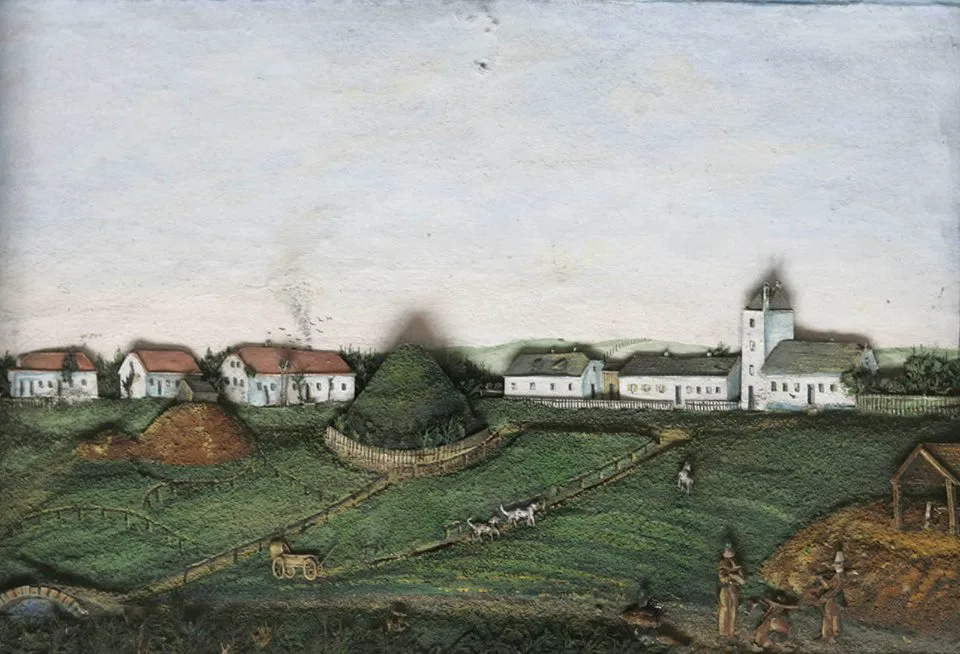
A former lead and silver ore mine in Tarnowskie Góry that operated from 1784 to 1912, today partly open to tourists and inscribed on the UNESCO list.
The Royal Fryderyk Mine (German: Friedrichsgrube) was a lead and silver ore mine in the Bobrowniki area near Tarnowskie Góry. It operated from 1784 until at least 1911 or 1912. Part of its workings is open to tourists today as the Silver Mine in Tarnowskie Góry, and the whole Tarnowskie Góry underground complex was placed on the UNESCO World Heritage List in 2017.
The first lead ore was found on 16 July 1784 near the Rudolphine shaft. The deposits lay almost horizontally, which affected the way the workings were driven.
Groundwater flooded the galleries, so the mine turned to a technical novelty. At the end of the 1780s a steam engine for drainage was installed at the Abraham shaft, on the initiative of Count Reden. According to sources it was the first such engine in Upper Silesia. It was brought from Cardiff by ship to Świnoujście, then up the Oder on three boats to Zdzieszowice and from there by cart to the mine. Further engines were cast in Gliwice in 1790, 1794/1795, 1802 and 1804.
From 1821 a deep drainage adit was driven, put into operation in 1834. Over a stretch of roughly 5.6 km it made it possible to do without costly drainage by steam engine.
In 1836 the ore began for the first time to be separated mechanically from the waste rock, and mechanical processing on a wider scale started in 1840. The mine also tested how to transport the ore fastest: in English carts, wheelbarrows or buckets. The carts performed best, so they were used wherever conditions allowed.
In 1816 the mine and the smelter employed a total of 540 workers and that year produced 1,495 marks of silver, 5,320 hundredweight of lead and 12,563 hundredweight of litharge. Miners worked 8 or 12 hours a day, and the eight-hour shifts ran from 6 to 14 and from 14 to 22. Work was mostly paid by the piece. They rarely had their own homes, so most often they rented rooms.
After the middle of the 19th century profitability fell. In 1858 the Higher Mining Office limited production because of the difficulties of the Fryderyk smelter. By 1910 several million tonnes of ore had been extracted, from which 167,000 tonnes of lead were obtained.
Visits take place in the Silver Mine. The route is 1,740 m long and resembles a triangle in shape, linking three former shafts: Anioł, Żmija and Szczęść Boże. It runs at a depth of about 40 m, and the boat trip along an underground gallery lasts over a stretch of 270 m. The temperature all year round is about 10 °C. On the route you can see mining faces from the turn of the 18th and 19th centuries, chambers and galleries of varying height, and a karst funnel which, according to the operator, is the only one in Europe in a former mine. In the pithead building there is an education centre with an installation showing how the first steam engine worked.
The UNESCO inscription covers the site under the name Tarnowskie Góry Lead-Silver-Zinc Mine and its Underground Water Management System. Not far away is also the tailings heap in Tarnowskie Góry.

Be the first! Add a comment.
You need to log in to add a comment.
Log in