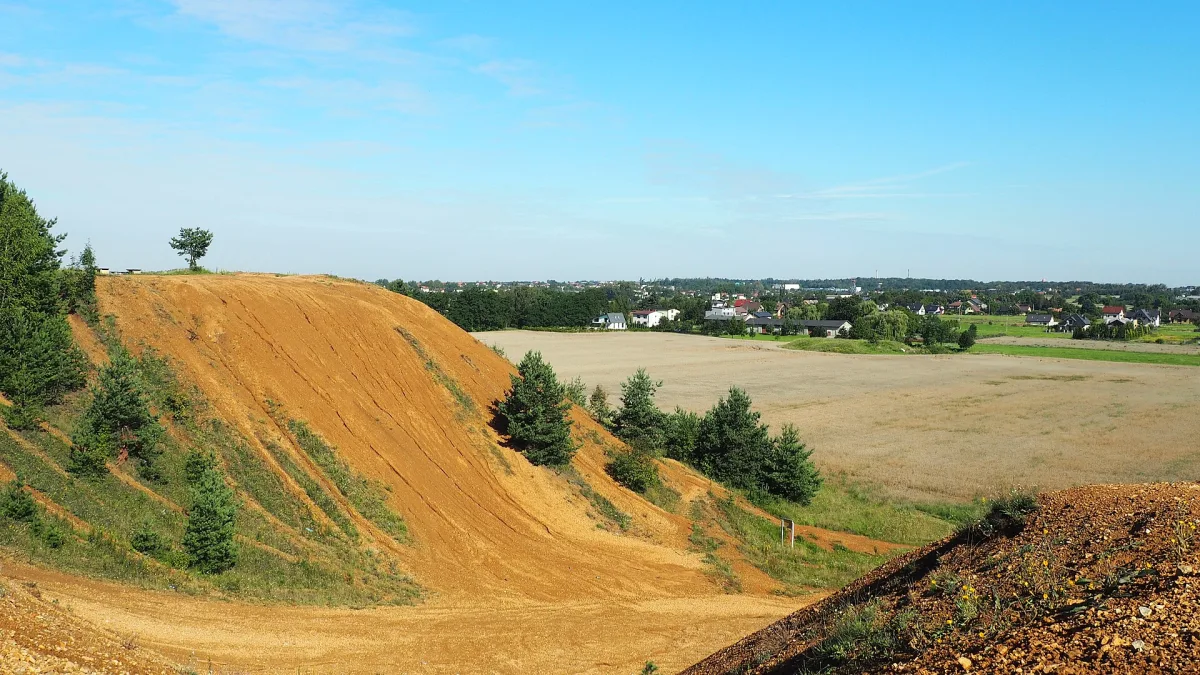
A spoil heap of ore-washing waste from the Fryderyk mine, on the UNESCO list, with calamine grasslands and a view of Tarnowskie Góry.
The ore-washing spoil heap is a flat rise in the southern part of Tarnowskie Góry, formed from dolomite waste left after washing ores. It arose at the Royal Fryderyk Mine and since 2017 has been among the sites inscribed on the UNESCO World Heritage List together with other remains of Tarnowskie Góry mining.
The heap is what remains of a processing plant in which lead, silver and zinc ores were separated from waste rock. In the 1830s and 1840s a modern washing plant belonging to the Fryderyk mine was built between the "Sophia" and "Frieden" shafts to a design by Rudolf von Carnall.
The plant was modernised in 1867, which increased zinc production and, with it, the amount of waste. In 1882-1887, 20 to 30 thousand tonnes of ore a year were processed here. The washing plant operated until 1912, after which the site with its buildings and equipment was taken over by the company Oberschlesische Eisenindustrie AG.
At the end of the Second World War the rise was incorporated into the German defence system. Four reinforced-concrete firing bunkers remain from it, two on the eastern and two on the western side, along with somewhat blurred lines of trenches.
The heap is L-shaped, with a flat top and steep slopes, and its height is about 17 metres. Since 2006 it has been part of the "Hałda Popłuczkowa" Cultural Park, covering 6.77 ha.
The waste is covered with vegetation that advanced from the south and south-east: wych elms, lime trees, birches, rowans and dwarf pines grow here. Only the youngest, northern part of the summit and the northern slope remain without plants. Near them grow calamine grasslands, that is, a plant community resistant to high concentrations of zinc and lead in the soil.
Protected species are also listed on the heap: common centaury, stemless carline thistle and broad-leaved helleborine. Its fauna includes insects, birds, hares and heat-loving lizards.
The flat summit is accessible from the west and north-west, which is why the heap serves as a viewpoint. From here you can see a panorama of Tarnowskie Góry with the church towers and the town hall, the chimneys of the zinc smelter in Miasteczko Śląskie, and Grojec Hill in the distance.
Closer by stretches the shaft top of the "Anioł" shaft with the Silver Mine in Tarnowskie Góry, the narrow-gauge railway embankment and other heaps of the former Fryderyk mine, among others at the "Nettelbeck", "Minette", "Carnall" and "Staszic" shafts.
The greatest threat to the grasslands is riding motorbikes and quads on the slopes, which speeds up erosion. They are also harmed by invasive plants, especially Japanese knotweed and goldenrods.
Since 2018 the heap has been studied by researchers from the University of Silesia, and under the BioGalmany project attempts are being made to restore the calamine grasslands. In February 2019 some of the pines were cut down for this purpose.

Be the first! Add a comment.
You need to log in to add a comment.
Log in