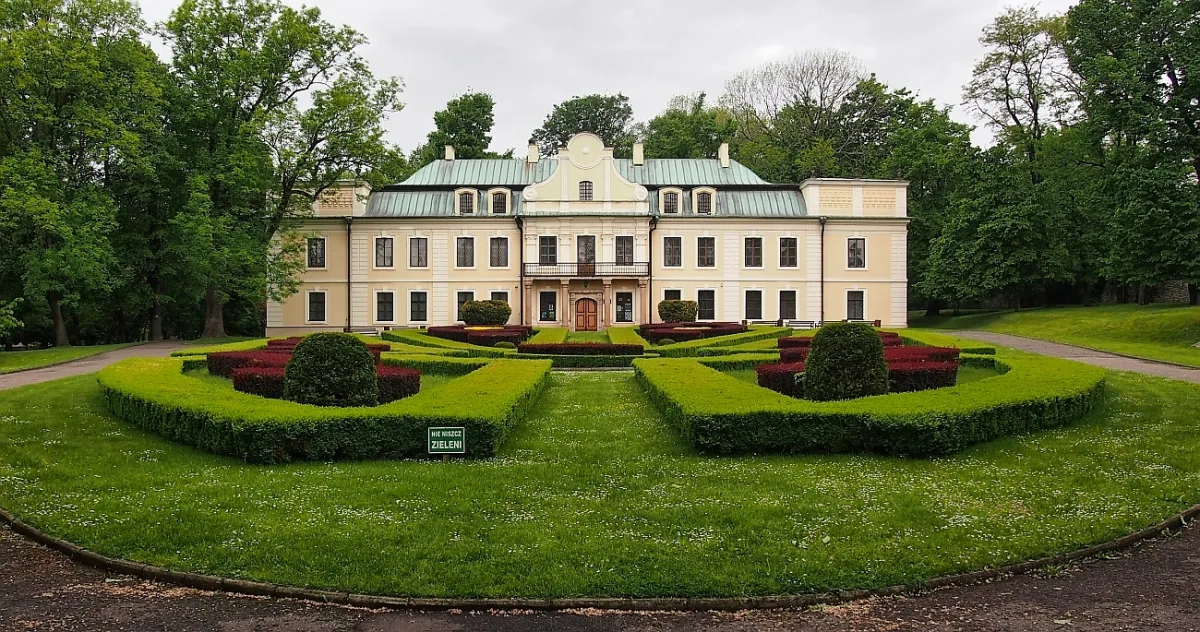
An early 18th-century palace in Będzin-Gzichów with polychrome paintings and a park, part of the Dąbrowa Basin Museum.
The Mieroszewski Palace, also known as the Gzichów Palace, stands on Gzichowska Street in Będzin. Built of brick in the Baroque-Classicist style, modelled on the palaces of contemporary France, it has long served as a museum and is part of the Dąbrowa Basin Museum.
The first owner was Kazimierz Mieroszewski, and the building is dated to 1702. In the 1830s it belonged to the Siemieński family, then to the Mycielski family, and after the January Uprising it was bought by the Silesian industrialist Gustav von Kramsta. From 1890 to 1939 the palace belonged to the Sosnowiec Mines and Ironworks Company, which set up offices and homes for its administration here.
After 1945 an agricultural cooperative ran the premises. In 1958 a community centre was established here, and from the mid-1960s the museum sought to change the building's function and to carry out full conservation of the complex, which was completed in March 1982.
The two-storey palace has an enfilade of rooms and a central hall linking the front entrance with the garden one. The 18th-century polychromes have survived, with portraits of the commanders Hannibal, Pompey and Scipio Africanus, scenes of knightly duels in the western salons and hunting scenes in the south wing. The palace was extended many times, so the style of the building is not uniform.
Behind the palace extends a park from the early 18th century with old trees. Stone sculptures of Bacchus and Flora, made in 1718 by Jerzy Leonard Weber, have survived. The palace is surrounded by manor outbuildings and farm buildings.
The castle hill is about 400 m away, so the palace combines well with a visit to Będzin Castle.

Be the first! Add a comment.
You need to log in to add a comment.
Log in