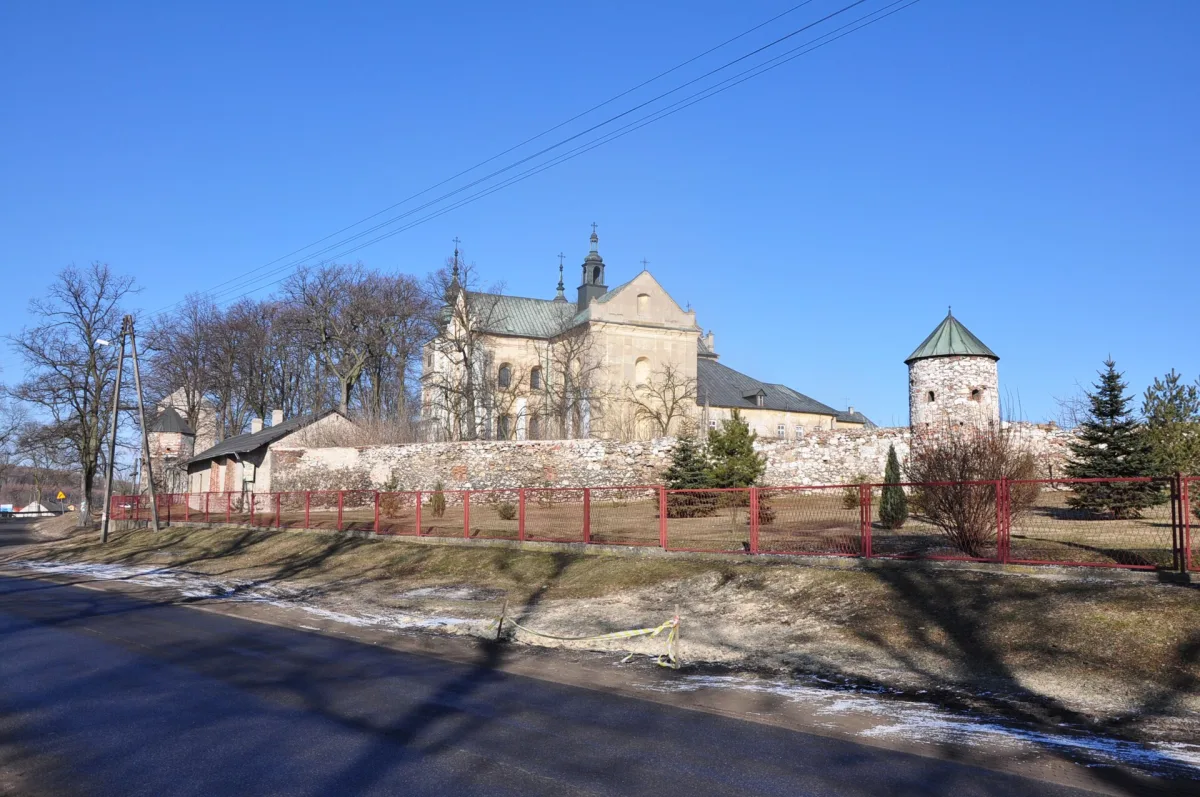
Medieval monastery of canons regular in Wancerzów near Mstów, with a Baroque church, defensive walls with towers and a Marian shrine.
The monastery of the canons regular in Mstów, in the locality of Wancerzów, is a medieval historic complex and the diocesan shrine of Our Lady of Mstów, Mother of Mercy. For several centuries it has shaped the character of the area: a settlement grew up by the monastery which received town rights in 1279.
According to one version the monastery was founded in 1218 by the Bishop of Kraków, Iwo Odrowąż, who brought twelve monks to Mstów. According to another it was founded before 1145 on the initiative of Piotr Włostowic, and the bishop only confirmed earlier grants. Archaeological research carried out since 2010 has uncovered foundations suggesting that the first church was masonry and Romanesque, not wooden as previously thought.
The monastery stood on the left bank of the Warta, in the Sieradz land, and so was subject to the bishops of Gniezno, while the parish in the centre of the town was subject to those of Kraków. The jurisdictional dispute was settled only in the second half of the 15th century. In the 13th and 14th centuries Mstów, as a border centre and customs station, was sometimes the target of plundering raids, and so the monastery was fortified.
In the first half of the 15th century a new church was raised on the site of the old one, and in 1441, at the synod in Łęczyca, it was given the rank of collegiate church. The monastery had a parish school, a hospital, a seminary for candidates for the priesthood and a scriptorium, and its library held 3,000 books. Its guests included Władysław the Elbow-high, Casimir the Great and Władysław Jagiełło.
In 1655 the Swedes, after a siege of several days, burned the town and the monastery. After a fire in the church in 1702 a new one was built, completed in 1742. Even before the end of construction, during a ceremony, the pillars of the south nave cracked, the ceilings and part of the walls collapsed, and at least three people died. Further fires broke out in 1776, 1800 and 1879, and damage was also done by Russian and Prussian troops. In 1823 the monastery was suppressed, in 1914 part of the buildings was demolished by Russian shelling, and in 1990 it returned to the Lateran canons. Between 1925 and 1936 the parish priest restored the buildings and reconstructed the defensive walls.
The present church is a three-aisled Baroque church with two towers, raised higher at the turn of the 19th and 20th centuries. The furnishings date mainly from the 18th century and are late Baroque. The church has eleven altars, among them a late Baroque high altar modelled on the one at Jasna Góra and two Rococo side altars. The music gallery is also Rococo. Special devotion is paid to a 17th-century copy of the image of Our Lady of Jasna Góra, called Our Lady of Mstów.
The three-winged monastery adjoins the church on the north. The south-east wing is late Gothic, from the second half of the 15th century, and houses the former chapter house with a reconstructed cross vault. In the middle wing a late Gothic portal from the early 16th century has survived. In the 17th century the complex was surrounded by walls with ten towers. Today a wall reconstructed after the war stands, with nine towers, and the former south gate serves as a bell tower. The west gate was built in the 18th century in the late Baroque style.
It is about half a kilometre from here to the centre of Mstów, and right beside it lies the Jewish Cemetery in Mstów. By the market square it is worth looking at the layout of the town, which developed thanks to the monastery.

Be the first! Add a comment.
You need to log in to add a comment.
Log in