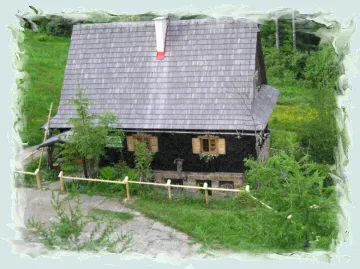
A small PTTK museum on the Przysłop clearing below Barania Góra, showing the history of mountain tourism in the Silesian Beskids in three rooms.
The Barania Góra Mountain Tourism Culture Centre PTTK “At the Sources of the Vistula” (Baraniogórski Ośrodek Kultury Turystyki Górskiej PTTK “U źródeł Wisły”) is a small museum of the history of tourism in the Silesian Beskids. It is housed in a wooden building on the Przysłop clearing below Barania Góra, within the administrative boundaries of Wisła, right next to the PTTK mountain hut. The exhibition covers about 40 square metres and consists of three exhibition rooms, to which is added the guide's duty room. Since 2016 the institution has also been known as the Barania Góra Centre for the History of Mountain Tourism “At the Sources of the Vistula”.
The idea goes back to 1967, and its originator was Edward Moskała, who wanted to create a network of institutions devoted to mountain tourism in the Polish Carpathians. The first such centre was opened in 1966 at Markowe Szczawiny below Babia Góra. The Barania Góra one was to be the next, but the matter dragged on for years. In 1988 a research station was set up in Wisła, and a year later the outbuilding of the former mountain hut on Przysłop, slated for demolition, was transferred to the centre.
The building was renovated through voluntary work. Tourism activists from Upper Silesia worked on it, especially members of the Katowice Beskid Guides' Circle (Koło Przewodników Beskidzkich). It was conserved on the outside, partition walls were removed to gain space for the collections, the floors and windows were replaced, the interiors were finished with wooden panelling and a ceiling previously hidden behind fibreboard was uncovered. The museum was opened on 12 November 1994. The first curator was Andrzej Dziczkaniec.
The first room is devoted to the beginnings of tourism in the Silesian Beskids. On display are documents of the branches of the Polish Tatra Society from Katowice, Cieszyn and Bielsko-Biała, display cases of the Beskidenverein and of Zaolzie, old guidebooks, photographs, postcards, collections of tourist badges and walking sticks with commemorative plaques.
The second room holds tourist publications, a display case on Edward Moskała, documents on the development of skiing in the Silesian Beskids and a collection of skis from the interwar period and modern times. There are also commemorative books of mountain huts, a relief map of the Silesian Beskids and a gift for the opening of the centre, namely the panorama visible from the tower on Barania Góra. In the ethnographic corner folk costumes and shepherds' and farm implements are shown.
The third room presents other mountain tourism culture centres in the Carpathians and a board of the centre's benefactors. Pennants from rallies and gatherings hang under the ceiling, and on the walls are replicas of plaques set up around Barania Góra, among them the one from the Biała Wisełka waterfalls. Outside the exhibition there is also the guide's duty room with a small kiosk with maps, postcards and an antiquarian bookshop of mountain publications. In the duty room you can get the commemorative stamps of the centre and of the tower.
Next to the museum, according to the data about 300 metres away, stands the PTTK Mountain Hut on Przysłop below Barania Góra.
It is about 2.8 kilometres in a straight line from here to the summit of Barania Góra. A viewing tower stands there, built in 1991 on the initiative of the PTTK Guides' Circle from Katowice. According to the history of the centre, it was the first such tower in the Polish Carpathians.
About two kilometres from the museum lies the Barania Góra Nature Reserve.

Be the first! Add a comment.
You need to log in to add a comment.
Log in