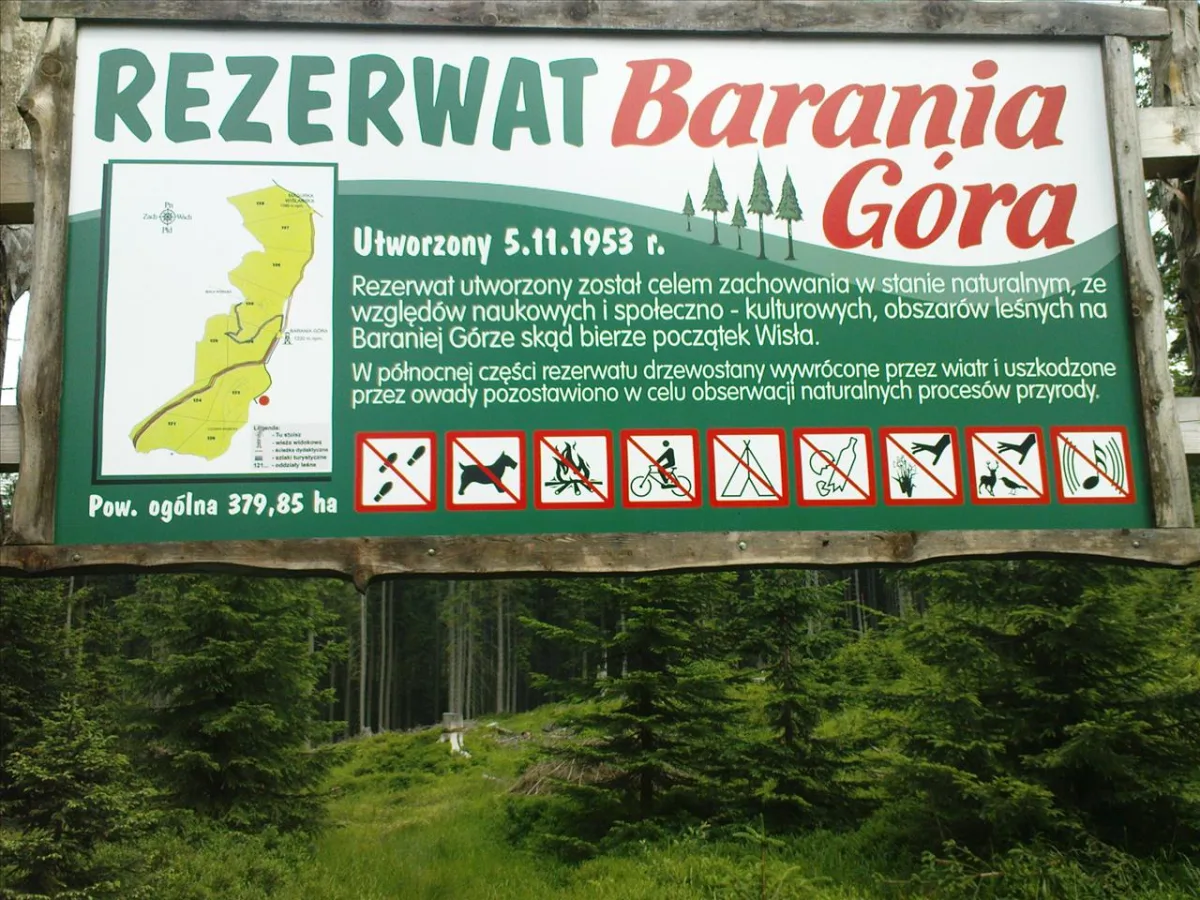
A strict forest reserve of 379.85 ha on the western slopes of Barania Góra, established in 1953, covering the source areas of the Black and White Wisełka.
The Barania Góra Nature Reserve is a strict forest reserve on the western slopes of Barania Góra in the Silesian Beskids, within the boundaries of the town of Wisła. It reaches all the way to the summit of the mountain (1,220 m above sea level) and covers the area where the Vistula (Wisła) rises.
The Barania Góra forests were already protected in the second half of the 19th century by the Habsburgs of Cieszyn, who came here with guests for annual capercaillie hunts. They brought in foresters from Styria and Carinthia to keep these birds undisturbed.
After 1922, when the autonomous Silesian Voivodeship began to operate, Silesian naturalists wrote about the natural value of Barania Góra. The first to do so, in 1923, was Kazimierz Simm, and a concrete reserve proposal was presented in 1931 by Marian Koczwara of the Silesian Museum in Katowice. Even before the nature protection act of 1934, the State Forests established a partial reserve of 388 ha here. The present reserve was established by an order of the Minister of Forestry of 5 November 1953, within very similar boundaries.
The reserve covers 379.85 ha at an altitude of 840 to 1,220 m above sea level and lies within the Silesian Beskids Landscape Park. It includes the source areas of the two headwater streams of the Vistula, the Black and White Wisełka (Czarna and Biała Wisełka).
Geologically it is Carpathian flysch, mainly thick-bedded, ferruginous sandstones of the Istebna beds with interlayers of shales and mudstones.
The reserve area is among the rainiest in the country, with precipitation of 1,100 to 1,700 mm a year, whereas in the Polish lowlands it is 500 to 600 mm. A considerable part of the precipitation is snow. In the summit areas the snow cover often exceeds 2 metres and lies for as many as 140 days. Frequent foehn-type winds, called halny, damage the tree stands.
Forest communities occupy almost the whole area, and the age of the trees ranges from 70 to 200 years. Considerable parts of the forest have kept the features of primeval stands. Highest up grows the upper montane spruce forest, and lower down a fir-spruce forest with fir and beech.
In the 1930s attempts were made to introduce mountain pine and Swiss stone pine on the summit. Only the stone pine survived, with two specimens preserved on the ridge just north of the summit. Among rare species, the Carpathian tozzia grows here.
Nearby are the summit of Barania Góra itself and the PTTK mountain hut at Przysłop below Barania Góra.

Be the first! Add a comment.
You need to log in to add a comment.
Log in