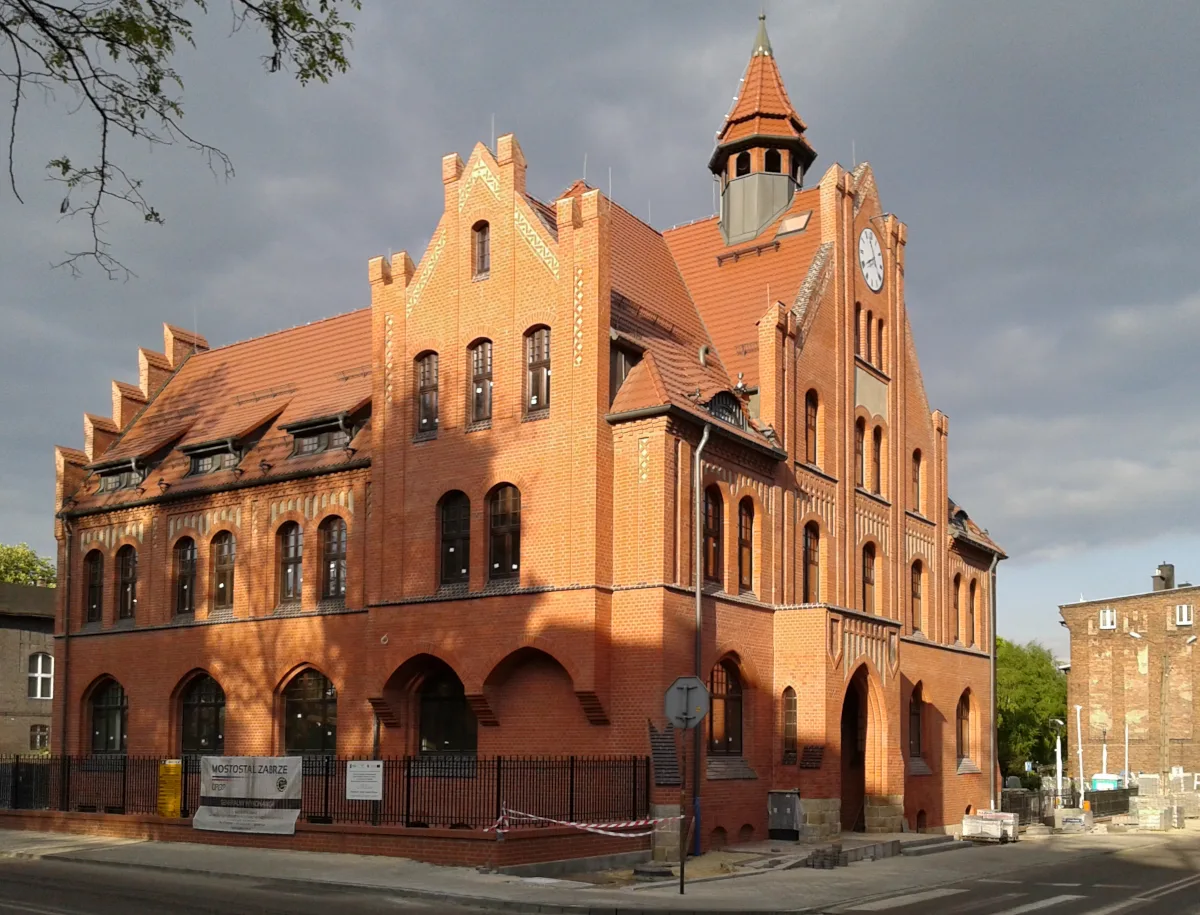
A municipal museum in a neo-Gothic building from 1907, presenting the history of the three Silesian Uprisings and the plebiscite.
The Museum of the Silesian Uprisings in Świętochłowice is a municipal institution whose task is to protect materials relating to the history of the Silesian Uprisings and of Świętochłowice. It is located at Wiktora Polaka 1, in a neo-Gothic building constructed in 1907 as the headquarters of the Donnersmarck estate administration.
The museum was established by a resolution of the Świętochłowice Town Council of 18 July 2012, transforming the existing Municipal Museum. In the years 2013-2014 the building was renovated and adapted, and the institution was opened to visitors in October 2014. Sources give two neighbouring opening dates, 17 and 18 October.
In 2018 the museum received the Wojciech Korfanty Award, and in 2019 the Juliusz Ligoń Silesian Award.
The exhibition occupies three levels of the building: the ground floor, the first and second floors, and the mezzanine. It is multimedia in character and follows a chronological order. It begins with the exhibition "Świętochłowice A.D. 1919", then presents the successive uprisings and the plebiscite, and ends by showing the insurgent fighting and the consequences of the Silesian risings.
The interior displays use, among other things, exhibits from the former Municipal Museum.
The building was designed by Emil and Georg Zillmann of Charlottenburg, the architects who also designed the workers' housing estates in Giszowiec and Nikiszowiec. There is a clock on the front façade. The estate administration moved here from a residence on Szpitalna Street that no longer exists.
In 1916 the building was bought by the Świętochłowice municipality, which had its offices here until April 1939, when it moved them to the new town hall. During the Second World War the German Schutzpolizei and a prison were housed here. In 1939 fifteen insurgents and activists, who had been tortured earlier, were taken from this building to be executed. Next to the main entrance hangs a plaque in their memory, unveiled in September 1947. At the turn of the 1960s and 1970s it was replaced by a bronze plate made at the Zgoda Steelworks, and in 2014 it was restored. State holidays are marked at the plaque.
After the war the building housed the Citizens' Militia, and from 1989 the Municipal Police Headquarters. On New Year's Eve 1999/2000 the building was set on fire and partly destroyed. The renovation in the years 2013-2014 prepared it to become the museum's home.
It is about 3.2 km from here to the Upper Silesian Ethnographic Park.
About 4.8 km further on lies the Silesian Park in Chorzów.

Be the first! Add a comment.
You need to log in to add a comment.
Log in