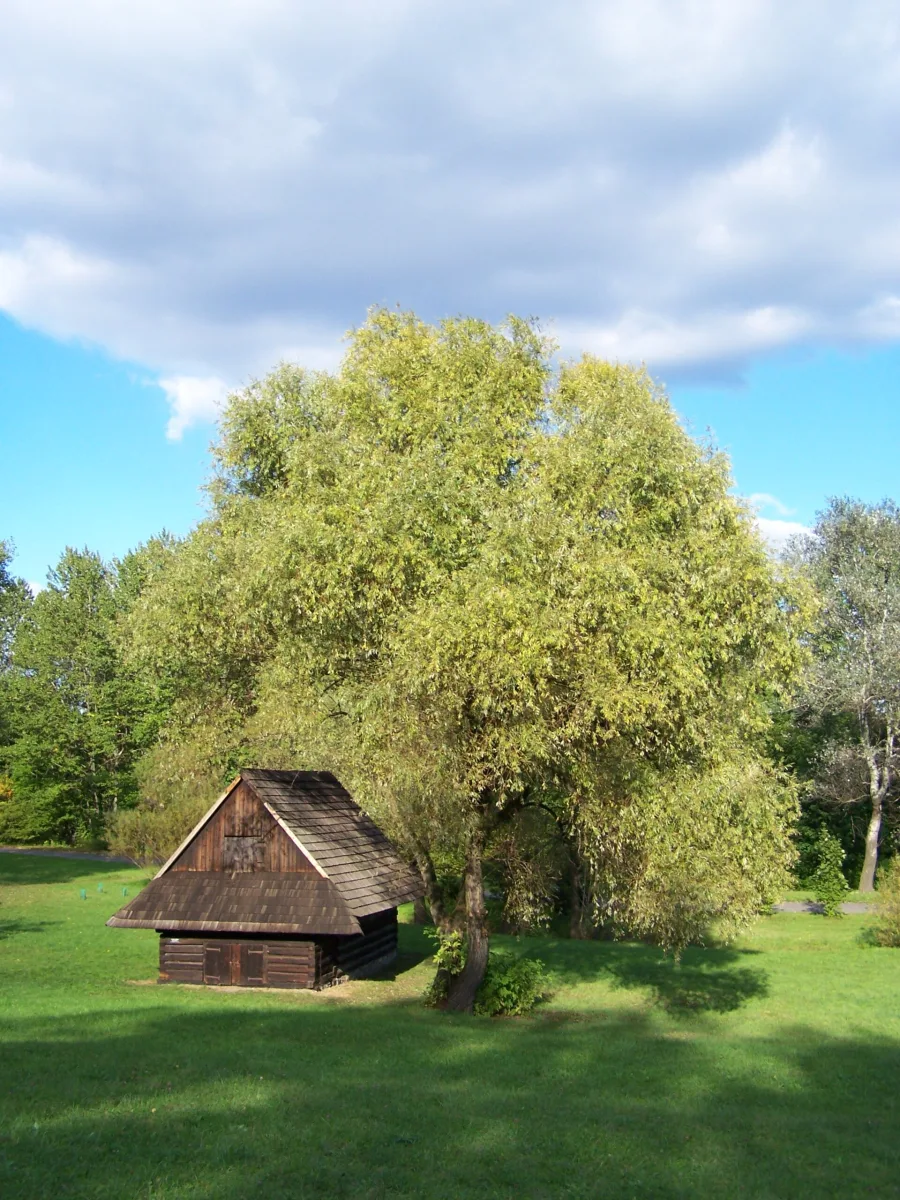
An open-air museum in the Silesian Park, opened in 1975, with about 78 historic buildings from Upper Silesia and the Dąbrowa Basin.
The Upper Silesian Ethnographic Park in Chorzów is an open-air museum of the park type, set within the Silesian Park. The exhibition was opened to visitors on 1 June 1975. Around 78 items of small and large architecture from the 17th to 20th centuries stand here, moved from the area of eastern Upper Silesia and from the Dąbrowa Basin, and the museum covers about 33 ha.
The historic buildings of village and small-town architecture stand in six geographical sectors and one thematic one, with arranged interiors. The sectors correspond to regions: the Silesian Beskids, the Cieszyn Foothills, the Pszczyna-Rybnik part, the Bytom-Tarnowskie Góry and Lubliniec parts, and the Dąbrowa Basin. The architecture of the industrial era is shown separately.
In the Beskid sector stand farmsteads from Istebna, among them a cottage from 1794, and a pastoral complex from Brenna with a shepherd's hut and a sheep pen. From the Cieszyn Foothills come, among others, a cottage from Bażanowice from 1872, a smithy from Zamarski from 1843 and a manor granary from Simoradz from 1738. In the Pszczyna-Rybnik sector you can see, among other things, an inn from Świerczyniec from 1870, a windmill from Grzawa from the first half of the 19th century and an octagonal barn from Brzeźce.
Among the religious buildings is a wooden church from Nieboczowy from 1791, moved to the museum in 1995 and consecrated in 1997, and an Evangelical church from Bytom-Bobrek from 1932, reconstructed in 2014-2017. The wayside chapels scattered around the museum bear images of saints and usually date from the 19th or early 20th century.
Plans for an open-air museum go back to 1928, when Dr Tadeusz Dobrowolski announced the collecting of endangered wooden churches. In the 1930s some of the buildings were taken to Kościuszko Park in Katowice, but the war halted the plans. The idea was returned to in the early 1950s, now in the Voivodeship Park of Culture and Recreation.
The independent museum institution was established on 1 August 1974, but buildings were moved earlier, by a team working under the Upper Silesian Museum in Bytom: in 1964 the first two arrived here, the parish granary from Warszowice and the windmill from Grzawa. The museum took its present name in 2010. The open-air museum has belonged to the Wooden Architecture Route since 2002.
The museum organises regular folklore events, among them the Silesian Gody (Śląskie Gody), which since 1998 have been combined with the parish fair in honour of St Joseph the Worker, patron of the church from Nieboczowy. Other well-known events include Holidays in the Open-Air Museum and Night at the Museum. The current offer includes themed walks, and one of the permanent exhibitions is ULiversum, devoted to bees and beekeeping.
The film "The Mill and the Cross" by Lech Majewski was shot on the museum grounds, using among others the cottages from Frydek and Istebna, the granary from Simoradz and the windmill from Grzawa.
The open-air museum lies in the north-western part of the Silesian Park.
Not far away is the Silesian Planetarium, as well as the Silesian Zoological Garden.

Be the first! Add a comment.
You need to log in to add a comment.
Log in