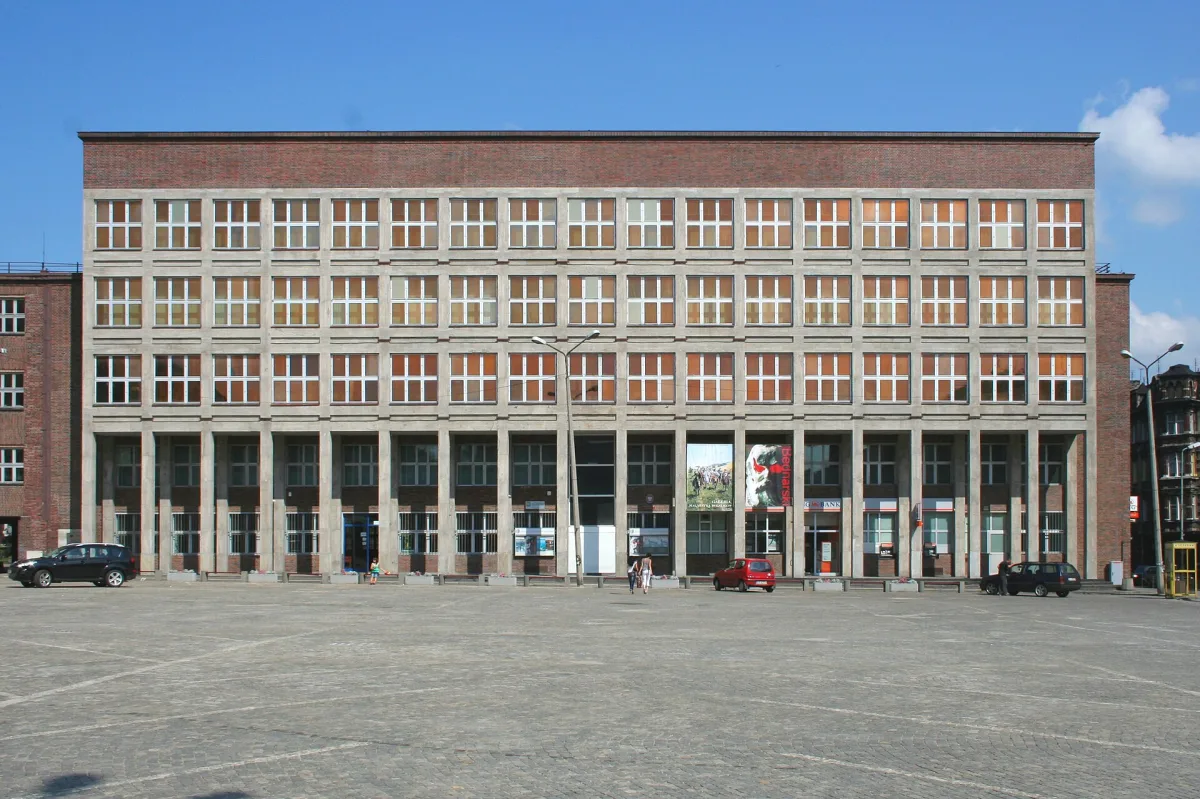
A regional museum founded in 1910, with departments of archaeology, ethnography, history, nature and art and a collection of Judaica, in a modernist building from 1929-1930.
The Upper Silesian Museum in Bytom is a cultural institution of the Silesian Voivodeship self-government, whose origins go back to 1910. Its collections number about a million exhibits, and its seat is a modernist building at plac Jana III Sobieskiego 2, built in 1929-1930 and entered in the heritage register in December 2022.
The museum began with the Bytom Historical and Museum Society, which was founded in 1910 by a group of enthusiasts of the town's history.
The society created a local museum on the basis of deposits of the private collections of the merchant Simon Macha and the teacher Kurt Bimler, together with municipal and guild souvenirs. In 1928 the museum was taken over by the Bytom local authority. The new building to a design by A. Stütz and H. Hatler was built in 1929-1930, but because of the economic crisis only half of the planned building was constructed, and the other part was never erected. The Upper Silesian Provincial Museum was officially opened on 24 October 1932.
In October 1939 the collections of the Silesian Museum in Katowice, liquidated by the Germans, were brought to Bytom, and after the war both collections became the basis of the revived institution.
On 10 May 1946 the first exhibition devoted to the Silesian Uprisings was organised here; they are also the subject of the Museum of the Silesian Uprisings in Świętochłowice. In 1950 the museum was nationalised and took its present name, and in 1999 it was taken over by the self-government of the newly created Silesian Voivodeship.
The collections are divided into departments: Archaeology, Ethnography, History, History and Culture of Lwów and the South-Eastern Borderlands, Nature and Art, and the museum also has a library of more than 50,000 volumes.
The Archaeology Department has artefacts from the Stone Age to the Middle Ages, including multanki, regarded as the oldest wind instrument of this type in Poland. The Ethnography Department, the third-largest ethnographic collection in Silesia, has gathered more than 20,000 museum objects, including folk costumes of all the subregions of Upper Silesia. In 2017 the museum received from the Jewish Religious Community in Katowice items from the former house of prayer of the Bytom Jews, among them more than 500 books, the third-largest collection of Hebrew religious books in Poland. The museum's website presents a permanent exhibition on the synagogue and the Jewish House of Prayer in Bytom and an exhibition on the history of life on Earth.
The museum today occupies two buildings: the main building and the former county office of Bytom County at ul. Wojciecha Korfantego 34.
The county office building dates from 1899-1902 and has eclectic architecture. The museum uses this building together with its outbuilding.
From Sobieski Square it is about 2.8 km to the Szombierki Power Station.
About 3 km from the museum lies Żabie Doły.


Be the first! Add a comment.
You need to log in to add a comment.
Log in