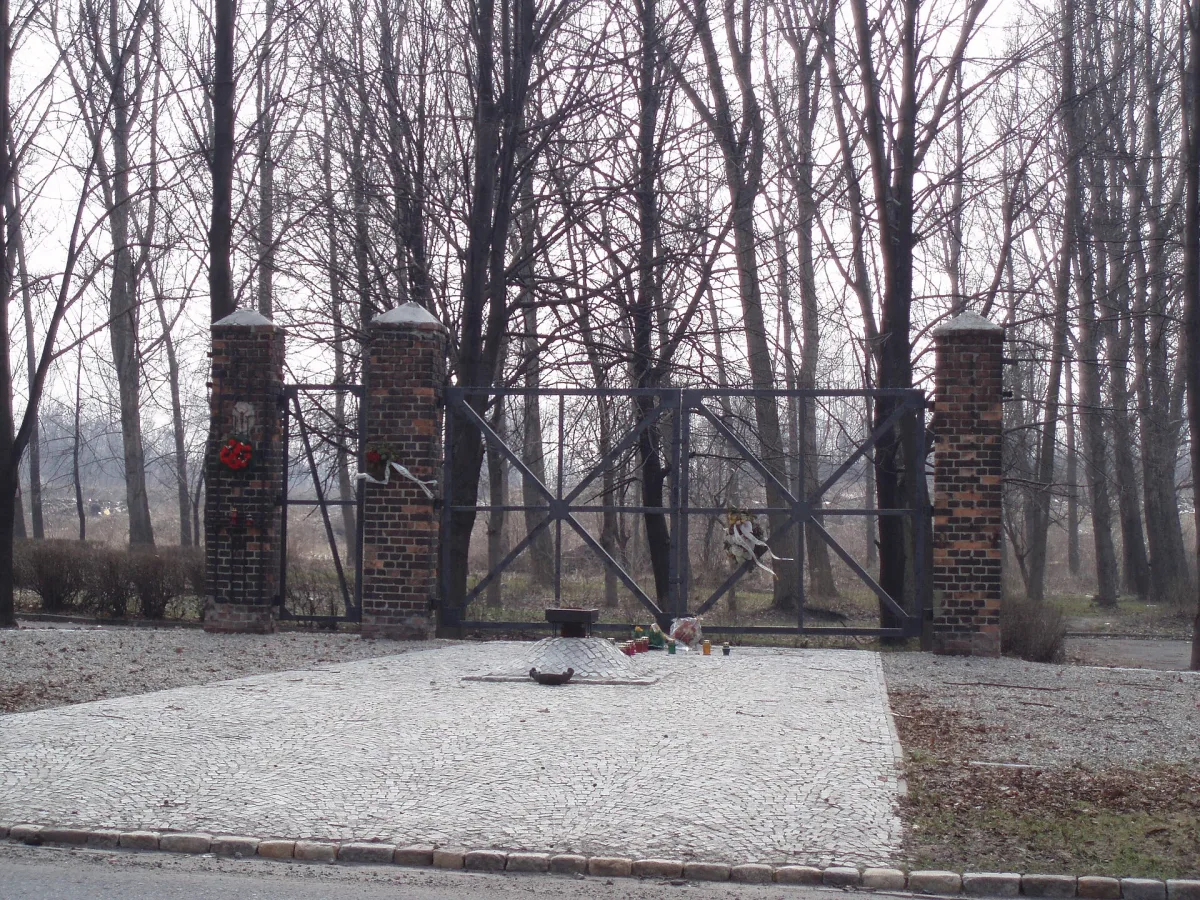
The site of a former German subcamp and a postwar labour camp in Świętochłowice-Zgoda, with a surviving gate and a memorial to the victims.
The Zgoda camp in Świętochłowice-Zgoda operated in two periods: in 1943-1945 as a German subcamp of KL Auschwitz, and from February to November 1945 as a labour camp subordinate to the Ministry of Public Security. Today the site is commemorated by the surviving camp gate and by monuments and graves in the town.
In 1943-1945 the KL Auschwitz-Eintrachthütte subcamp stood on the same site. In 1943 the Germans built four watchtowers and surrounded the area with a double barbed-wire fence. Before the evacuation in December 1944 and on 23 January 1945 there were 1,200 prisoners in the camp. According to the town of Świętochłowice, hundreds of people died in the German camp, mainly Jews and Poles, and also, among others, French people.
People from Upper Silesia were sent to the camp on the basis of a decree of the Polish Committee of National Liberation (PKWN) and other legal acts. They included Silesians, Poles, Germans, Jews and citizens of other countries, accused among other things of signing the Volksliste or of a hostile attitude towards the authorities. As the town states, the decision to imprison people lay with the Security Office (UB) and the NKVD and was not based on court sentences. Some prisoners were sent to work in nearby mines and steelworks.
The camp commandant was Salomon Morel. In 1996 the Polish prosecutor's office charged him, among other things, with causing the deaths of at least 1,538 prisoners, but he was never tried. He died in Israel in 2007. In July 1945 a typhus epidemic broke out in the camp in which many people died, including women and children. In November 1945 the camp was closed down. Some prisoners were released and others were transferred to the Central Labour Camp in Jaworzno.
Sources give different figures. According to the town, about 6,000 people passed through the camp in 1945; according to studies cited in the literature, at least 5,764. The Institute of National Remembrance has documented 1,855 deaths. The town puts the minimum number of fatalities at about 1,700, while other studies speak of more than 2,000 or even 3,000 people.
The surviving camp gate is an authentic relic and is entered in the heritage register of the Silesian Voivodeship. The area around it has been laid out as a commemorative space, with new paths, benches and lighting. A monument to the victims of the camp stands by the gate.
The dead prisoners were buried in mass graves. A mass grave of the camp's victims is in the Evangelical-Augsburg cemetery in Świętochłowice, where there is also a Wall of Remembrance with plaques commemorating the dead. Families of the victims can apply to the town office to have a plaque placed. A symbolic grave of the camp's victims was set up in the Old Cemetery on Cmentarna street. The town runs a separate website with documents, witness accounts and photographs.
The history of the Silesian Uprisings and of the region can be explored at the Museum of the Silesian Uprisings in Świętochłowice.

Be the first! Add a comment.
You need to log in to add a comment.
Log in