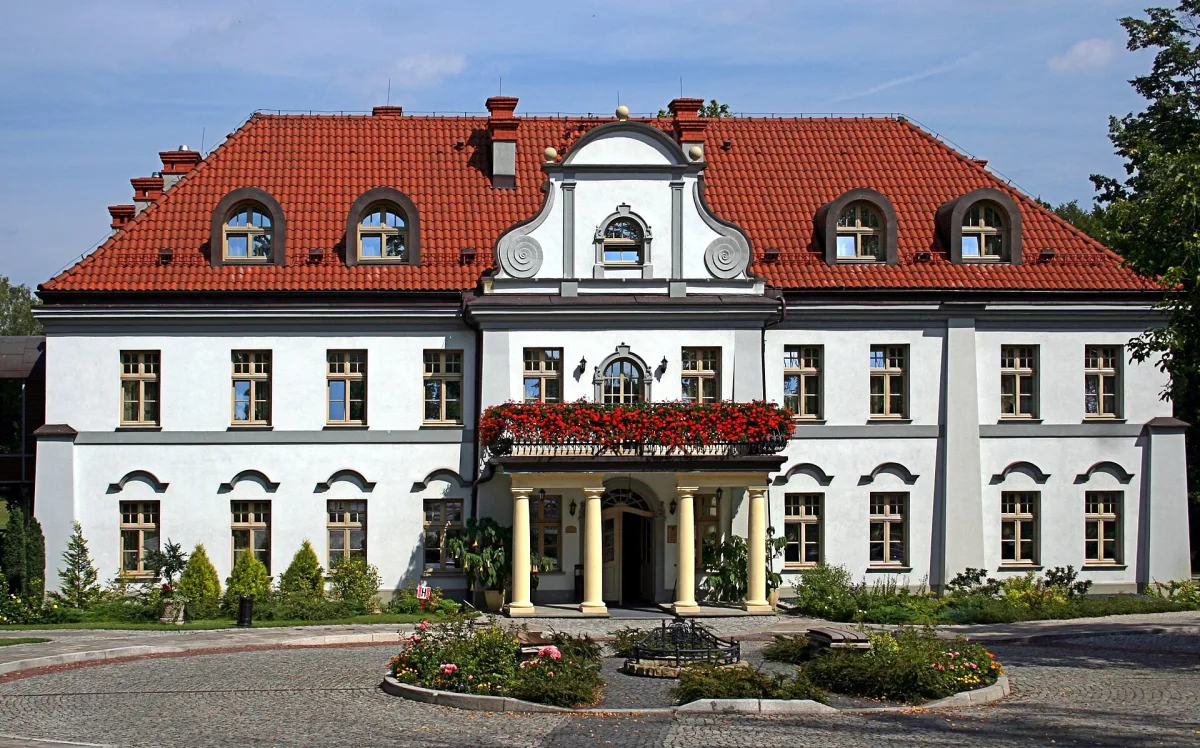
A palace from the turn of the 19th and 20th centuries, linked to the Polish insurgent movement during the Silesian Uprisings, today a hotel with a park and ponds.
The palace in Czarny Las stands in a village in the municipality of Woźniki, in Lubliniec County. It was built at the turn of the 19th and 20th centuries as the residence of the Helenenthal estate, and in the years of the Silesian Uprisings it was a place linked with Polish patriotic activity. Today it houses a hotel with a restaurant, so it is visited mainly from the outside and from the park.
The estate was bought before 1886 by a Wrocław merchant, Ferdinand Ziegler, and the palace was built on his commission. Before 1917 the new owner became Kazimierz Niegolewski, a politician on the Polish side and in 1922 the first starost of Lubliniec County in the Second Polish Republic. The palace was rebuilt at that time to a design by Roger Sławski. Later the estate fell into debt and was parcelled out, and in 1942 the property was taken over by the treasury of the Third Reich.
In 1918-1922 the houses of Polish activists in the area were often searched. According to the hotel's website, the palace was then used to hide weapons for the insurgents and people wanted in Prussia for anti-state activity. According to the hotel's website, it was in Czarny Las that Wojciech Korfanty conceived the idea of calling the people of Upper Silesia to an armed uprising, and according to other sources he signed an appeal here calling for the uprising. During the Third Uprising the owner's wife, Wiktoria Niegolewska, organised a hospital for insurgents in the palace, and in 1920 she opened a private Polish school here for 40 children from the area.
The building has Neo-Baroque and Neoclassical features. It is a brick, plastered two-storey palace on a rectangular plan with a usable attic and a hipped roof with dormer windows. The facade has eleven bays, and in the middle is a three-bay projection with the main entrance, in front of which stands a columned porch with a balcony. The projection is crowned by a gable with pilasters and volute scrolls. A part of the palace appears in the coat of arms of the village.
After the war ownership matters dragged on for a long time and were settled in 1963. From 1973 the palace was run as a tourist hostel by an agricultural cooperative, and from 1988, after its purchase by a cooperative of disabled people, a rehabilitation and holiday centre operated here. After a renovation at the end of the 1990s, a four-star hotel was opened in 2003. A park with ponds extends around the building, and additional accommodation and a restaurant have been set up in newer buildings.
Closest to Czarny Las lies the nature reserve Góra Grojec, about 7 km from the palace. In Koziegłowy, a little further, stands a castle, and in Starcza two churches, among them the Church of Our Lady of Częstochowa.

Be the first! Add a comment.
You need to log in to add a comment.
Log in