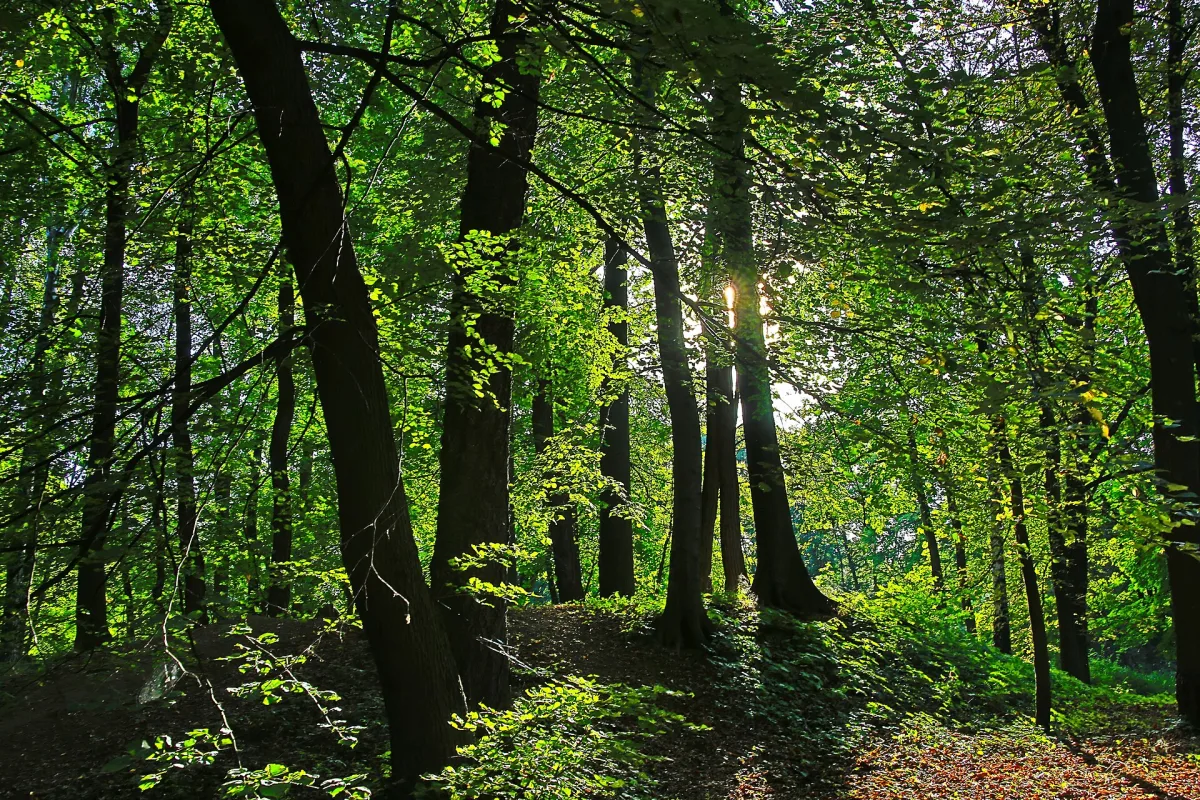
A historic park from 1903 on the spoil heaps of former ore mines, part of the UNESCO site, with an observation tower and a pond with a fountain.
The Municipal Park in Tarnowskie Góry covers 21.5 ha between Wyszyńskiego and Bałtycka streets, in the centre of the town. It was laid out in 1903 on warpie, that is spoil heaps left by 19th-century ore mines, and since 2016 it has been entered in the heritage register.
The originator of the park was the parish priest Fr Franciszek Kokot, who bought the land, and the mayor Richard Otte adapted it to its new function. The design was made by the municipal gardener P. Bernert. The park lies on mining remains, and therefore forms part of the site inscribed in 2017 on the UNESCO World Heritage List: the Tarnowskie Góry Lead-Silver-Zinc Mine and its Underground Water Management System.
The entrance is marked by a group of erratic boulders, the largest of which is a natural monument. On one of the stones hangs a plaque with a poem by the local chronicler Jan Nowak from 1925. Almost 50 species of trees and 10 species of shrubs grow in the park, most of them native.
Facilities include a wooden observation tower, a pond with a fountain, a café, tennis courts, a playground, a sledging hill and a concert shell. The avenues have names referring to the mining history of the town: Aleja Kaganków, Aleja Skarbka, Aleja Dobrego Urobku, Aleja Sztygarów and Skrót Gwarków. After 1910 a sports pitch was set up here, in 1928 an ice rink, and in 1977 a sledging hill with a lift, which was later dismantled.
In the western part of the park a war cemetery for soldiers of the First World War was established in 1918. In this part there is also a monument to the victims of the Smolensk air disaster of 2011.
It is about 400 m from here to Plac Gwarków. You can go underground at the Silver Mine in Tarnowskie Góry, and next to it is the Tarnowskie Góry Water Park.

Be the first! Add a comment.
You need to log in to add a comment.
Log in