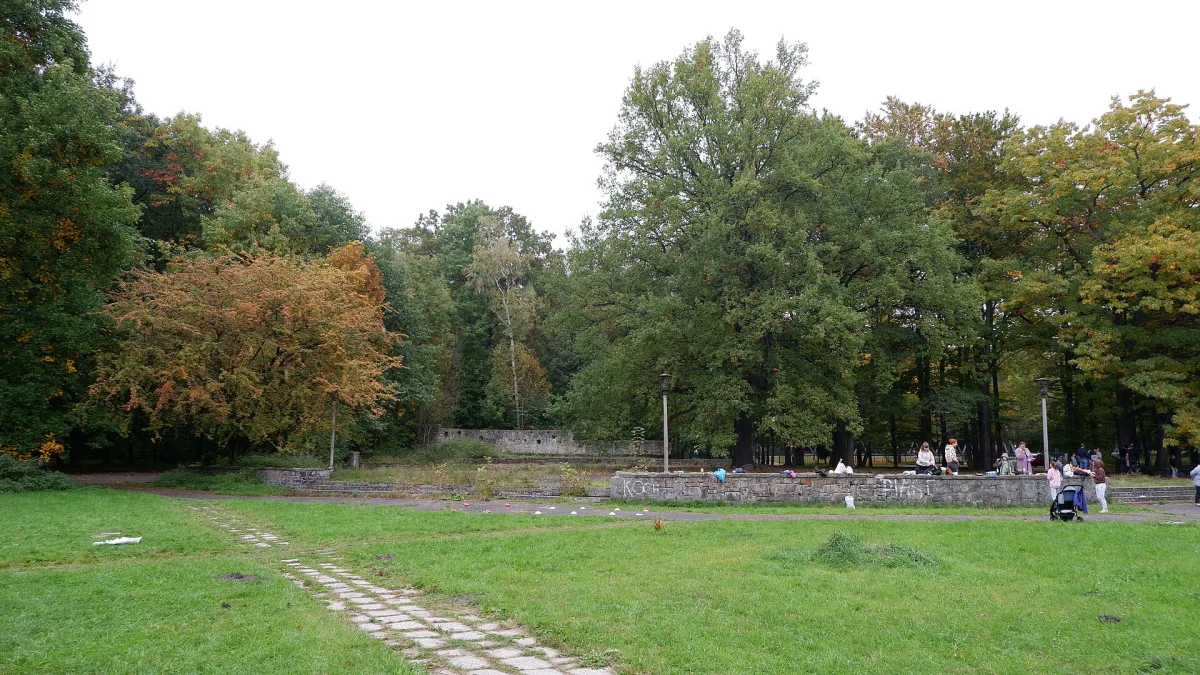
A municipal woodland of a natural character in Gliwice-Zatorze, covering about 197.6 ha, with an educational trail, playgrounds and a brine graduation tower.
The Park of Culture and Recreation in Gliwice (Park Kultury i Wypoczynku) is a municipal woodland of a natural character in the Zatorze district, in the eastern part of the town. It covers about 197.6 ha and belongs to the forest Protective Belt of the Upper Silesian Industrial District. It has an educational trail, two playgrounds, traces of former entertainment venues and a brine graduation tower with deckchairs.
A forest has been known on this site since the Middle Ages, and a 17th-century town chronicle mentions municipal forests. It was marked on a map from 1736, and the name Stadtwald, that is the town forest, appears on a map from 1812. After 1945 the name Park of Culture and Recreation was adopted. The full name is the Park of Culture and Recreation for the towns of Gliwice-Zabrze. The names Las Żorek (Siorek), Park Leśny and Lasek Chorzowski are also used.
The area of the forest shrank: in 1931 it had 350 ha, after 1945 364 ha, and in 2010 197.6 ha. The Zatorze district was created at the beginning of the 20th century, and in the garden-city concept the town forest played an important role, together with the Municipal Palm House. In 2004 the neighbouring Lipowy Cemetery was enlarged at the expense of 5.17 ha of forest.
At the end of the 19th century the forest became popular thanks to the Zameczek Leśny (Forest Little Castle), a café in the English-Chinese style, opened on 29 July 1896 to a design by Eugen Kohn. In 1950 the building was taken over by the Heavy Industry Construction enterprise, and in 1959-1962 the Czarny Kot cabaret performed in it. The Zameczek was razed to the ground in May 2020.
A wooden cycling track was also built in the forest, opened on 12 September 1897. It was 400 m long and was regarded as the largest such facility in Germany, with stands for 3,100 spectators. On the same day a concert shell was opened, today in ruins. In 1909 the 10th German Youth Games were held in the forest, and in 1910 a makeshift runway was laid out by the Zameczek, from which the well-known aircraft designer Claude Dornier later took off.
Of the former shooting range seven mounds from the bullet traps remain, and by Szymanowskiego Street one can see the ruins of foundations, probably of a German ammunition store. In the forest there is also a disused pool with a fountain and a sculpture, Three Girls, by the sculptor Hans Breittenbach.
Deciduous trees dominate, mainly beeches and oaks, and conifers also grow here. The park is regarded as an area of natural value, especially for birds: more than 300 nest boxes hang in the trees. You may meet roe deer, hares and wild boar. Every year about 20 thousand trees are planted to replace those felled in sanitary cuttings.
The educational trail is 975 m long and links the playground on Brzozowa Street with the playground on Horst Bienek Street. Along it stand a dozen or so boards about the most common tree species. The Gliwice section of the Polish Hussar Trail (Szlak Husarii Polskiej), laid out in 1969-1970 by Father Jerzy Pawlik, runs through the park, as do cycle routes.
The graduation tower was put into service in July 2020 on Chorzowska Street. It stands on a rectangular plan of about 13 by 40 m, is almost 8 m high and has a roof that protects the brine from being diluted by rain. Around it a zone with deckchairs and benches has been laid out, together with a garden of about 700 shrubs, grasses and perennials. The paths have been adapted to the needs of people with disabilities. For the winter the graduation tower is taken out of use, and when using it the rules on the boards by the structure apply.
It is about 1.7 km from here to the Gliwice Radio Tower and about 3 km to the Municipal Palm House.

Be the first! Add a comment.
You need to log in to add a comment.
Log in