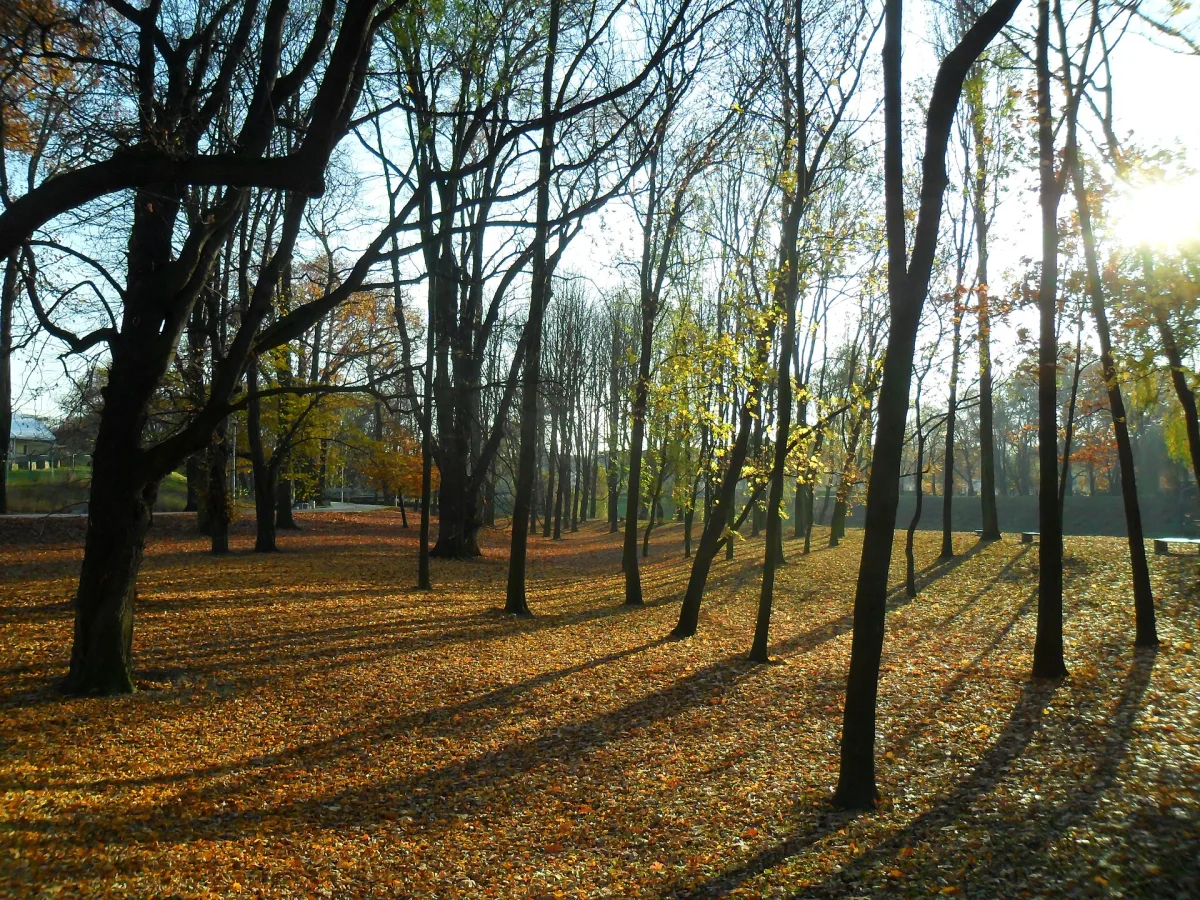
A park around the castle in Racibórz with black poplars more than 200 years old, left from a former riparian forest.
Castle Park is a green area in the centre of Racibórz, on the right bank of the Oder, in the Ostróg district. It surrounds the Racibórz Castle and the stadium of the sports and recreation centre, so a walk along the paths is easily combined with a visit to the castle hill.
The park occupies the site of a former willow-poplar riparian forest, and some of the trees are natural remnants of that forest. The most valuable are more than twenty black poplars, whose trunks measure from 4 to more than 6 metres in circumference and whose height exceeds 20 metres. The oldest specimens are more than 200 years old. Many of them are in poor condition: they have broken boughs, rotten trunks and unusual growths on the bark.
The tree stand is varied. Growing here are Norway maple, sycamore, European ash, pedunculate and red oak, small-leaved lime, elm, horse chestnut, walnut, black locust, weeping and crack willow, black alder and several species of poplar. Less often one finds silver maple, common beech and trumpet creeper. There are also ornamental shrubs and conifers, flower beds, lawns and meadows. In spring anemones and hollow-root bloom in the undergrowth.
At the crossing of Zamkowa and Armii Krajowej streets grows a swamp oak, which was recognised as a natural monument by a city council resolution in 1992. It is about 110 years old, 310 cm in trunk circumference and 16 m high. The tree is incomplete: a stump and about 40 per cent of the crown have survived, but its health was assessed as satisfactory. It was protected as a remnant of the original layout of the park and the old trees around the castle. Further ashes and pedunculate and red oaks are being considered as candidates for the same protection.
In the park there is also a monument to the Silesian Insurgents, unveiled in 1958 at the place where the Germans buried participants of the Third Silesian Uprising. The park itself is entered in the heritage register and dated to the turn of the 19th and 20th centuries.

Be the first! Add a comment.
You need to log in to add a comment.
Log in