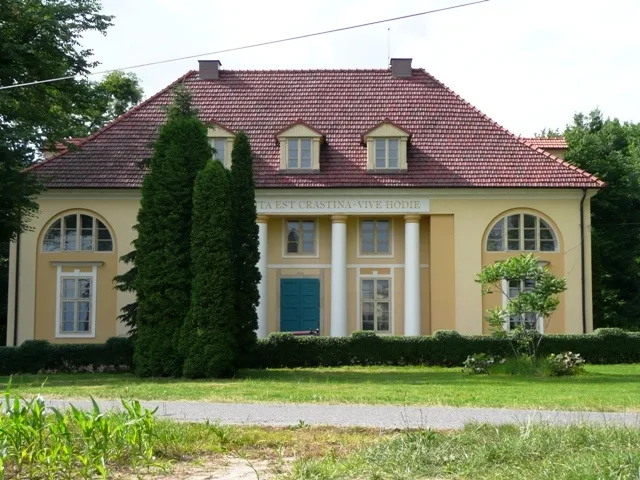
A late Neoclassical hunting lodge of the princes of Pszczyna from 1792-1800 in Poręba, now a hotel with a restaurant.
The Princely Pheasantry (Książęca Bażantarnia) is a late Neoclassical small palace in Poręba, part of Pszczyna, built in 1792-1800 for Frederick Erdmann, Prince of Pszczyna. Today it houses a hotel and restaurant, and its historic interior layout remains legible.
The idea of breeding pheasants in Poręba dates back to 1770. Land was bought from peasants, a birch wood was added, water conditions were altered, and ponds, streams, avenues and promenades were laid out. In 1792 the landscaping plan was supplied by the prince's architect Wilhelm Pusch. He took as his model a design by Carl Gotthard Langhans that had been published earlier.
Frederick Erdmann died in 1797 and did not live to see the building finished; it was completed by his son Frederick Ferdinand. The exact date the palace was put into use is known: 25 June 1800. The main residence of the princes remained Pszczyna Castle, and the Pheasantry served chiefly for entertainment.
It is a brick, plastered building on a rectangular plan, with a high hipped roof and a south-facing front. The five-bay façade is decorated with a four-column portico preceded by steps. The windows and doors have flat surrounds with keystones.
Inside, the symmetrical two-bay layout has survived, with a shallow entrance hall and a two-storey salon on the axis, with chamfered corners. The salon has a balcony for an orchestra and choir. Zabytek.pl gives the building material as brick and the date as 1800.
In the 19th century balls were held in the salon to mark the birthdays of members of the princely family, and guests from Pszczyna and the surrounding area were invited. Some parties lasted until four in the morning. During the First World War the Pheasantry was visited by the German Emperor and officials, because the staff of the German army was then based in Pszczyna.
In 1922 Prince Hans Heinrich XV agreed to an inn being run here, where President Ignacy Mościcki, among others, stayed. At that time the park had a winter sports area with a ski jump and trails, and in summer people ran and rode horses. The palace was entered in the heritage register in the 1960s. It was later taken over by the Pniówek mine for social purposes, and the outbuildings were demolished. Conservation work was completed in 2011.

Be the first! Add a comment.
You need to log in to add a comment.
Log in